
Langsa Customs Destroys Illegal Cigarettes Worth Rp 1.29 Billion
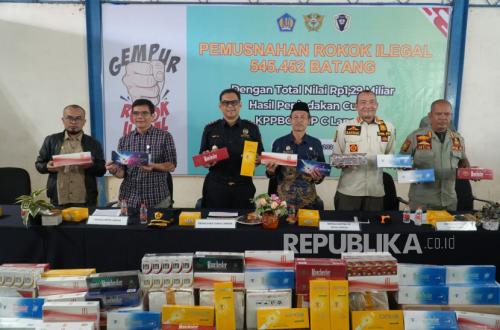
Langsa Customs destroyed 545,452 sticks of illegal cigarettes in the premises of the Langsa Customs Office on Thursday (9/4/2026). The destroyed goods from enforcement actions represent an accumulation from 63 Enforcement Evidence Letters (SBP) over the period from May 2025 to February 2026. The value of the destroyed goods amounts to Rp 1,293,331,780, with an estimated state loss of Rp 886,757,053. The Head of Langsa Customs Office, Dwi Harmawanto, stated that the destroyed illegal cigarettes consist of various brands, such as H&D, Manchester, Englishman, Luffman, IB, Mer-C, Oris Pulse, Platinum Seven, Luckyman, and others. The diversity of these brands indicates that the circulation of illegal cigarettes continues in various forms and requires ongoing supervision and enforcement. “We take this step (destruction) to ensure that the goods from enforcement actions do not re-enter circulation in society, no longer have economic value, and form part of the accountable resolution of enforcement goods,” said Dwi. Inter-Agency Collaboration Dwi mentioned that efforts to supervise and enforce against the circulation of illegal cigarettes are carried out by Langsa Customs through synergy with law enforcement apparatus and related agencies, particularly the Civil Service Police Unit. These efforts are implemented through market operations and socialisation of excise regulations to the public and business actors. “Inter-agency collaboration is an important part in increasing compliance, suppressing the circulation of illegal excisable goods, and strengthening public protection. In the future, synergy with law enforcement apparatus and related agencies will continue to be enhanced to support the effectiveness of supervision and law enforcement in the working area of Langsa Customs,” said Dwi. Dwi explained that the resolution of enforcement goods in the excise sector is guided by Ministry of Finance Regulation Number 17 of 2024 on Procedures for Resolving Excisable Goods and Other Goods Confiscated for the State, Controlled by the State, and Owned by the State. Meanwhile, the management of state fixed assets originating from ex-customs and excise assets, including destruction, is also regulated in Ministry of Finance Regulation Number 150 of 2023 as an amendment to Ministry of Finance Regulation Number 51/PMK.06/2021. “These regulations affirm that destruction is one form of goods management and is interpreted as an action to physically destroy and/or render the goods unusable,” said Dwi. The destruction process was carried out openly and accountably by first cutting the cigarettes to eliminate their physical form and usability. Subsequently, the evidence goods were destroyed by incineration at the Final Disposal Site (TPA). This procedure aligns with the provisions in Ministry of Finance Regulation Number 17 of 2024, which defines destruction as an activity to eliminate the original form and/or essential nature of excisable goods and/or other goods, as well as Ministry of Finance Regulation Number 150 of 2023, which affirms destruction as an action to physically destroy and/or render state fixed assets unusable. In the general provisions for implementing the destruction of state fixed assets, destruction can also be carried out by burning, and its implementation is documented in the Destruction Minutes. “Thus, the methods of cutting and burning are carried out to ensure that the enforcement goods cannot be reused or re-circulated in society, while also being conducted in accordance with the approval of the authorised official and applicable legal provisions,” said Dwi. Dwi emphasised that this destruction activity represents the commitment of Langsa Customs in carrying out supervision and law enforcement functions firmly, consistently, and transparently. According to him, this destruction is not merely an administrative step but part of law enforcement to ensure that illegal cigarettes do not re-enter circulation in society. The circulation of illegal cigarettes without excise stamps or those not complying with excise regulations impacts the loss of state revenue potential and creates unfair business competition for compliant business actors. The destruction of enforcement goods becomes an important step in closing the chain of law enforcement processes while preventing illegal goods from re-circulating in society. Langsa Customs reaffirms its commitment to continuously strengthen supervision and enforcement against the circulation of illegal excisable goods in its working area. Dwi stated that Langsa Customs will continue to strengthen supervision, synergise with law enforcement apparatus and related agencies, protect the public, and safeguard state revenues from the excise sector. “We also urge the public not to buy, sell, or distribute illegal cigarettes and to actively participate by reporting any indications of violations in the customs and excise sectors,” said Dwi.