
Land movement, sinkholes, and creeping as warning signals
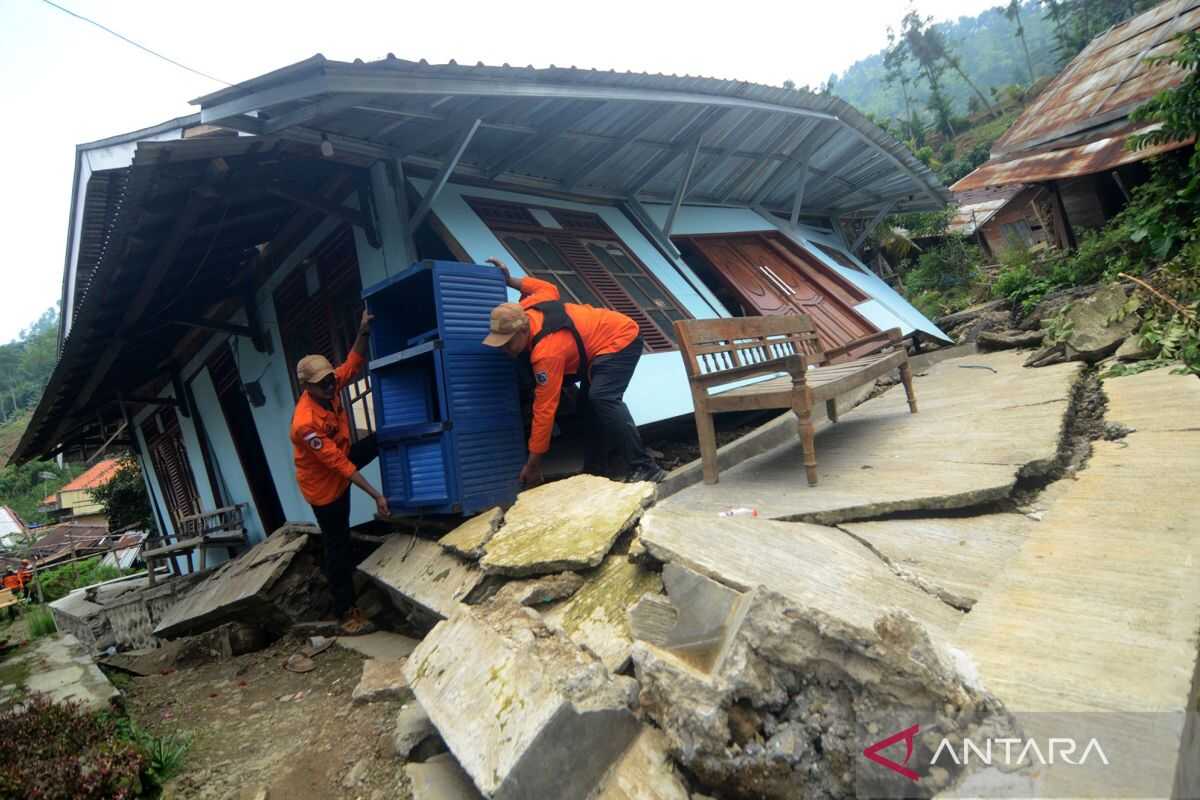
Jakarta (ANTARA) - In recent times, mass media have reported numerous incidents of land movement, sudden ground collapse (sinkholes), and slow land movement (creeping) occurring with increasing frequency across various regions of Indonesia.
Public concern often centres on geological risks, but when examined from an environmental biology perspective, these phenomena are in fact indicators of serious damage to the biological structure of soil caused by human intervention — namely excessive groundwater exploitation and loss of vegetation due to deforestation or land-use conversion.
These phenomena are not merely technical or natural issues but reflect fundamental disruption in the relationship between water, living organisms in the soil, and vegetation as components that have long sustained the carrying capacity and stability of the ground.
Soil is not merely inert material. Soil biology explains that soil is a living ecosystem comprising microorganisms, soil fauna, plant roots, organic matter, and minerals that form structural aggregates (Brady & Weil, 2017). Soil microbes and fungi help create natural adhesives that stabilise soil particles, whilst plant roots mechanically reinforce soil structure. Together, they maintain soil cohesion and help absorb and store water.
Without strong vegetation or sufficient organic matter, soil structure becomes fragile. Rainwater is not properly absorbed, accelerating erosion, whilst the soil loses its ability to withstand external pressures such as heavy rainfall or surface loads. Under such conditions, soil is more susceptible to shifting, landslides, or subsidence when subjected to additional pressure, particularly from anthropogenic factors — anything generated, influenced, or caused by human activity, especially regarding the environment or ecosystems.
Indonesia is among the countries facing immense pressure on groundwater resources due to urbanisation growth and rising demand for clean water. Java, as the centre of government and economic activity, is the most prominent example.
Demand for groundwater for domestic, industrial, and agricultural needs has risen sharply, driving groundwater extraction beyond the natural capacity of aquifers to recharge. Research in the Bandung Basin has shown that declining groundwater levels constitute one of the primary factors causing land subsidence — largely attributable to uncontrolled groundwater extraction, with subsidence rates reaching several centimetres per year, far exceeding natural contributions such as sediment consolidation (Frost et al., 2022).
In the capital Jakarta and its surroundings, ongoing groundwater extraction is also closely linked to land subsidence. Studies using satellite technology have revealed that the metropolitan area experiences consistent ground subsidence, in tandem with pressure on groundwater resources (Abidin et al., 2011). Data indicate that across various urban areas of Java, land subsidence reaches 2 to 15 centimetres per year, with human factors more dominant than natural ones. This trend is also consistent with findings from major cities in other parts of the world, confirming that over-extraction of groundwater is the primary cause of subsidence in urban areas (Chang et al., 2009).
Declining groundwater levels can directly affect hydrostatic pressure — the pressure exerted by a stationary fluid due to its own weight, acting in all directions. Within the ground, water functions as a support that sustains subsurface structures. When groundwater is excessively drawn, this pressure diminishes, making underground cavities fragile. Without sufficient hydrostatic pressure, previously stable cavities can collapse, potentially triggering the formation of sinkholes that may occur without prolonged warning signs.
Furthermore, changes in soil moisture levels caused by drastic groundwater extraction reduce the cohesion of soil particles, causing the soil to lose elasticity and become more susceptible to creeping — extremely slow yet continuous ground movement. Creeping often goes undetected for extended periods until it ultimately causes damage to infrastructure such as buildings, roads, or drainage systems.
Ground movement is not solely triggered by the groundwater crisis. Another factor exacerbating soil stability is the high rate of deforestation and land-use conversion that has occurred extensively across various regions of Indonesia. When forests are felled for plantations, settlements, or infrastructure development, the role of vegetation as a “biological support” for the soil is lost and becomes unbalanced. Plant roots that previously held soil particles together disappear, making the soil more easily eroded by rainwater and gravitational pressure. Additionally, populations of soil microbes that play a role in forming soil aggregates decline drastically due to changes in moisture conditions and organic matter. Soil that loses these biological components becomes less capable of withstanding external pressure and more vulnerable to structural damage (Lal, 2015; Six et al., 2004).
Intensive land-use conversion, particularly for monoculture agriculture (for instance, from natural forest to oil palm) or urban settlements, also alters the physical and chemical properties of soil, thereby reducing the soil’s capacity to absorb water and maintain cohesion. The combined impact of deforestation and groundwater exploitation accelerates the occurrence of creeping phenomena, and even surface subsidence that only becomes apparent when damage has already spread to infrastructure or settlements.
Land movement, sinkholes, and creeping are not problems that can be addressed merely through technical repairs at a single point. This is also a public policy issue requiring an integrated, science-based approach.
The government needs to urgently formulate and enforce clear regulations regarding groundwater utilisation. Rules governing the quantity, location, and depth of bore wells must be strictly enforced to prevent excessive and uncontrolled extraction. These regulations must be accompanied by licensing mechanisms and firm sanctions for violators.
Furthermore, the development of surface water infrastructure and clean water distribution must be prioritised. With adequate surface water available in many regions, dependence on groundwater can be significantly reduced. This not only alleviates pressure on groundwater resources but also helps maintain the hydrostatic pressure that supports soil structure.
Vegetation rehabilitation and soil conservation programmes also play a vital role in restoring the biological functions of soil. Replanting trees, developing reforestation initiatives, and conserving soil organic matter will help improve soil aggregation and enhance the soil’s ability to retain water and withstand gravitational pressure.
Additionally, the government needs to implement modern monitoring systems based on technology such as radar satellites (InSAR) and soil sensors. These technologies enable early detection of ground movement, allowing mitigation measures to be taken more swiftly before soil deformation becomes a widespread ecological disaster.
The government must also strengthen the capacity of supervisory and law enforcement bodies to monitor illegal groundwater use and destructive land-use conversion practices. Synergy between institutions, from central to regional level, is essential to ensure every policy can be effectively implemented on the ground.
Action needed
Soil stability damage is not merely a scientific or technical issue; it directly impacts public safety, local economies, and environmental sustainability. Infrastructure such as roads, buildings, and drainage systems can be damaged by subsidence or slow ground movement. Agricultural land and settlements threatened by subsidence also pose a real threat to livelihoods and the lives of citizens.
Indonesia now stands at a critical crossroads. The decisions and actions taken today regarding groundwater management and land conservation will determine the fate of future generations. When the ground begins to move, nature is sending a signal — that the limits of environmental carrying capacity have been exceeded and that development approaches that disregard ecological balance will have serious consequences.
From the above analysis, it can be concluded that incidents of land movement, sinkholes, and creeping are complex problems encompassing biology, hydrology, and human activity. Uncontrolled groundwater exploitation and loss of vegetation have damaged the biological balance of soil, reduced the hydrostatic pressure that supports soil structure, and accelerated ground deformation. Indonesia must not ignore these phenomena.
Moving ground is the voice of nature calling us to act. And the government must answer that call through firm policies, grounded in science, and oriented towards environmental sustainability and public safety.
*) Misbakhul Munir SSi MKes is a Biology lecturer at UINSA Surabaya