
Labour Party Highlights Three Key Factors Regarding the 'Parliamentary Threshold'
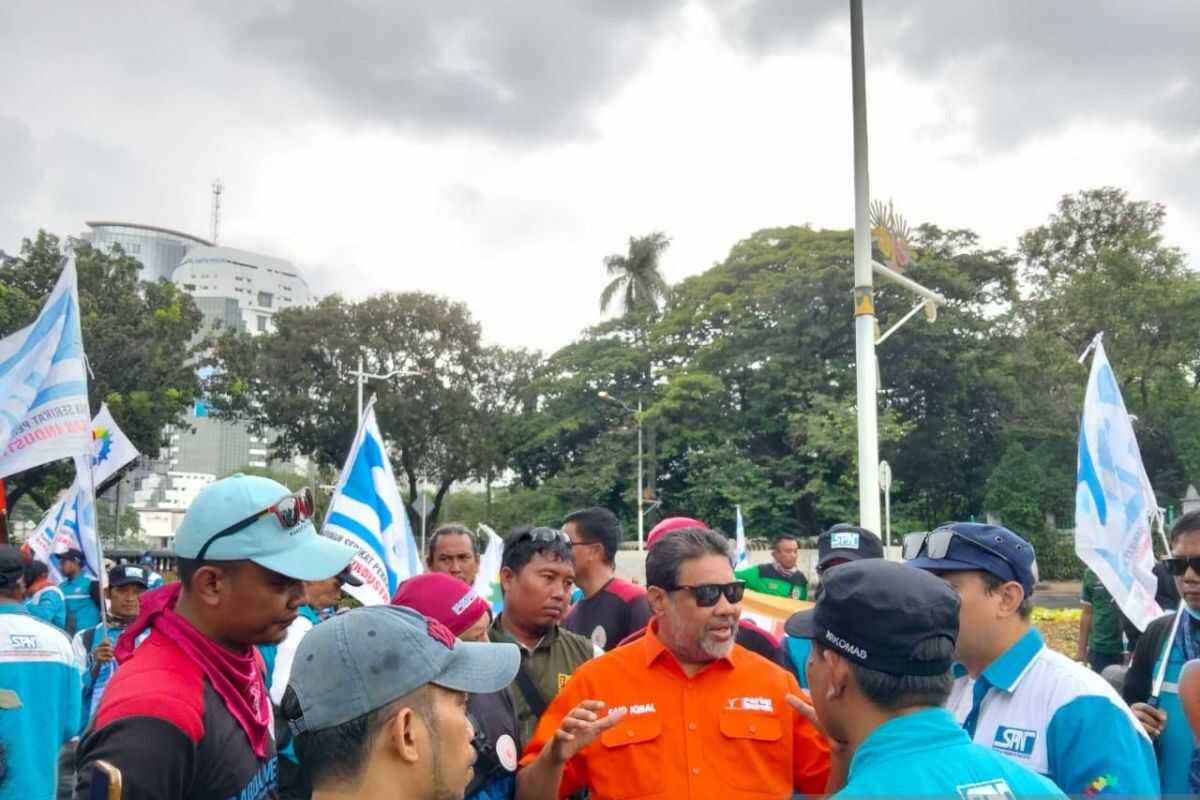
The Labour Party has highlighted three key factors that should be considered in the discussion about increasing the parliamentary threshold (PT) to 7 percent.
Said Iqbal, President of the Labour Party, stated that these three factors are related to Constitutional Court Decision No. 116/PUU-XXI/2023, the number of wasted votes, and the method of calculating the parliamentary threshold.
“The issue of the parliamentary threshold is a central issue for the People’s Sovereignty Movement (GKSR), which consists of eight non-parliamentary political parties, including the Labour Party. At least, there are three important factors that need to be highlighted in the regulation of the PT,” he said when contacted in Jakarta on Thursday.
The first factor, he said, is the Constitutional Court’s decision requiring changes to the parliamentary threshold. These changes must not conflict with political rights, popular sovereignty, and rationality.
“First, there is Constitutional Court Decision No. 116/PUU-XXI/2023, which essentially states that the legislative body must make changes to the norms and figures of the PT in the Election Law, as long as it does not conflict with political rights, popular sovereignty, and rationality,” he said.
According to him, the Constitutional Court’s decision instructs the legislative body to lower the threshold, not raise it above four percent.
Increasing the threshold would violate morality, rationality, and fairness, which cannot be tolerated.
“The Constitutional Court will certainly reject such a rule. The Labour Party will certainly challenge the rule. In that context, the proposal to raise the PT above 4 percent must be strongly rejected. This is because the idea clearly contradicts the intent of the Constitution, as stated in Constitutional Court Decision No. 116/PUU-XXI/2023,” he said.
In addition, Said said that the second important factor to consider is the issue of wasted votes in the four percent parliamentary threshold regulation.
The Labour Party presented data showing that more than 57.1 million valid votes were wasted due to the implementation of the four percent threshold in the 2019 election.
This number increased in 2024 to 60.6 million valid votes. Based on data from the two elections, the average number of wasted votes reached over 40 percent.
“What kind of democracy are we building if tens of millions of voters’ votes are always wasted in every election due to the 4 percent PT rule?” he asked.
The third factor, he said, is the method of calculating the parliamentary threshold, which is based on the national vote share of political parties.
This rule contradicts many Constitutional Court decisions, which essentially state that election regulations must be linked to electoral districts.
“Please see Constitutional Court Decisions No. 19/PUU-XVII/2019, No. 20/PUU-XVII/2019, No. 28/PUU-XXII/2024, and Decision No. 137/PUU-XXII/2024. In all of these decisions, the Constitutional Court clearly states that electoral districts must be a key element in setting election rules,” he said.
Therefore, he said that when discussing the parliamentary threshold rule, it must be linked to electoral districts and the calculation method should refer to the vote share of political parties in each electoral district.
“So, when talking about the PT rule, the rule must always be linked to electoral districts so that the basis for calculating the PT should refer to the vote share of political parties in each electoral district, not based on the national vote share of political parties,” said Said.