
Labour Leader Gives 14 Days to Revoke New Outsourcing Rules, Plans to Approach Prabowo
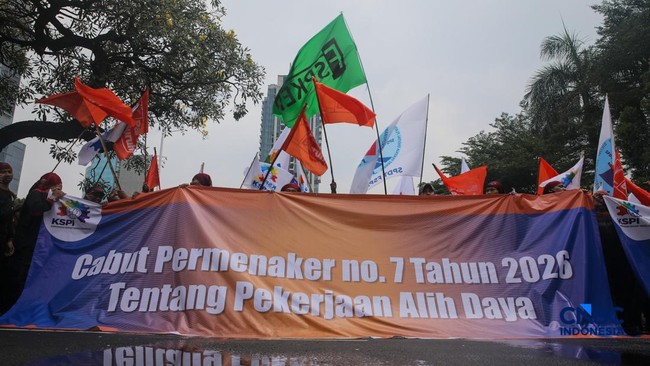
Jakarta, CNBC Indonesia - Hundreds of workers affiliated with the Indonesian Confederation of Trade Unions (KSPI), Labour Party, Indonesian Metal Trade Union Federation (FSPMI), and National Workers’ Union (SPN) gathered and staged a protest in front of the Ministry of Manpower (Kemnaker) office in Jakarta on Thursday (7/5/2026). During the action, KSPI President and Labour Party President Said Iqbal emphasised that his side would write to President Prabowo Subianto to request a revision of Ministerial Regulation No. 7 of 2026, which regulates outsourcing. He stated that the issue of abolishing outsourcing had already been directly conveyed to President Prabowo during the International Labour Day or May Day commemoration some time ago. However, according to him, the new regulation issued by Kemnaker contradicts the workers’ aspirations. “May Day was already conveyed directly to President Prabowo Subianto to abolish the outsourcing system. Even in my speech, it was stated as such,” said Said Iqbal to reporters when met at the location. “But it seems that the Minister of Manpower (Yassierli) and Kemnaker are taking the point as if this is a gift. This is a bitter gift. So Ministerial Regulation 7/2026 is a bitter gift because the outsourcing does not meet the workers’ expectations. It actually legalises (outsourcing),” he continued. Said Iqbal admitted that up to now, his side has not officially conveyed objections to the Ministerial Regulation to President Prabowo. However, KSPI along with the Labour Party will soon send an official letter so that the regulation is revoked and replaced with a new one. “We haven’t conveyed to Mr President about Ministerial Regulation 7/2026, but soon KSPI will convey this together with the Labour Party in writing to Mr President Prabowo Subianto so that this Ministerial Regulation is revoked first, and a new Ministerial Regulation is made,” he explained. He assessed that the regulation has the potential to become a permanent norm in the Manpower Law if not revoked immediately. Therefore, workers strongly reject the existence of the policy. “If this is not revoked, it will become a norm in the Manpower Law. This is what we reject, because there has never been a discussion as conveyed by Comrade Suparno, President of FSPMI,” said Said Iqbal. He also gave a deadline to Kemnaker to amend the regulation before the official letter is sent to the President. “We give 2x7 days. So 14 days to the Minister of Manpower to fix it, revoke it, make a new Ministerial Regulation according to what we demand. Outsourcing workers are prohibited from being employed in direct production processes or core activities,” he said. According to him, if outsourcing is still allowed, it must be based on agreement with the trade union. He also stated that the practice of outsourcing should be limited to only five types of support services. “Secondly, if allowed, it must be an agreement with the Trade Union. For now, only 5 support services. Catering, Security, Driver, Cleaning Service, and mining services,” he said. Said Iqbal also highlighted the practice of partner workers in the SOE environment. He demanded that all forms of outsourcing, including partnership patterns, be abolished. “All SOEs must abolish their outsourcing. Including partners, because there is a term partner. Pos partner, partner in OSPLN, we demand it be abolished,” he said. “There is no such thing as partner employment relationship,” Said Iqbal stressed. Meanwhile, President of the Indonesian Metal Trade Union Federation (FSPMI), Suparno criticised the process of drafting the Ministerial Regulation because it was deemed not to fully involve trade unions. “For the Ministerial Regulation, it should go through the Tripartite LKS. The Tripartite LKS was not involved, from the workers’ union, the labour union also had no discussion about the content of the Ministerial Regulation. So they were only invited that outsourcing was done FGD to make what, what regulation,” said Suparno on the same occasion. According to him, after the forum group discussion (FGD) was completed and it was agreed to draft the regulation, the trade unions were no longer involved in further discussions. “Finally in that FGD, it was agreed to make a ministerial regulation. Up to that point. After the FGD agreed to make the ministerial regulation, the trade unions and labour unions were no longer involved. Suddenly Ministerial Regulation 7/2026 appeared,” he said. When asked if the trade union side knew the content of the regulation’s material before it was issued, Suparno answered briefly. “Didn’t know the material at all,” he concluded.