
Korlantas to Implement Layered Traffic Engineering for 2026 Lebaran Return Flow
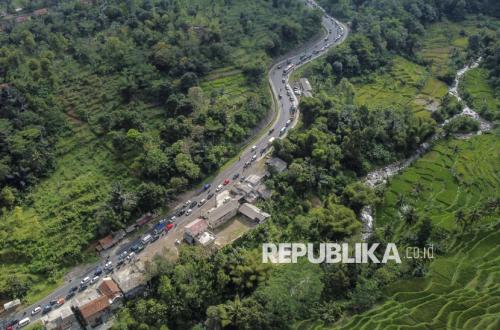
REPUBLIKA.CO.ID, CIKAMPEK – The National Traffic Police Corps (Korlantas) of the Indonesian National Police is preparing a layered traffic engineering strategy to anticipate the Lebaran return flow in 2026. This scheme is formulated based on mapping vehicle movements and evaluations of the outbound flow, which indicate a significant increase in mobility.
Head of Korlantas Polri, Inspector General Agus Suryonugroho, explained that the distribution of vehicle flow during the return will be dominated by vehicles heading to Trans Java at around 66%, while 33% are directed to West Java. This composition forms the basis for the traffic engineering regulations that will be implemented in stages.
“From Trans Java, it’s approximately almost 66%. This is what we must manage,” said Agus at the Korlantas Polri Command Centre, Cikampek, on Sunday (22/3/2026).
Korlantas begins preparing flow management from H+1 Lebaran by anticipating agglomeration movements from several areas. Local movements from Solo Raya, Semarang Raya, Jabodetabek, Malang Raya, to Bali are predicted to increase and potentially add to traffic density.
Security is carried out through security posts, service posts, and integrated posts across all regional police (Polda) areas. Officers are deployed to escort vehicle movements, including routes to tourist destinations and ferry ports.
“Anticipation after H+1 Lebaran, agglomeration from Solo Raya, Semarang Raya, including Jabodetabek, Bali, and Malang Raya, has been prepared through security posts, service posts, and integrated posts in each Polda,” said Agus.
To alleviate density from West Java, Korlantas relies on the Jakarta-Cikampek II South Toll Road, which has been tested. This section is planned to be opened during the peak return flow to break up vehicle concentration.
This step is combined with the management of alternative routes such as Bocimi to smooth the distribution of vehicle flow to Jakarta and surrounding areas. Adjustments are made according to field conditions and traffic volume.
“From West Java, the solution is quite strategic because Japek II South has already been tested by us,” said Agus.
Traffic engineering is also prepared in the form of local one-way systems implemented in stages. The initial scheme is planned from KM 414 to KM 70, with the possibility of extension following the dynamics of vehicle flow in the field.
Korlantas also prepares contraflow on sections approaching Jakarta, especially at bottleneck points that could trigger density. The determination of contraflow implementation depends on real-time traffic counting monitoring results.
“If necessary, starting 23 March, we will implement the first stage of local one-way from KM 414 to KM 70,” said Agus.
Experience from the outbound flow serves as the foundation for compiling the return flow strategy. Vehicle volume was recorded to increase from 258,000 to 270,000 at the peak of the outbound flow on Wednesday (18/3/2026), so traffic arrangements are prepared to be more adaptive and responsive.
Korlantas also records that traffic safety and security conditions during the outbound period up to the eighth day of Operation Ketupat are under control. Accident figures and fatalities show a decline compared to the same period last year.
“Accident incidents with fatalities of deceased victims dropped by 27%,” said Agus.
Supervision in tourist areas is also tightened to anticipate congestion due to illegal parking. Management of parking pockets and vehicle flows is carried out together with local governments and communities.
Korlantas ensures that all strategies run in an integrated manner to maintain the smoothness of the Lebaran return flow. Control is carried out dynamically following traffic developments in the field.