
Korlantas Polri to Implement Local "One Way" Ahead of Peak Return Flow
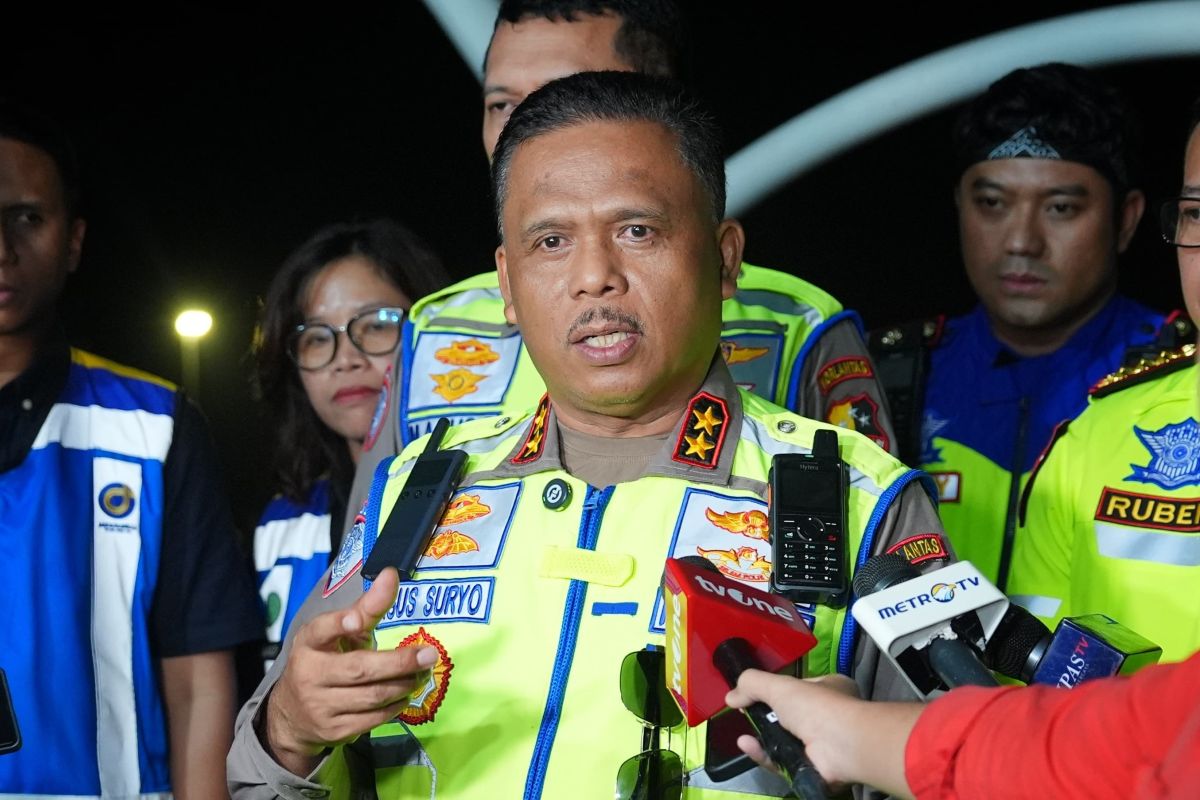
Karawang, West Java - The Indonesian National Police Traffic Corps (Korlantas Polri) will implement a traffic engineering measure in the form of a first-stage local one-way system ahead of the peak return flow of the second mudik period, which falls on 28-29 March 2026.
Head of Korlantas Polri, Inspector General of Police Agus Suryonugroho, stated that the scheme is planned to start from KM 188 of the Cipali Toll or KM 263 of the Pejagan Toll towards Jakarta.
“It is likely that the first-stage local one-way engineering will be carried out on Friday, possibly from KM 188 of the Cipali Toll or KM 263 of the Pejagan Toll. The decision will be made with the aim of accelerating the return flow from Trans Java to Jakarta,” he said at the Jasa Marga Office at KM 70 of the Cikampek Utama Toll, Karawang, West Java, early Friday morning.
Furthermore, he continued, if vehicle flow from East Java, Yogyakarta, Solo Raya, and Semarang remains high, it is possible that an extended one-way will be applied from KM 414 of the Kalikangkung Toll.
“We will monitor the dynamics on the ground. If the flow is still high, additional engineering will be immediately implemented to ensure smoothness,” he said.
Further, Agus stated that traffic conditions from KM 414 of the Kalikangkung Toll to KM 200 of the Cipali Toll on Thursday (26/3) were still relatively smooth, with vehicle speeds ranging from 60-70 kilometres per hour.
However, congestion began to occur upon entering KM 20 due to side obstructions.
“We observed many mudik travellers who are fatigued and stopping on the roadside or at rest areas. Almost all rest areas are full and unable to accommodate vehicles, leading to build-ups,” he said.
Nevertheless, he added, overall, the traffic flow at night is still manageable.
Meanwhile, on arterial routes, congestion is more significant when traffic engineering is not applied.
Public movement in agglomeration areas and local socialising activities are still ongoing, although not too dense.