
Korean Experts and Media Spotlight Kim Jong-un's Age as They Watch Maduro-Khamenei's Fate
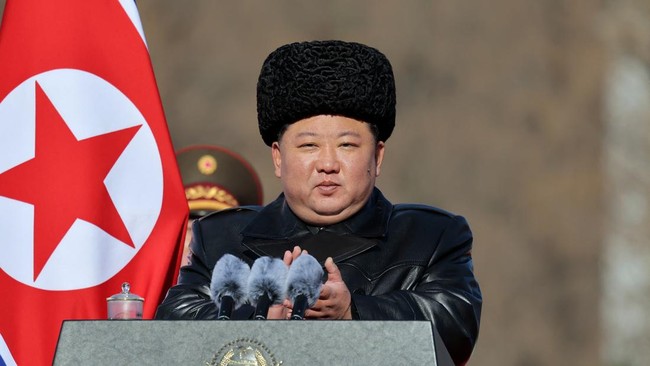
Jakarta, CNBC Indonesia - Experts in South Korea are examining North Korea’s reaction to the United States–Israel strike on Iran. A debate has emerged about whether its leader, Kim Jong-un, feels uneasy about the dramatic downfall of Venezuelan President Nicolas Maduro and Iran’s Supreme Leader Ayatollah Ali Khamenei.
The Korean Herald notes that experts say the lesson for Kim may not be fear but survival. Rather than pushing him toward talks with Washington, such events could reinforce his belief that only credible nuclear deterrence guarantees the regime’s security.
Experts say that this strategic difference may strengthen, rather than frighten, Pyongyang as they watch the military actions and their political impact, they indicate.
In a Sunday statement broadcast by the Korean Central News Agency, the Pyongyang Foreign Ministry spokesperson condemned what it described as “the malodorous actions of the United States and Israel” and “illegal aggression.” The statement avoided naming US President Donald Trump.
Maduro’s ouster in January and the subsequent US-backed operation that eliminated Khamenei mark a sequence of regime-toppling actions against leaders who openly oppose Washington. Several experts say the developments will surely resonate in Pyongyang and that the ousting of anti-US leaders in sequence makes Kim’s calculation harder, especially over whether to accept the prospect of a summit.
“North Korea may focus on the fact that Iran was ultimately attacked despite pursuing nuclear negotiations and attempting to reach a deal,” said Lim Eul-chul, a professor at Kyungnam University’s Institute for Far Eastern Studies, quoted by The Korean Herald, Saturday (7 March 2026).
“There is almost no possibility that Pyongyang will trust Washington’s sincerity of the ‘unconditional dialogue’ offer.”
Lim says that for Kim, the lesson may be sobering: engagement does not always guarantee security.
North Korea’s leader Kim Jong-un told the Ninth Congress of the ruling Workers’ Party that he had opened the door to talks with Washington if the country respects “the status of North Korea at present, as defined in North Korea’s constitution, and halts its hostile policy.” Kim referred to North Korea’s constitutional designation as a nuclear-armed state, a condition that the US has consistently rejected.
On the other hand, Trump has expressed interest in meeting Kim during a planned visit to Beijing next April, but prospects remain uncertain.
Lim argues that what happened in Iran goes beyond symbolic pressure.
“Accurate intelligence gathering over years that enabled the United States to eliminate the Iranian Supreme Leader, together with the rapid execution shown in ‘Operation Epic Fury,’ represents more than just a simple warning to Kim Jong-un — it is an existential threat,” he said.
Accordingly, Pyongyang “is fully aware that US intelligence capabilities and the attack patterns demonstrated in Iran could be applied to North Korea in the same way, or more precisely.”
Rather than rushing to the negotiating table, such developments could reinforce Kim’s belief that only credible nuclear deterrence guarantees his survival.
“Without provoking Trump, North Korea is expected to maintain a calm surface posture,” Lim said.
“Rather than engaging in hard provocations, they will bide their time, focusing the nation’s full capabilities on turning the country into a broad fortress with the belief that only ‘the balance of terror through nuclear weapons’ guarantees survival.”
Leif-Eric Easley, an international relations professor and senior researcher at Ewha Womans University, said Kim will watch not only the military actions but also their political impact.
“Kim Jong-un will realise that the Iranian Supreme Leader, who had been in place for 37 years, was killed along with members of his family. He will see footage of Iranians celebrating in the streets and hear of expatriates seeking roles in the political transition,” Easley said.
“He will surely take steps to avoid a similar fate for his family and North Korea.”
According to Seoul’s Ministry of Unification in January, Kim has replaced commanders from three of four units responsible for his security and protection over the past three years.
Yet other experts note that fears of a fate similar to Maduro’s and Khamenei’s could push Kim toward renewed diplomacy, in an effort to avoid direct confrontation with Trump.
Yang Moo-jin, a prominent professor at Korea University, said, “Rather than reject Washington’s offer, Kim may begin taking steps to avoid President Trump’s displeasure.”
Other experts say that North Korea’s potential poor relations with allies could push Pyongyang toward dialogue with Washington.
Cho Han-bum, a senior researcher at the National Unification Institute, said, “If the Russia–Ukraine war ends, North Korea–Russia relations may ease, which would place Pyongyang in an unfavourable position, and relations with China have not significantly improved. Given that the chances for negotiation may shrink as President Trump enters the second half of his term, dialogue (with Washington) may be the only way out left for Kim.”
Since Russia’s invasion of Ukraine, Moscow and Pyongyang have significantly strengthened their military ties, with North Korea reportedly supplying …