
Know the Legal Risks if the Certificate of Inherited Land Has Not Been Transferred
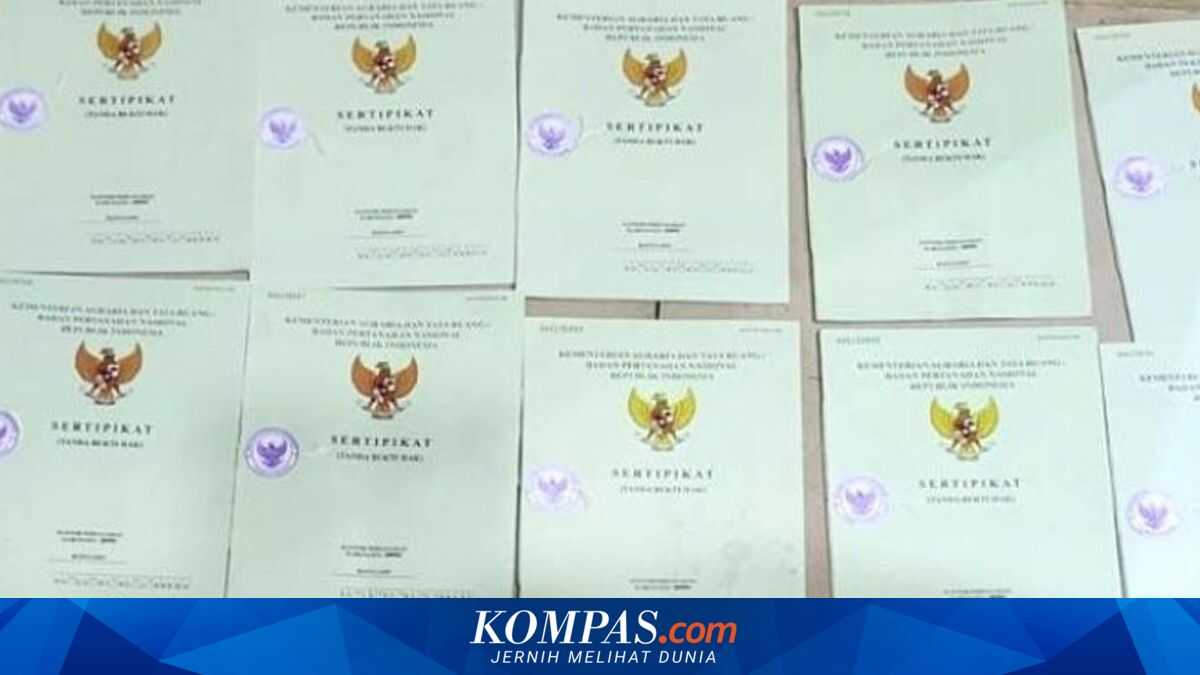
JAKARTA, KOMPAS.com - A certificate of inherited land that has not been transferred to the heirs has the potential to cause various legal problems, ranging from family disputes to transactions that can be considered legally flawed.
The transfer of the certificate is a process of changing the ownership data from the deceased to the rightful heirs through a Land Deed Official (PPAT) and registered with the Land Office under the Ministry of Agrarian Affairs and Spatial Planning/National Land Agency (ATR/BPN).
As long as this process has not been carried out, the name on the certificate is still recorded in the name of the deceased, so the heirs have not been recognised as the rightful owners administratively.
In the land registration system in Indonesia, every transfer of rights must be registered. This is regulated in Article 37 paragraph (1) of Government Regulation (PP) Number 24 of 1997 concerning Land Registration, which states that the transfer of land rights can only be registered if it is proven by a deed made by a PPAT.
Meanwhile, Article 42 of PP Number 24 of 1997 stipulates that the transfer of rights due to inheritance must be registered by the heirs so that the ownership data in the certificate is in accordance with the actual condition.
Without this registration, administratively the land owner is still considered to be the deceased.
Even though, in principle, the heirs inherit the rights and obligations of the deceased, as regulated in Article 833 of the Civil Code, proof of land ownership must still refer to the legal data in the certificate.
Land that has not been transferred also has the potential to cause conflicts between heirs. Without clear administration, one party may claim or even sell the land without the consent of the other heirs.
In addition, the division of inheritance is hampered because the ownership status has not been officially updated.
In practice, the sale and purchase of inherited land that has not been transferred cannot be directly registered with the land office.
As a result, the transaction has the potential to be considered legally flawed because it does not meet the provisions of Article 37 of PP Number 24 of 1997, which requires a PPAT deed from the rightful owner.
Banking also generally rejects certificates that are still in the name of the deceased as collateral for credit because the ownership status is not yet clear.
The heirs, in principle, also inherit the rights and obligations of the deceased. If the inherited land turns out to be in a dispute, mortgaged, or has other legal problems, then the consequences may also be borne by the heirs.