
KNKT Reveals Cause of Train Collision between Commuter Train and Argo Bromo Intercity Train in Bekasi
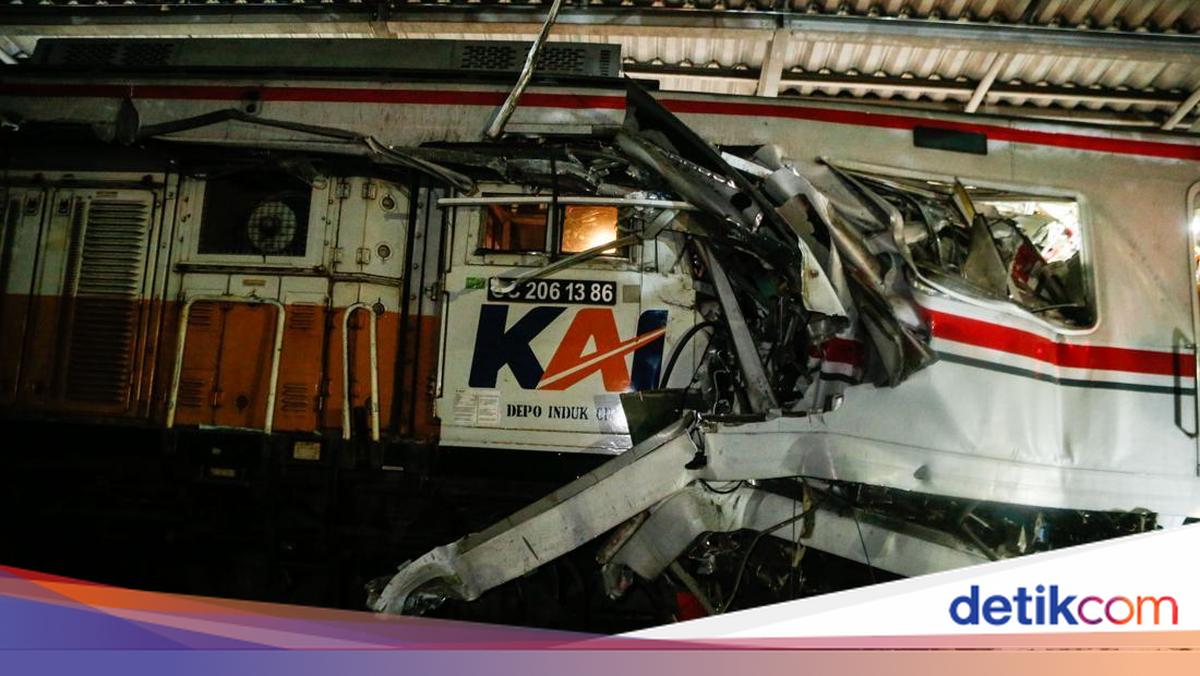
The Indonesian National Transportation Safety Committee (KNKT) Chairman Soerjanto Tjahjono disclosed the findings during a working session of Commission V of the Indonesian House of Representatives with the Minister of Transportation Dudy Purwagandhi and representatives of Indonesian Railways (KAI).
The collision sequence involved two separate incidents. The first collision involved an electric taxi and commuter train KRL 5181B, whilst the second involved the intercity Argo Bromo Anggrek train and the KRL service train (PLB) 5568A. The sequence of events began when an electric taxi became stuck on an illegal railway crossing and was struck by commuter train KRL 5181B. Upon receiving the accident report, the PLB 5568A service train stopped on an adjacent track to await further instructions and ensure operational safety. Several minutes later, the PLB 5568A was struck from behind by the Argo Bromo Anggrek train, which struck the rear carriages. This second collision resulted in dozens of deaths and dozens of injuries.
Regarding the electric taxi, Soerjanto explained that data from the black box of the electric taxi numbered B 2864 SBX showed no system malfunction before the first collision. “Data from the monitoring device of vehicle B 2864 SBX showed no system errors based on data collected one hour before the incident,” Soerjanto stated in a written statement on Friday (22 May 2026).
Soerjanto also noted that the vehicle had passed electromagnetic compatibility testing based on Indian standards, namely EMC AIS-004, which is equivalent to the international UN R10 standard. In Indonesia, this standard is not yet a legal requirement for vehicles.
According to black box data, the taxi was travelling normally at approximately 15 km/h whilst descending towards the railway crossing area. At that time, the transmission was in D (Drive) mode. The vehicle then shifted to N (Neutral) position and coasted freely at speeds between 3 and 7 km/h. KNKT stated that the cause of the shift to neutral at 12:08 remained unknown.
As the vehicle approached the tracks, the driver attempted to accelerate to remove the vehicle from the railway line. However, because the transmission remained in N position, engine power could not be transmitted to the wheels. “The driver attempted to press the accelerator pedal by up to 25 per cent. However, because the vehicle remained in N position, no power was transmitted to the wheels and the vehicle continued to coast freely,” Soerjanto explained.
The driver then increased accelerator pressure to 51 per cent, but the vehicle did not move because the transmission remained in neutral until the vehicle’s speed eventually dropped to zero. KNKT added that after the vehicle stopped on the tracks, the transmission was briefly shifted to D position, but the driver did not press the accelerator. Subsequently, the transmission was shifted to P (Park) position. After that the driver pressed the accelerator, applied the brakes, and repeatedly pressed the start/stop button. However, because the vehicle remained in P position, the car could not move.
Regarding the Argo Bromo Anggrek train’s continued movement despite another train being stopped on the same track, Soerjanto explained that the collision between the electric taxi and the Jakarta-bound KRL occurred at 20:48:29. However, at 20:50:43, the Argo Bromo Anggrek train was still receiving a green signal to pass Bekasi Station. Within only 3 minutes and 43 seconds after the first collision, the train struck the stationary PLB 5568A at Bekasi Timur.
KNKT also noted that PLB 5568 experienced a delay of approximately eight minutes from its schedule, whilst the Argo Bromo Anggrek train was actually travelling three minutes faster than its scheduled arrival time at Bekasi Timur Station. During the session, a DPR member questioned why, after the first collision occurred, the signal on the adjacent track remained green rather than changing to red to stop the approaching train.
In addition to the main signalling system, Soerjanto also disclosed a problem with the supplementary signal at the accident location. According to KNKT’s explanation, the collision occurred at night in an area filled with light sources from markets and houses near the tracks. This condition made it difficult for the train drivers to distinguish the railway signal from the ambient light.
“The train driver experienced difficulty distinguishing the actual signal because the white light in the vicinity came from market kiosks and houses near the tracks,” Soerjanto explained. Near the UB104 (Block Repeat) signal location, there were also house lights and street lamps with intensity and colour similar to the signal itself.
“If the driver could see the supplementary signal clearly, the collision might have been avoided. However, due to visual interference, the train drivers and assistant drivers could not see the signal properly, resulting in a problem with the UB signal,” Soerjanto explained.
The session also highlighted sluggish communication between train traffic control authorities. According to Soerjanto, the PLB 5568 service train and the Argo Bromo Anggrek train were under the control of different operational units. “The Southern Train Controller (PK) must first report to the supervisor, then the supervisor communicates to the Eastern PK, and only then can the Eastern PK contact the train driver,” Soerjanto explained.
According to KNKT, this communication chain caused delays in handling the situation and is an aspect that needs improvement in the future. KNKT explained that the train traffic management system at Bekasi Station is only responsible up to point 14T. As a result, the J12 signal could still show a green light even though PLB 5568 was still stopped further along the track.