
KKP records Indonesia's fishery exports reaching Rp16.7 trillion by March 2026
Jakarta - The Ministry of Marine Affairs and Fisheries (KKP) has recorded the value of fishery product exports from the beginning of the year until just before Eid al-Fitr, or mid-March 2026, reaching 983.1 million US dollars, or approximately Rp16.7 trillion.
Ishartini, Head of the KKP’s Marine and Fishery Product Quality Control and Supervision Agency, quoted from her official statement in Jakarta on Wednesday, explained that until the temporary suspension of goods transportation on 13 March, the export volume of fish to various countries reached 197,718 tonnes.
This value was obtained based on the issuance of Fishery Product Quality and Safety Certificates (SMKHP), which are a standard food safety requirement in 140 trading partner countries.
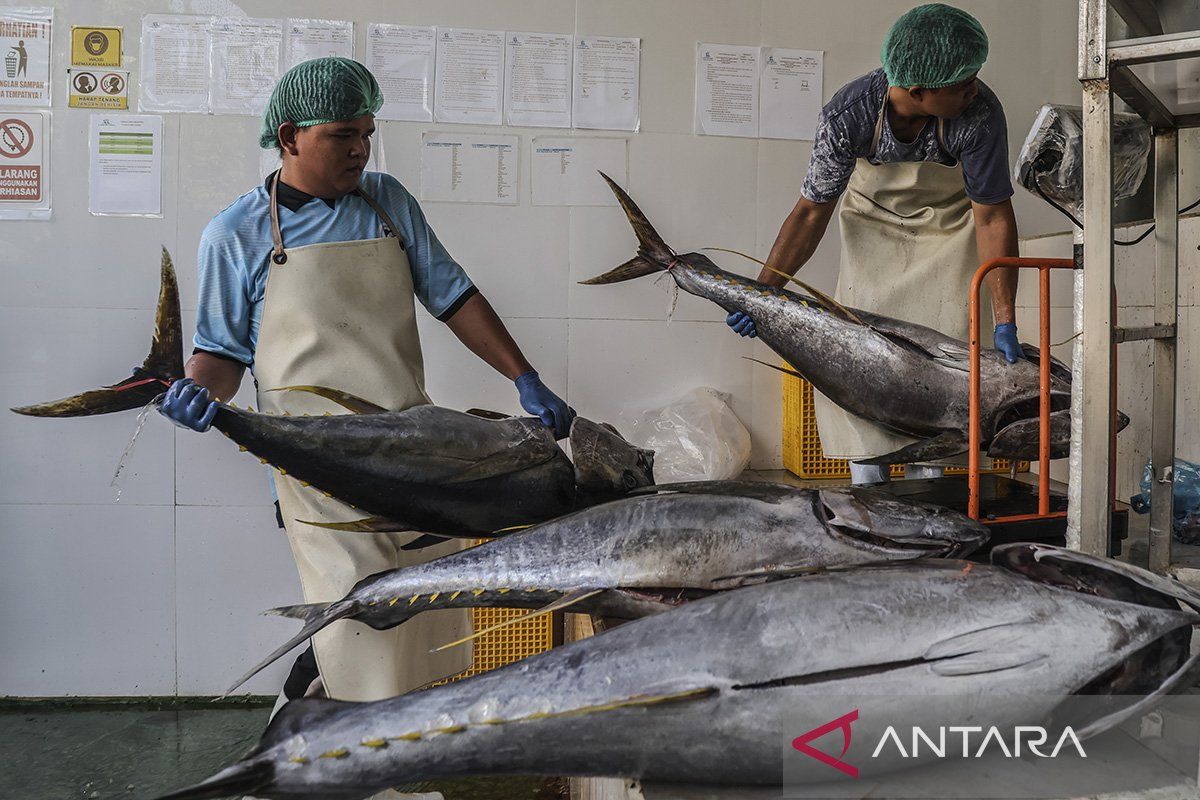
“The top ten flagship commodities are vannamei shrimp, tuna, squid, blue swimming crab, seaweed, skipjack tuna, crab, tiger prawn, ribbonfish, and octopus,” she said.
Ishartini acknowledged that the escalation of geopolitical tensions in the Middle East has impacted fishery export activities.
According to her, compared to the same period last year, export volume decreased by 41.35 per cent, while export value fell by 21.71 per cent.
Ishartini stated that demand for Indonesian fishery products remains relatively stable, as seen from the continuous processing of applications for Fishery Product Quality and Safety Certificates (SMKHP).
“From the volume perspective, it is indeed constrained because the supply chain is affected by the escalation, for example, changes in shipment routes, additional logistics costs, container shortages, and mother vessel limitations, all of which contribute to increasing product prices,” she explained.
To maintain trade stability, Ishartini said she will encourage increased domestic absorption of fishery products.
In addition, according to her, intensive communication is being conducted with authorities in partner countries as well as domestic stakeholders to anticipate the impacts of the global situation.