
KKP Implements Stelina System as a Gradual Export Requirement
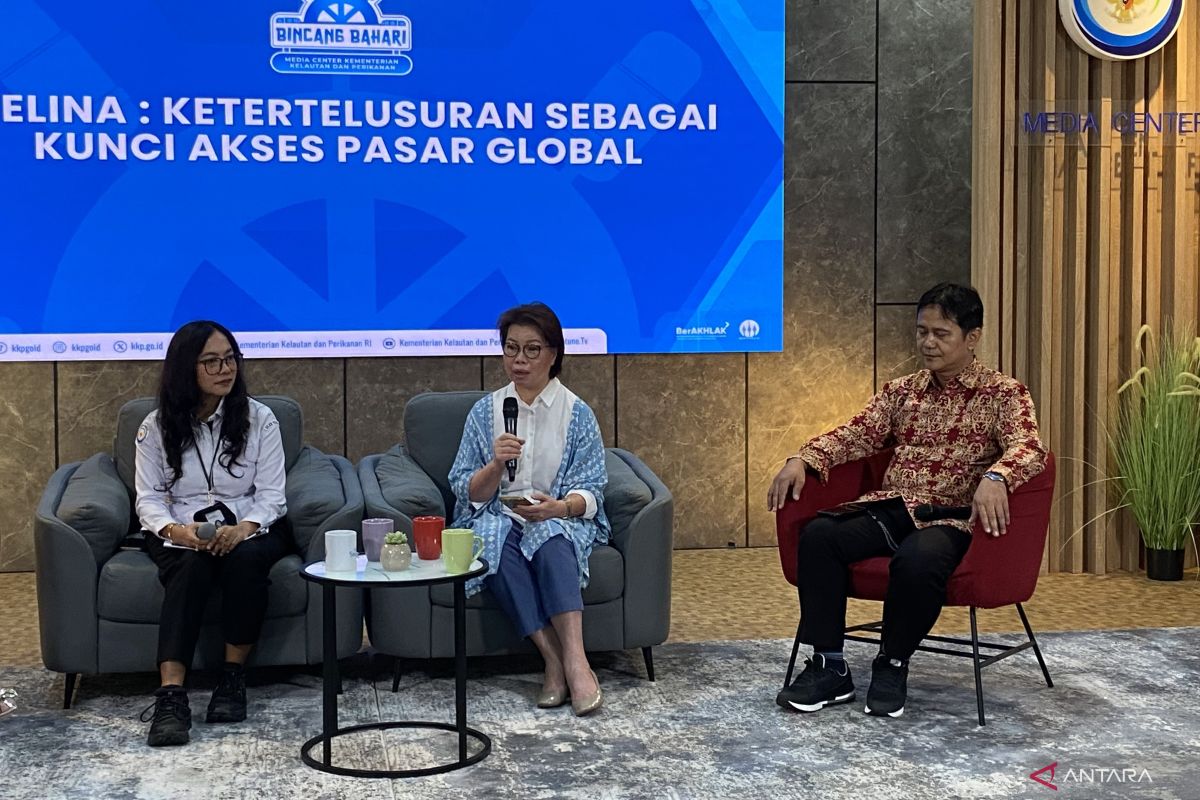
Jakarta (ANTARA) - The Ministry of Marine Affairs and Fisheries (KKP) is beginning to implement the digital traceability system Stelina for exporters of fishery products on a gradual basis.
Lia Sugihartini, Head of the Monitoring and Traceability Working Team at the Directorate of Infrastructure and Facilities, Directorate General of Competitiveness Enhancement for Marine and Fishery Products at KKP, explained that this policy responds to international market demands requiring Indonesian fishery products to be legal, traceable, and derived from sustainable activities.
During a discussion at the KKP office in Jakarta on Tuesday, Lia stated that the implementation of Stelina will initially focus on major export commodities such as tuna, shrimp, and crab.
“Currently, only 584 business actors are implementing Stelina, and in the future, the number will be gradually increased, especially for exporters,” she said.
Stelina is a digital platform that integrates data from upstream to downstream, from capture, aquaculture, distribution, processing, to marketing.
The system is regulated through Ministry of Marine Affairs and Fisheries Regulation No. 32 of 2024 on the National Fish Traceability and Logistics System (Stelina) and meets the international standards of the Global Dialogue on Seafood Traceability (GDST).
Lia noted that with these standards, Indonesia has become the first country to pass the capability test, enabling interoperability with various global systems.
According to her, this gradual implementation considers the readiness of the fish processing industry. The government targets all tuna, shrimp, and crab exporters to use Stelina by no later than 2027.
With interoperability, Lia continued, business actors who already have traceability systems can connect their data to Stelina without duplicate input.
“So, we can open up interoperability with traceability systems owned by business actors or globally,” she said.
She added that KKP will also collaborate with various parties, including associations and strategic partners.
In the future, KKP hopes to establish direct communication with export destination countries such as the United States, the European Union, and Japan, which require Indonesian fishery products to have a clear traceability system.
“Thus, they can accept Stelina for data sharing between governments,” she stated.
Meanwhile, Janti Djuari, CEO & Founder of the Indonesian Pole and Line and Handline Fisheries Association (AP2HI), assessed that this system will greatly assist the industry, as buyers have always requested verification on whether products are caught by specific fleets.
According to him, the implementation of the Stelina traceability system is not a burden but a solution to meet the requirements demanded by international buyers.
He hopes the system will facilitate the verification process to be more efficient according to market needs.
“Because, in the end, export documents must be under the government’s flag; there must be a government stamp,” he said.