
KIP Kuliah budget increases as Government ensures access remains protected
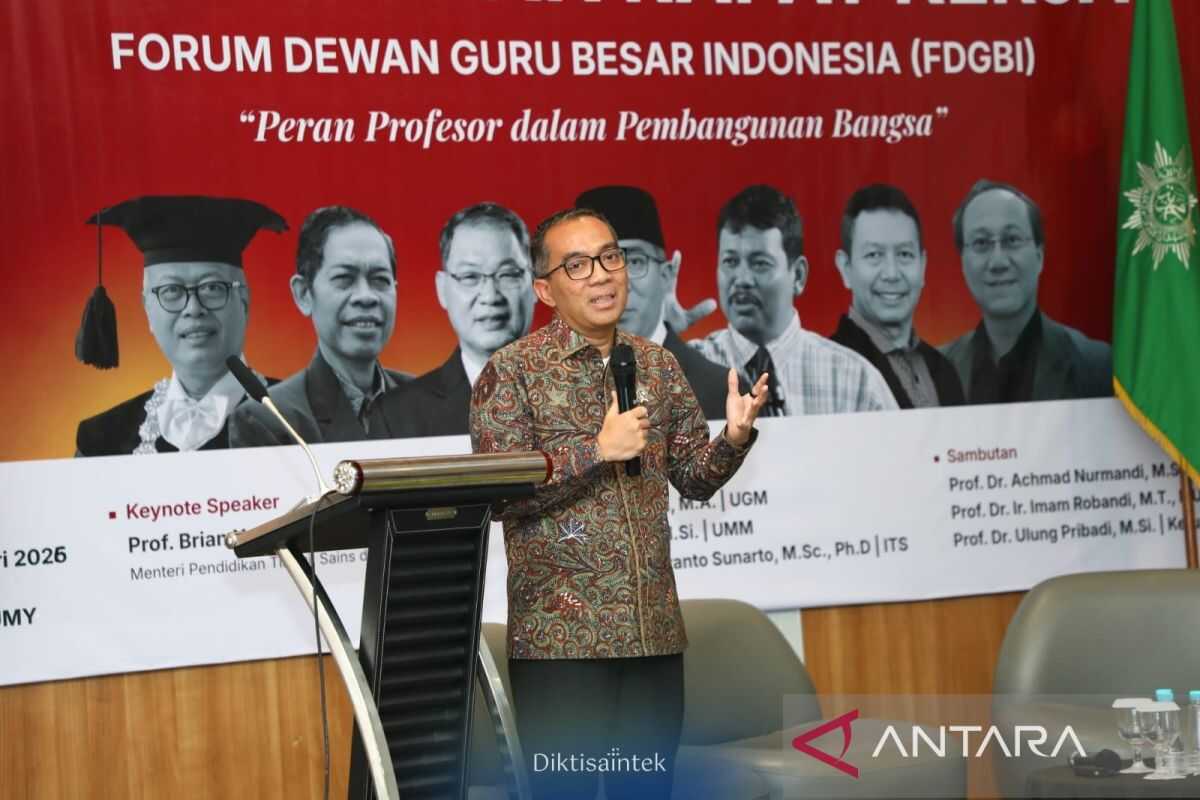
Jakarta (ANTARA) - The Ministry of Higher Education, Science, and Technology (Kemdiktisaintek) has confirmed that access to higher education for students from disadvantaged families remains protected, with the budget for the Kartu Indonesia Pintar (KIP) Kuliah programme continuing to increase.
In 2020, the KIP Kuliah budget stood at Rp6.5 trillion. The allocation has risen significantly since then, reaching Rp14.9 trillion in 2025 with a target of 1,044,921 student recipients based on the Budget Implementation Document (DIPA).
For the 2026 fiscal year, the KIP Kuliah budget allocation under DIPA has increased to Rp15,323,650,458,000, targeting 1,047,221 student recipients.
In a statement issued in Jakarta on Monday, Minister of Higher Education, Science, and Technology Brian Yuliarto said his ministry continues to oversee the KIP Kuliah programme to ensure its budget is not reduced and that the programme is implemented even more effectively.
“KIP Kuliah is a strategic instrument for ensuring equitable access to higher education opportunities,” he said.
“Kemdiktisaintek will continue to ensure that the living cost allowance from KIP Kuliah is the full entitlement of students, and that universities and all other parties are prohibited from imposing any charges on KIP Kuliah recipients,” he added.
With the increased budget, expanded coverage, and improved policies, Minister Brian affirmed that KIP Kuliah remains a vital component of the strategy for building an inclusive and equitable higher education system.
The government is ensuring that access to higher education remains open and increasingly broad for young Indonesians across all regions.
“We at Kemdiktisaintek invite all Indonesian children from disadvantaged families, especially senior secondary and vocational school graduates, not to worry about pursuing higher education. KIP Kuliah will serve as a means for the nation’s children to achieve a better future,” Brian Yuliarto said.
The distribution of KIP Kuliah quotas during the 2020–2024 period was based on the intake capacity of each study programme according to its accreditation status at each university.
This scheme placed campus capacity and study programme quality as the basis for quota allocation, meaning the number of recipients at each campus followed a relatively stable policy from year to year, with the proportion of recipients at each university remaining broadly consistent.
From 2025, the PPAPT unit of Kemdiktisaintek has been tasked with managing the KIP Kuliah programme. To improve targeting accuracy, priority for recipients at public universities (PTN) is given based on the number of holders of the senior secondary-level Kartu Indonesia Pintar or those registered in the Integrated Social Welfare Database (DTKS), or those in the maximum Decile 3 of the PPKE classification who have passed the National Selection Based on Achievement (SNBP) and the National Selection Based on Test (SNBT) at their respective public universities and were registered in the KIP Kuliah system prior to sitting the SNBP and SNBT examinations.
For private universities (PTS), quotas are distributed by the Higher Education Service Institutions (LLDikti) based on the intake capacity of each study programme according to its accreditation status at private universities within the LLDikti’s working area.
Under this policy, priority for KIP Kuliah recipients is attached to students from poor and near-poor families who pass public university entrance selection through SNBP or SNBT, meaning they are automatically designated as KIP Kuliah recipients after verification and validation by the university.