
Kim Jong Un Accelerates Nuclear Weapons Production Despite No 'Call' to War
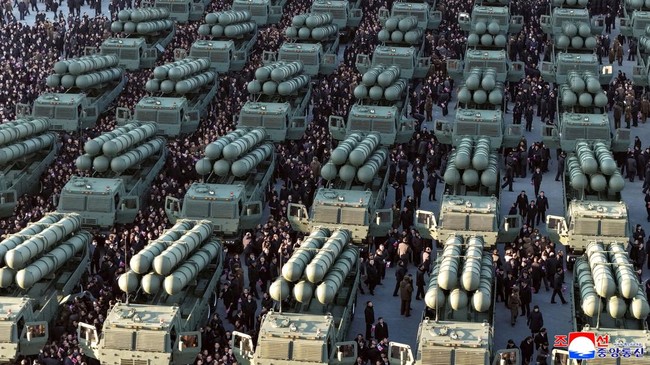
North Korean leader Kim Jong Un has reaffirmed his commitment to accelerating the strengthening of his country’s nuclear capabilities at a rate he described as “exponential”. The statement was made during his visit to a new uranium enrichment facility located at an undisclosed site.
Kim stated that North Korea has successfully more than doubled its nuclear material reserves for weapons purposes over the last five years. He emphasised that strengthening the nuclear arsenal is a top priority amidst increasing global security uncertainties.
“The potential threats and unpredictable long-term crises further highlight the urgency and responsibility of the historic mission to improve both in quality and quantity, and to sustainably and acceleratedly strengthen nuclear war deterrence,” Kim said, as quoted by KCNA on Friday (6/5/2026).
Photos released by KCNA show Kim, alongside several high-ranking officials, visiting the new uranium enrichment facility. One partially obscured image appears to show Kim reviewing nuclear warhead designs during a meeting focused on strengthening North Korea’s nuclear deterrence capabilities.
Pvongyang’s move to expand its nuclear weapons stockpile and launch systems occurs amidst deteriorating relations with South Korea. The North Korean government no longer recognises Seoul as a potential partner for the future reunification of the Korean Peninsula.
Based on various open estimates, North Korea is currently believed to possess at least 60 nuclear warheads. This figure remains far below the inventories of Russia and the United States, which each possess more than 5,000 warheads.
Several analysts suggest that North Korea is learning lessons from conflicts involving its non-nuclear allies. The United States’ attack on Iranian nuclear facilities last June, alongside ongoing tensions between Washington and Tehran, is seen as reinforcing Kim’s belief that nuclear weapons are the most effective deterrent against external military pressure.
In addition to developing nuclear weapons, North Korea continues to bolster its conventional military strength. According to a recent report by the International Institute for Security Studies (IISS), the country maintains approximately 1.1 million active personnel, making it one of the largest armed forces in the world.
The increase in North Korea’s military capabilities is prompting the United States and its allies in the Asia-Pacific region to accelerate the development of missile defence systems, long-range strike capabilities, and hypersonic weapon technology.
IISS arms control expert Daniel Salisbury noted that Pyongyang’s armament programme still leaves much uncertainty regarding the scale of its ambitions. According to him, several public estimates suggest North Korea may have produced enough material for up to 90 nuclear warheads and may have assembled around 50 units.
Meanwhile, international attention is also focused on the new uranium enrichment facility in Yongbyon. The existence of this facility was first revealed by the International Atomic Energy Agency (IAEA) about a year ago. IAEA Director General Rafael Grossi explained last June that the construction of the new facility is part of the expansion of North Korea’s nuclear programme at the Yongbyon complex, one of the country’s primary nuclear weapons research centres.
Researchers from the Middlebury Institute of International Studies, Jeffrey Lewis and Sam Lair, previously noted that North Korea continues to expand its highly enriched uranium production capacity by adding more centrifuges in a more efficient area. Lewis even estimated that the new facility visible in KCNA photos could double the production of highly enriched uranium (HEU).
On the same day as the visit to the facility, Kim also led an important meeting regarding the strengthening of national nuclear capabilities. He stated that the government has set priorities to execute an ambitious plan aimed at increasing the nation’s nuclear strength exponentially.
“We have confirmed the order of priority to implement an ambitious future plan designed to strengthen our national nuclear strength at an exponential rate,” said Kim.
This statement comes only a few weeks after the White House stated that US President Donald Trump and Chinese President Xi Jinping, in a meeting in Beijing, reaffirmed their shared goal of achieving the denuclearisation of North Korea. However, signals from Pyongyang indicate the opposite direction.
Last week, North Korea reaffirmed that the denuclearisation of the country “will never happen”. This stance shows that Kim is currently more focused on strengthening strategic ties with Xi Jinping and Russian President Vladimir Putin, rather than reopening arms control talks with Washington.