
Khofifah urges strengthening of cooperatives to reinforce people's economy
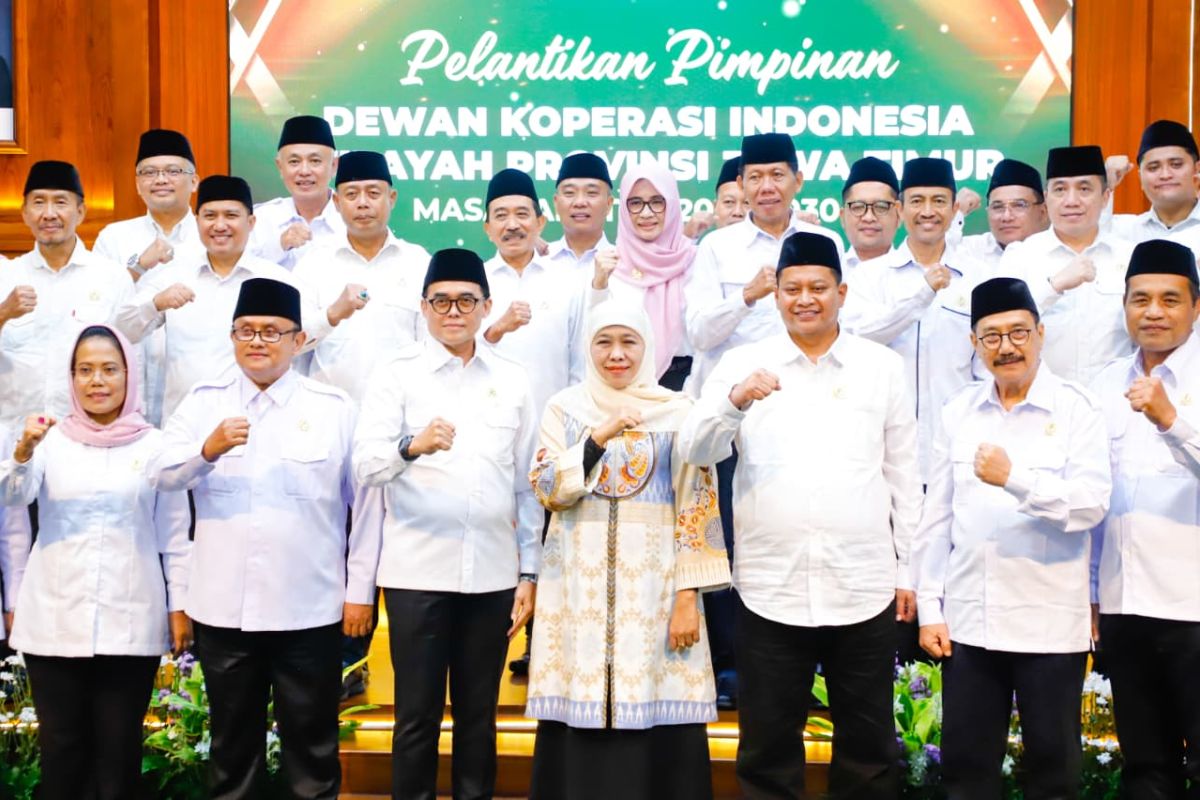
Surabaya — East Java Governor Khofifah Indar Parawansa has urged the strengthening of cooperatives’ role to reinforce the grassroots economic ecosystem in the region whilst attending the inauguration of the Indonesian Cooperative Council Regional Board (Dekopinwil) for East Java for the 2025–2030 term.
“Therefore, cooperatives must be built as an economic movement based on collective effort that is capable of strengthening people’s economy from the ground up, whilst serving as part of efforts to strengthen the grassroots economic ecosystem in the region,” she said in a statement received in Surabaya on Monday.
Khofifah noted that cooperatives not only possess economic value but also have strong historical and ideological roots in the history of world economics.
“I have had the opportunity to visit Rochdale in Greater Manchester. That is where cooperatives were born in 1844. This is actually something deeply ideological that we rarely discuss. Cooperatives emerged as a response to the effects of the Industrial Revolution,” she said.
According to her, during that period various economic ideas emerged as a response to social changes caused by the Industrial Revolution, including the economic thinking of Karl Marx as expressed in his renowned work Das Kapital.
However, she added, England developed a cooperative system as an economic model emphasising social solidarity and collective effort.
“In many European countries, in very luxurious shopping malls there is still a co-op corner. They provide space for cooperatives so that small businesses and cooperatives continue to survive and develop,” she said.
She also cited examples of successful cooperatives in several countries that have grown into large economic institutions managing strategic sectors such as energy, fisheries and banking.
“One significant example we can observe is Rabobank, a workers’ cooperative from the Netherlands. This demonstrates that cooperatives can become very large and powerful economic institutions,” she added.
In East Java, Khofifah continued, there are cooperative models capable of developing businesses to the point of owning their own companies or corporations, one example being in Bojonegoro District.
“Usually large corporations own cooperatives. But in Bojonegoro, there is a cooperative that owns a corporation. This is a model that I believe we can use as a reference for cooperative strengthening,” she said.
Khofifah also noted that cooperative strengthening has become a priority of the central government, including through the separation of the Ministry of Cooperatives and the Ministry of Micro, Small and Medium Enterprises (MSMEs).
“Why did the President separate the Cooperative Minister and the MSME Minister? So that cooperatives can operate more broadly and become a reference as the pillar of Indonesia’s economy,” she said.
The cooperative movement must be built with ideological spirit. Not merely as business, but as a movement that truly strengthens people’s economy from the ground up.
She added that in 2025 East Java achieved its target of establishing 8,494 Red and White Village Cooperatives (KDMP) across all villages. By 15 March 2026, a total of 997 village cooperatives had become operational and begun implementing economic activities at village level.