
Khofifah intensifies subsidised markets to safeguard public purchasing power
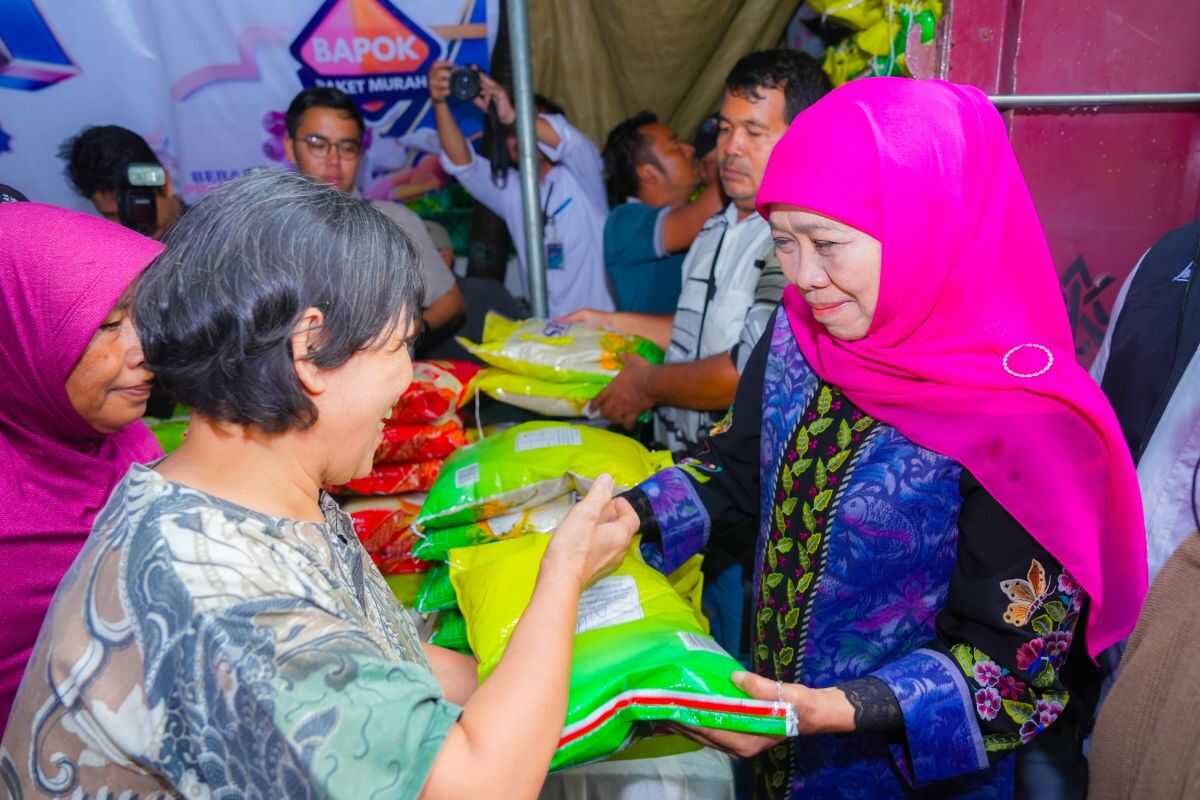
Surabaya (ANTARA) — East Java Governor Khofifah Indar Parawansa is intensifying the rollout of subsidised markets during Ramadan to maintain staple food price stability and safeguard public purchasing power across the region, including Surabaya, ahead of Eid al-Fitr 1447 Hijriah.
“Every fasting month and in the lead-up to Lebaran, demand for staple food logistics rises and this has the potential to trigger price increases,” Governor Khofifah said in Surabaya on Tuesday.
She added that subsidised markets are being held so that the public need not worry about or be burdened by surging prices for essential goods.
“Our hope, of course, is that people can observe the fasting month more peacefully and smoothly,” she said.
The East Java provincial government held its 25th subsidised market in the grounds of the At-Taqwa Mosque, Jemur Wonosari, Wonocolo sub-district, Surabaya, which was enthusiastically received by hundreds of residents, particularly housewives seeking affordable staple goods.
Various commodities were sold below market prices, including premium rice at Rp14,000 per kilogramme, medium-grade rice at Rp11,000 per kg, MinyaKita cooking oil at Rp13,000 per litre, free-range chicken eggs at Rp22,000 per pack, and wheat flour at Rp10,000 per kg.
Additionally, granulated sugar was sold at Rp14,000 per kg, garlic at Rp6,000 per 250 grammes, shallots at Rp7,000 per 250 grammes, small red chillies at Rp4,000 per 100 grammes, large red chillies at Rp2,000 per 100 grammes, and chicken meat at Rp30,000 per pack.
The first female governor of East Java confirmed that subsidised markets would continue to be held throughout Ramadan and indeed throughout 2026, as a form of government intervention to maintain staple food price stability.
“We have scheduled this so that strategic programmes like subsidised markets can continue to exist as an effort to stabilise staple food prices. We work in tandem with what the regencies and cities are doing, so the programme is complementary in nature,” she said.
She noted that the subsidised market locations are placed very close to mosques, bringing them within easy reach of residential neighbourhoods.
“I always insist that the locations be far from traditional markets. The hope, of course, is that these can directly reach the communities who need them most,” she said.
On the same occasion, Governor Khofifah also distributed rice aid to hundreds of elderly residents and handed out eggs to housewives accompanied by children, as part of efforts to improve family nutrition.
She also purchased various micro, small, and medium enterprise (MSME) products as a gesture of support for the local economy.
One Wonocolo resident, Asri, said she had been greatly helped by the subsidised market in her neighbourhood.
“Today I bought rice and eggs because the prices are cheaper than at the market. During Ramadan, my family consumes a lot of egg-based dishes as a side, especially at sahur, because they are practical, healthy, and nutritious,” Asri said.