
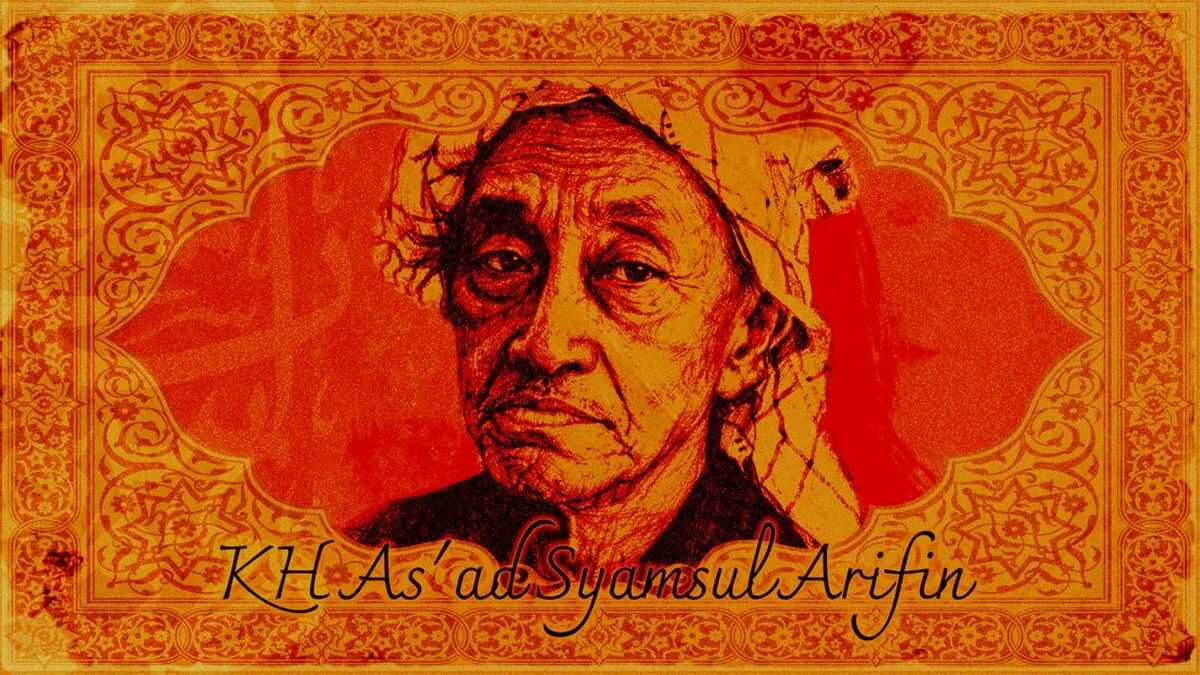
KH As'ad Syamsul Arifin, Son of Mecca and Architect of the November 10 Resistance
History is sometimes not born from clashes of weapons, but rather from the whispers of long prayers in the Holy Land.
One such figure is KH Raden As’ad Syamsul Arifin, a National Hero designated by the state in 2016. He was an Islamic scholar and fighter who played a crucial role in defending Indonesian independence during Dutch aggression.
He was born far from the archipelago and the Javanese homeland he would come to cherish, instead in the Holy City of Mecca Al-Mukarromah in the Arabian Peninsula in 1897.
In the sacred city, never silent from remembrance of the Almighty, As’ad began his life when his parents were residing to perform the Hajj pilgrimage whilst studying Islamic teachings there.
He was the eldest son of KH Syamsul Arifin (Raden Ibrahim) and Nyai Siti Maimunah. According to NU Online, his father was descended from Sunan Kudus, whilst his mother was descended from Sunan Ampel.
Coming from a deeply religious family background, As’ad studied throughout his childhood and adolescence at various Islamic boarding schools from Madura to Java and Mecca, his birthplace.
At the age of six, As’ad was sent to Pamekasan on the island of Madura to stay at the Kembang Kuning Islamic boarding school.
After living in Pamekasan for five years, young As’ad was taken by his father to Java. They settled in Sukorejo, Banyuputih, Situbondo, an area still surrounded by dense forest.
There his father built an Islamic boarding school to preach and teach Islam. Initially the school was merely a small wooden hut, a prayer hall, and student dormitories housing only a few people. The school expanded as more students arrived to study Islamic teachings. Thus the school became known as Pesantren Salafiyah Syafi’iyah in 1914.
As’ad was tempered by discipline in the scriptures and the patience of life, then returned to seek knowledge in the Holy Land.
Upon returning from the Holy Land, As’ad did not immediately assume leadership of the school. He continued his travels seeking knowledge at various boarding schools.
From Tebuireng in Jombang to Bangkalan in Madura and other schools, As’ad studied not just texts but people and life itself.
After his father’s death in 1951, As’ad inherited the leadership of Pesantren Salafiyah Syafi’iyah. Then in 1968, Syafi’iyah University was established there with faculties of education and Islamic preaching.
Defending Independence
The times demanded not only prayer but also courage. After the Jihad Resolution was issued to defend Indonesian independence, As’ad descended to the battlefield leading santri militias.
In the forests of the Tapal Kuda region, his name echoed as a respected leader—not because of a loud voice, but because of a clear objective: Freedom or Death!
According to NU Online Jatim, KH As’ad was involved in guerrilla warfare fighting to expel Japanese occupiers from Jember.
He formulated strategy and launched attacks against the occupiers from Pesantren Raudlatul Ulum in Sumberwringin, Sukowono, which served as his main headquarters.
KH As’ad, known for his charisma, was respected by communities in the Tapal Kuda region, which includes Banyuwangi, Situbondo, Bondowoso, Probolinggo, Jember, Lumajang and Pasuruan. This was particularly true for the three militias: the Sabilillah Force, Hizbullah, and Pelopor.
During the November 10, 1945 battle in Surabaya, As’ad sent members of the Pelopor and Sabilillah Forces from Situbondo to the Tanjung Perak area where they engaged in fierce fighting at the Red Bridge.
Similarly, followers of Kiai As’ad from Bondowoso headed directly to Tanjung Perak and engaged in armed conflict with Dutch forces at the Red Bridge. In this event, Kiai As’ad actively led the fight against Dutch colonisers who were backed by Allied forces.
Fulfilling Independence
Amid the dynamics of post-independence politics, KH As’ad became a key bridge between Islam and Indonesian nationalism, between faith and patriotism.
His final role in the history of Nahdlatul Ulama was serving on the Mustasyar (advisory council) of the Central Leadership. He also served as a Member of the Constituent Assembly from 1957 to 1959.
KH As’ad Syamsul Arifin passed away on August 4, 1990 in Situbondo, East Java, at the age of 93.
He left behind a thriving Islamic boarding school, a strong Nahdlatul Ulama, and a nation he had defended with prayer and blood.
KH Raden As’ad Syamsul Arifin was subsequently designated as a National Hero through Indonesian Presidential Decree Number 90/TK/Year 2016 dated November 3, 2016, conferring the title of National Hero.