
Key Causes of the Argo Bromo Anggrek Collision with the KRL: Signalling and Communications
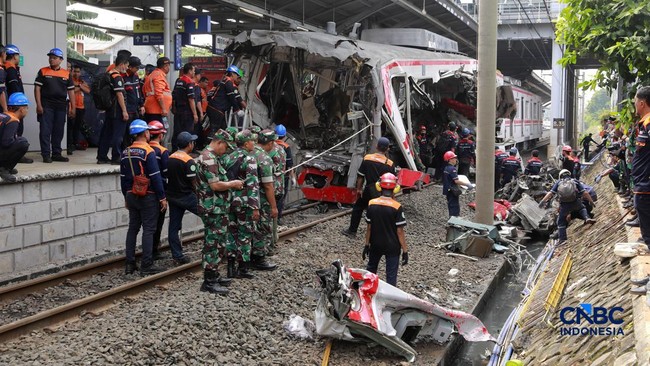
Jakarta, CNBC Indonesia - The National Transportation Safety Committee (KNKT) has disclosed an initial investigative report into the collision between the Argo Bromo Anggrek train and a KRL Commuter Line on the Kampung Bandan-Cikarang route at Bekasi Timur station on 27 April. The incident involved Argo Bromo Anggrek train number KA 4B on the Gambir-Surabaya Pasar Turi route and the KRL train number 5568A on the Kampung Bandan-Cikarang route.
Chairman Soerjanto Tjahjono said in the initial report there were three causes of the collision between the two trains. Firstly, a signalling anomaly between Bekasi and Bekasi Timur stations. ‘Based on the results of a Train Stepping service simulation conducted in the Bekasi Station Equipment Room and field simulations after the incident, with the route running directly from Track 3 at Bekasi Station and the track condition 104BT in the Bekasi Timur area being occupied, the signal at the exit J12 (Bekasi) could display a green aspect (symbol 5) or a safe aspect. The repeater signal UB104 shows a horizontally lit white light (symbol 9C3) indicating a red block indication. Then, the block signal B104 shows a red aspect (symbol 7). The simulation results are consistent with the signalling aspects.’
From the simulation, this indicates the signal at Bekasi Station could not detect the 5568A train at Bekasi Timur, which would indicate that the exit signal should show a safe or green light. The repeater signal showed an unsafe aspect or a horizontal white light when the preceding signal was red, and the block signal showed a red aspect. The exit signal, in fact, should have shown a caution (yellow) if the preceding signal still indicated an unsafe or red status.
Not only that, based on preliminary simulations, the driver of Argo Bromo Anggrek also had difficulty seeing the repeater signal in the Bekasi-Bekasi Timur block due to illumination from nearby homes and market lights.
‘In the cab of the locomotive, and in the KRL cab, we observed at night that the driver struggled to see the repeater signal because of lighting from markets and houses around the track. There were lights from residents and street lamps with intensity and colour resembling the repeater signal,’ he said.
In addition to signalling, there was miscommunication between the railway’s Train Operation Control (PK). Moreover, the communication system was considered overly convoluted. ‘The Radio communications used by the PK South (S.27) and PK East (S.1) areas were not integrated well, causing delays as PK South had to inform the Chief who then passed the information to PK East. This needs addressing,’ he explained.
He said PK did not know the real-time conditions around Bekasi, as communications were carried out via voice radio. ‘We received reports from the Argo Bromo Anggrek driver that he had to brake from 1.3 km after receiving information of a temperamental approach of the KRL ahead. The driver attempted braking, but PK did not know the actual conditions around Bekasi Timur since communication was only by radio in the cab.’
There was also miscommunication between PK Bekasi Timur and the Argo Bromo Anggrek driver, where PK instructed only progressive braking rather than full braking, making the collision unavoidable. ‘PK East informed the driver to perform gradual braking and to use the horn 35 times, but information about the line clearance ahead was not obtained from the relevant crossing,’ he said.
Soerjanto explained that KA 4B Argo Bromo Anggrek had actually already performed emergency braking when passing the block signal before Bekasi Timur. However, because PK only instructed gradual braking, the collision could not be avoided. ‘From the data logger, KA 4B Argo Bromo Anggrek performed emergency braking and independent braking at 300 metres from the block signal before Bekasi Timur. The collision occurred at a speed of 40-60 km/h,’ he concluded.