
Katadata Releases KIMCI Research to Understand Indonesia's Middle-Class Landscape
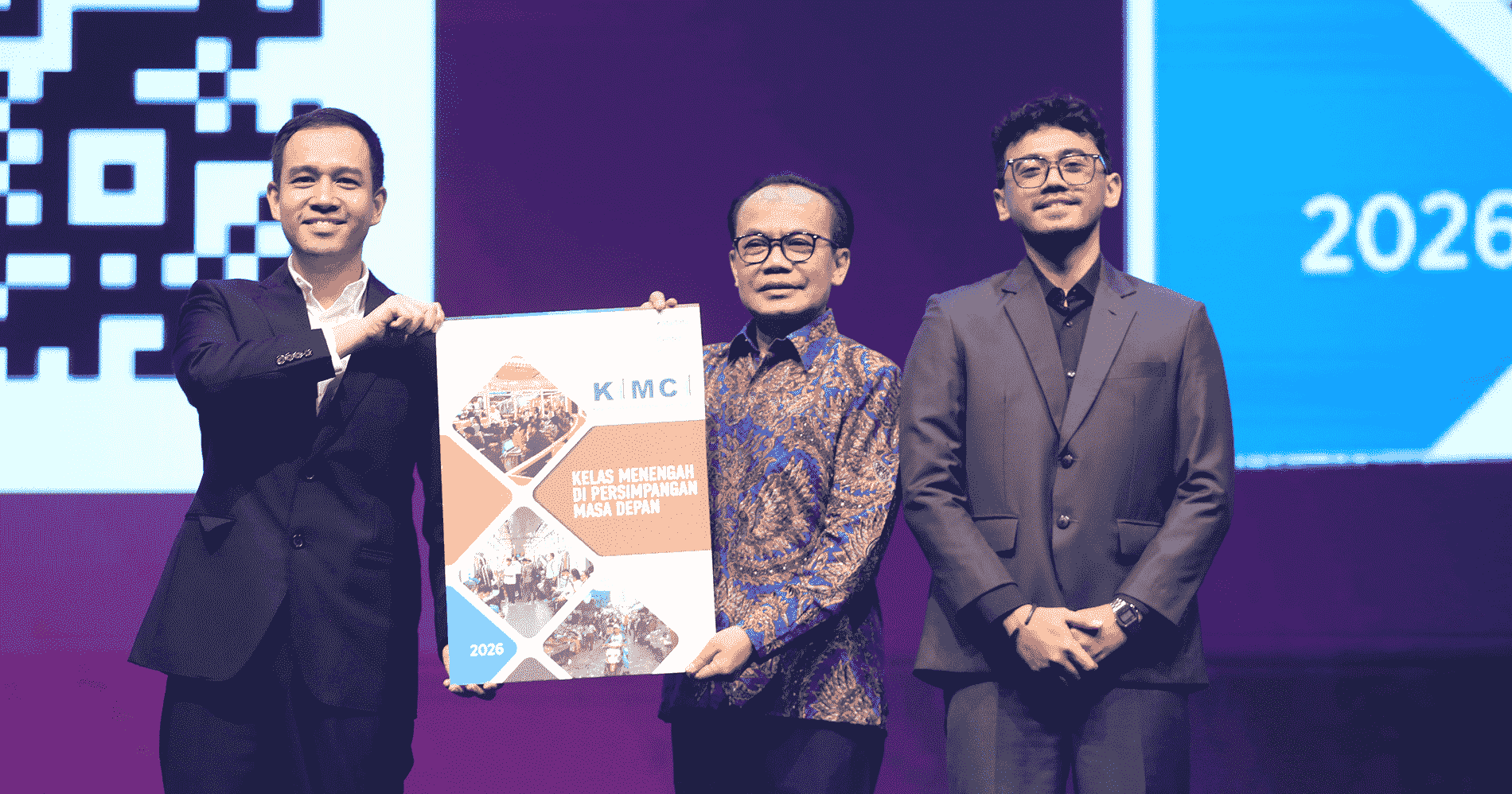
Katadata Insight Center has once again released its flagship report, the Katadata Indonesia Middle Class Insight (KIMCI), at the IDE Katadata Future Forum 2026. The report dissects the condition of the middle class in Indonesia.
In his opening remarks at the IDE Katadata Future Forum 2026, Co-Founder and CEO of Katadata Indonesia, Metta Dharmasaputra, expressed hope that the KIMCI research could serve as a reference for various stakeholders in understanding the condition of the middle-class group in Indonesia.
“Hopefully, in its second year, KIMCI can become a reference for understanding the landscape map of the middle class in Indonesia,” said Metta while opening the IDE Katadata Future Forum 2026 themed “Adapting to What Comes Next” at Djakarta Theater, Jakarta, on Wednesday (15/04/2026).
Metta highlighted the continuously declining number of the middle class. The National Socio-Economic Survey (Susenas) shows that the middle class began to decline since 2019 (21.5%), reaching 16.9% in 2024.
At the same time, the aspiring middle class group continues to show an increase, reaching 48.8% in 2024. Meanwhile, Bappenas once estimated that Indonesia has the opportunity to become a developed country by 2045 if the proportion of the middle class reaches 70% of the total population.
The middle class itself has a crucial role in Indonesia’s economy. In 2024, this group was recorded to contribute 81.5% of total household consumption. Meanwhile, household consumption is the main contributor (58.8%) to Indonesia’s gross domestic product (GDP).
“The middle class is the key to changing the country and society,” said Metta.
At the KIMCI launch event, Vice President of Finance and Business Development at Katadata, Ivan Triyogo Priambodo, revealed findings that many middle-class individuals do not feel that having one job is sufficient.
“For the middle class, one source of income is no longer enough to provide certainty, so side jobs are not just additional but a layer of security,” said Ivan.
According to him, this is a sign that the middle class is building a more adaptive and resilient life strategy against uncertainty.
“At the same time, consumption patterns are becoming wiser; purchasing decisions are not solely determined by the cheapest price. What is increasingly important to them is value,” he said.
Meanwhile, Research Analyst at Katadata Insight Center, Kholis Dana P., also presented the research findings. According to him, public policy plays an important role, from maintaining purchasing power, controlling living costs, expanding access to employment, to adaptive social protection.
“The middle class is not just about protection, but about ensuring they continue to grow and contribute sustainably,” said Kholis.
The KIMCI research discusses several solutions on how the middle class can still rise or at least survive amid various economic pressures. This includes utilising AI technology to support productivity, seeking information, learning new skills, to completing professional work.
KIMCI 2026 comprehensively captures the current condition of the middle class, from consumption behaviour to economic sentiment.