
Kartini's Flame in the City of Heroes
Kartini is not merely a name in the national calendar. She is an idea that continues to move, demanding relevance in every era. Surabaya has shown promising initial steps, but the journey is still long.
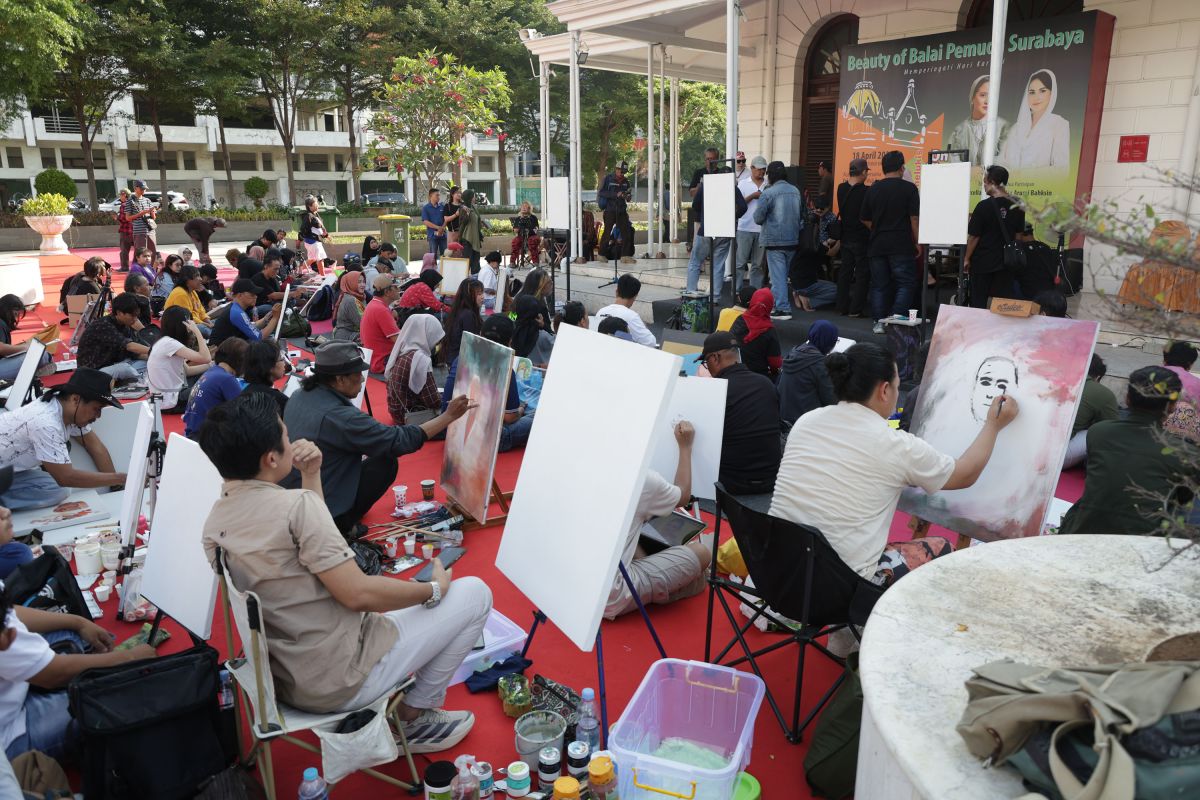
Surabaya (ANTARA) - In a corner of Surabaya City, canvases are spread out in the courtyard of Balai Pemuda. Brushes move slowly, recording the traces of old buildings that have witnessed decades of the city’s artistic pulse.
At the same time, in small early childhood education rooms, simple stories flow, instilling values of courage and mutual cooperation in children.
These two events may seem different, but they actually meet at one point: efforts to nurture Kartini’s spirit in the face of the modern city.
Ahead of Kartini Day, Surabaya does not merely commemorate the figure of that pioneering woman emancipator. This city is trying to translate Kartini’s ideas in a contemporary context through art, education, and public policy.
Behind these various initiatives, a fundamental question arises: to what extent is Kartini’s spirit truly alive, rather than just an annual ceremony?
Space to grow
Balai Pemuda is not just an old building. It is a space of collective memory, the birthplace of many artists who shaped the face of the city’s culture. From generation to generation, this space has become a meeting point for creativity, as well as proof that a city is not built only from concrete, but also from imagination.
The communal painting activity titled “Beauty of Balai Pemuda Surabaya,” held ahead of Kartini Day, shows one important thing: art is still given space. The city government is trying to maintain the continuity of the creative ecosystem, even amid the pressures of development that often prioritise economic aspects.
This is where Kartini’s relevance lies. She is not only a symbol of women’s struggle, but also a symbol of the courage to think and express. When artistic spaces are preserved, the city is actually safeguarding spaces of freedom, something that Kartini once fought for in her own time.
However, the issue is not that simple. Art is often viewed as an “unproductive” sector because it does not directly generate regional income. This perspective is dangerous. If the measure of development is only economic, then spaces like Balai Pemuda will always be in a vulnerable position.
In fact, a city without art is a city that has lost its soul. Art functions as a balancer, even as a critique of the direction of development itself. In this context, policies to preserve artistic spaces are not merely a cultural choice, but a strategic necessity.