
Karding Meets Halal Agency Head, Agree to Implement This
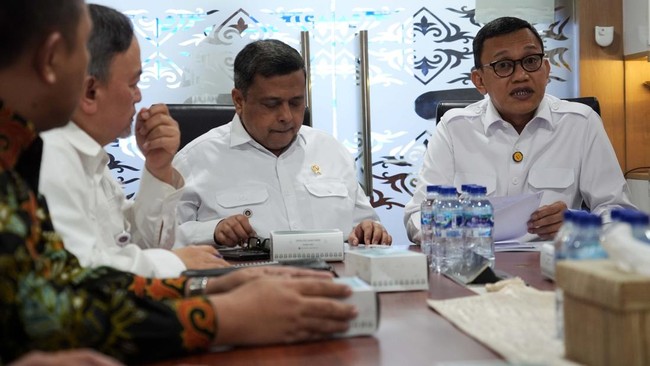
Jakarta, CNBC Indonesia - The Head of the Indonesian Quarantine Agency (Barantin) Abdul Kadir Karding emphasised that guaranteeing halal products is fundamentally a state obligation. The presence of halal certification not only provides protection to the public but also strengthens food security and enhances the competitiveness of Indonesian product exports.
He stated that commodities in the form of animal, fish, and plant products consumed by the public also need to consider halal aspects. This is not without reason. Indonesia, he added, is a country with a Muslim-majority population. This was conveyed during a meeting with the Head of BPJPH Ahmad Haikal Hasan at the Barantin office in Jakarta on Monday (4/5/2026).
Barantin together with BPJPH, he said, are strengthening synergy in overseeing biosecurity and halal products ahead of the implementation of the 2026 Mandatory Halal policy. This collaboration is focused on ensuring the flow of commodity traffic remains smooth without sacrificing aspects of product health and halal status.
“Barantin has the responsibility to safeguard biosecurity resources and ensure that all commodity traffic entering, exiting, or moving between areas in Indonesia is guaranteed to be healthy,” he said.
“Indonesia is a country with a majority Muslim population, so halal aspects must also be considered. Therefore, harmonisation of regulations and standards between product health aspects and halal aspects is very necessary,” Karding added.
In the meeting, Barantin and BPJPH discussed various matters, from regulatory harmonisation, data exchange and information system integration, to strengthening policy socialisation, improving human resource capacity, and preparing technical guidelines for oversight.
This step also includes implementing integrated oversight up to periodic monitoring and evaluation of policies to ensure effectiveness in the field.
“It is hoped that these matters will serve as our initial foundation and can bridge this cooperation so that health oversight of halal product traffic in the field can be carried out effectively,” he stated.
Karding emphasised that this synergy will drive a comprehensive and traceable oversight system, from pre-border, at-border, to post-border. Halal certificates will also become supporting documents in quarantine actions.
“The halal certificate will become a complementary document in quarantine actions, so the synergy between Barantin and BPJPH can support the realisation of an integrated, accountable oversight system that is able to protect public interests and the national economy,” he explained.
Meanwhile, BPJPH Head Ahmad Haikal Hasan stated that cooperation with Barantin is an important part of implementing the 2026 Mandatory Halal policy.
According to him, this synergy is key to ensuring that halal certification implementation runs effectively without hindering commodity traffic flows, especially at entry and exit points for goods.
He also emphasised that all products entering, circulating, and traded in Indonesian territory must have clear halal status, in accordance with legal provisions.
“All healthy products can enter Indonesia; for halal products, a halal label will be given, and for non-halal products, a non-halal label will be given. This label is not just a label, but also a form of trust for the public,” Haikal clarified.
With this strengthened synergy, the government targets the 2026 Mandatory Halal implementation to run effectively, while maintaining trade smoothness and increasing public trust in products circulating domestically.