
KAI's Retail Freight Volume Rises Further, Believed to Help Lower National Logistics Costs
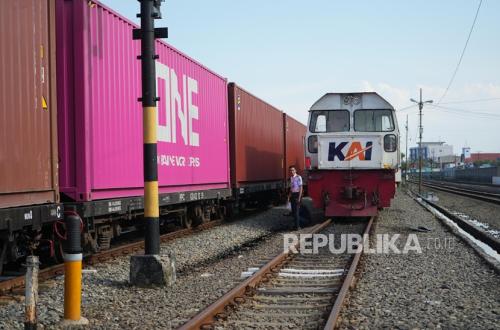
PT Kereta Api Indonesia (KAI) sees rail-based freight transport as having a considerable opportunity to help reduce national logistics costs, which remain relatively high. Strengthening logistics distribution via rail is thought to improve supply chain efficiency while strengthening the competitiveness of the domestic industry.
KAI Vice President Corporate Communications, Anne Purba, said Indonesia’s logistics costs currently range from about 15% to over 20% of GDP, while the global benchmark sits around 7-8%. Rail is increasingly chosen as a mode of goods distribution due to its large capacity, more predictable travel times, and support for logistics cost efficiency in the national supply chain.
She stated that the more efficient the distribution costs, the greater the opportunity for the domestic industry to improve the competitiveness of its products in domestic and global markets. Logistics efficiency will have a direct impact on the cost of industrial production. When goods distribution is more effective, the national supply chain will become more competitive.
KAI recorded retail freight volumes from January to April 2026 of 82,129 tonnes, up 4.86% from 78,323 tonnes in the same period last year. Compared with January–April 2024 of 66,654 tonnes, the volume grew 23.22%. Specifically in April 2026, KAI’s retail freight volume reached 21,844 tonnes, up 22.87% from April 2025’s 17,778 tonnes.
KAI says the growth indicates increasing demand from businesses for more efficient and measurable goods distribution services. To support rail-based logistics strengthening, KAI continues to increase freight capacity. Currently, KAI operates wagons with an average capacity of 50 tonnes and is in the process of increasing to 70 tonnes per wagon. With a single rake of up to 60 wagons, carrying capacity can reach 4,200 tonnes in a single trip.
In addition, KAI is strengthening the integration of logistics services with industrial estates, warehousing, and ports to ensure faster and more efficient goods distribution. According to KAI, around 60% of national logistics activity remains concentrated on Java, with logistics costs estimated at Rp2,400–Rp2,500 trillion per year. An efficiency improvement of around 30% could yield savings of up to Rp1,000 trillion.
“With a broad operational network and large carrying capacity, rail has great potential to support a more efficient, safe, and sustainable national logistics distribution,” said Anne.