
KAI to Develop Vertical Housing in Manggarai Station Area
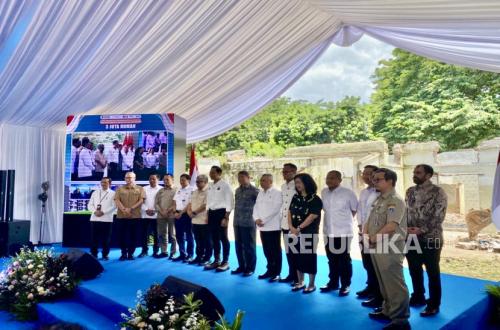
PT Kereta Api Indonesia (KAI) plans to build vertical housing in the Manggarai Station area, South Jakarta, with a total of 2,200 housing units. The project will utilise 2.2 hectares of land to support the government’s three million house construction programme.
KAI President Director Bobby Rasyidin stated that the housing will be constructed across eight towers spread across two blocks, namely Block G and Block F. Each tower is planned to have 12 storeys with two unit types: 45 square metre and 52 square metre units.
“At Manggarai Station, we will build eight towers with a total of 2,200 units,” Bobby said during the groundbreaking ceremony for the housing development at Manggarai Station, Jakarta, on Monday, 16 March 2026.
Bobby explained that the station-based housing development aims to create a more integrated urban ecosystem with public transport. The concept is expected to facilitate urban mobility whilst bringing residential areas closer to activity centres.
“Construction work will commence shortly, so by early 2027 we will already be able to hand over keys for these units,” Bobby stated.
Bobby noted that Manggarai Station is one of Jakarta’s major transport hubs, with over 770 train journeys daily. This comprises 638 commuter rail journeys and approximately 70 Soekarno-Hatta Airport commuter line journeys.
Manggarai Station will also be integrated with Jakarta LRT and Transjakarta transport systems through intermodal integration development. Throughout 2025, approximately 10.53 million passengers passed through the station.
As a transit station, Manggarai serves more than 200,000 passengers making train transfers daily.
Beyond Manggarai, housing development groundbreaking ceremonies were also held at three other station locations. At Kiaracondong Station in Bandung, 753 housing units will be built on 7,600 square metres with two towers.
Subsequently, in the area near Dr Kariadi General Hospital Station in Semarang, 1,042 housing units will be constructed on 1.2 hectares with two towers standing 42 storeys high. Meanwhile, at Gubeng Station in Surabaya, 1,489 housing units are planned on 1.2 hectares with two towers standing 52 storeys high.
Bobby stated that housing development in station areas represents KAI’s effort to utilise land assets to support transit-oriented development (TOD) based area development. KAI is recorded as owning approximately 320 million square metres of land across various regions in Indonesia with development potential.
“Housing development in station areas is part of KAI’s support for the three million house programme,” Bobby said.
According to Bobby, KAI has the potential to develop approximately 131,000 housing units based on station areas in the Jabodetabek region. This housing is expected to help people obtain residences closer to public transport, making daily mobility more efficient.
Financing for the vertical housing construction comes from various sources, including KAI internal financing, domestic loans, and support from BPI Danantara.
Coordinating Minister for Infrastructure and Regional Development Agus Harimurti Yudhoyono stated that vertical housing development in station areas is one effort to expand access to adequate housing for communities.
“This is part of the three million house construction programme, which is a major vision of President Prabowo Subianto to address the housing backlog problem, where many Indonesians still lack their own homes,” said AHY.
AHY noted that vertical housing development is also expected to help low-income communities gain access to more affordable housing in urban areas. Additionally, the housing construction sector is seen as capable of driving economic growth as it involves many supporting industrial sectors.