
KAI Only Manages 28 Per Cent of Level Crossings in the Merak-Cikampek Corridor
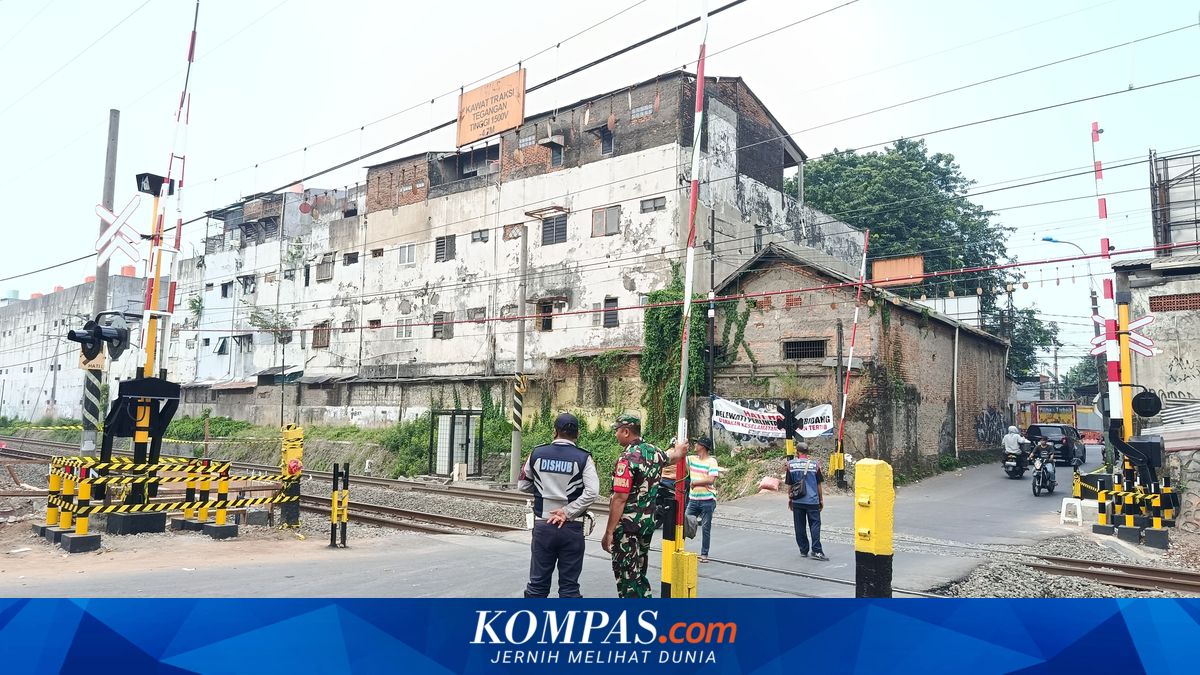
JAKARTA, KOMPAS.com – PT Kereta Api Indonesia (Persero)’s campaign to eliminate illegal level crossings in its Jakarta operational area has revealed an imbalance in institutional responsibility.
Priority is given to eliminating access roads with a width of less than 2 meters or crossings with intervals of less than 800 meters.
This radical policy has sparked massive debate, as data from stakeholders confirms that the railway operator actually only controls a small minority of all accident-prone points along the Merak-Cikampek line.
The remainder falls under the jurisdiction of local governments at 63 points (14.7 per cent), private entities at 12 points (0.03 per cent), community initiatives at 102 points (23.8 per cent), and 130 points (33.07 per cent) that are abandoned and unguarded.
Djoko Setijowarno, an academic from the Civil Engineering program at Unika Soegijapranata and also a member of the Advisory Council of the Indonesian Transportation Society (MTI), stated that this disproportionate distribution of management responsibilities reflects a failure in inter-agency coordination to mitigate transportation risks.
According to him, unilaterally closing access roads will trigger significant disruption to road traffic due to diverted vehicle flows.
The vulnerability of the Jakarta Daop 1 corridor is consistent with longitudinal research conducted by transportation researcher Dicky Arisikam in 2023.
The study proved that the probability of railway accidents is directly proportional to the frequency of train journeys, the number of switches, the existence of bridges over a century old, and the curvature of the track with an extreme radius of less than 250 meters.
Djoko emphasized that the neglect in protecting the 130 illegal points corresponds directly with fluctuations in accident rates.
The company recorded 55 incidents of vehicles colliding with trains in 2023, which decreased to 49 cases in 2024, but then accelerated again to 54 cases in 2025.
“Spatial anomalies in the form of dense residential areas encroaching on railway easements further lengthen the list of pedestrian fatalities,” added Djoko.
The fatality graph recorded 156 cases in 2023, decreased to 151 cases in 2024, and then increased drastically to 168 cases in 2025.