
Jusuf Kalla: Mosques must become centres of civilisation and community progress
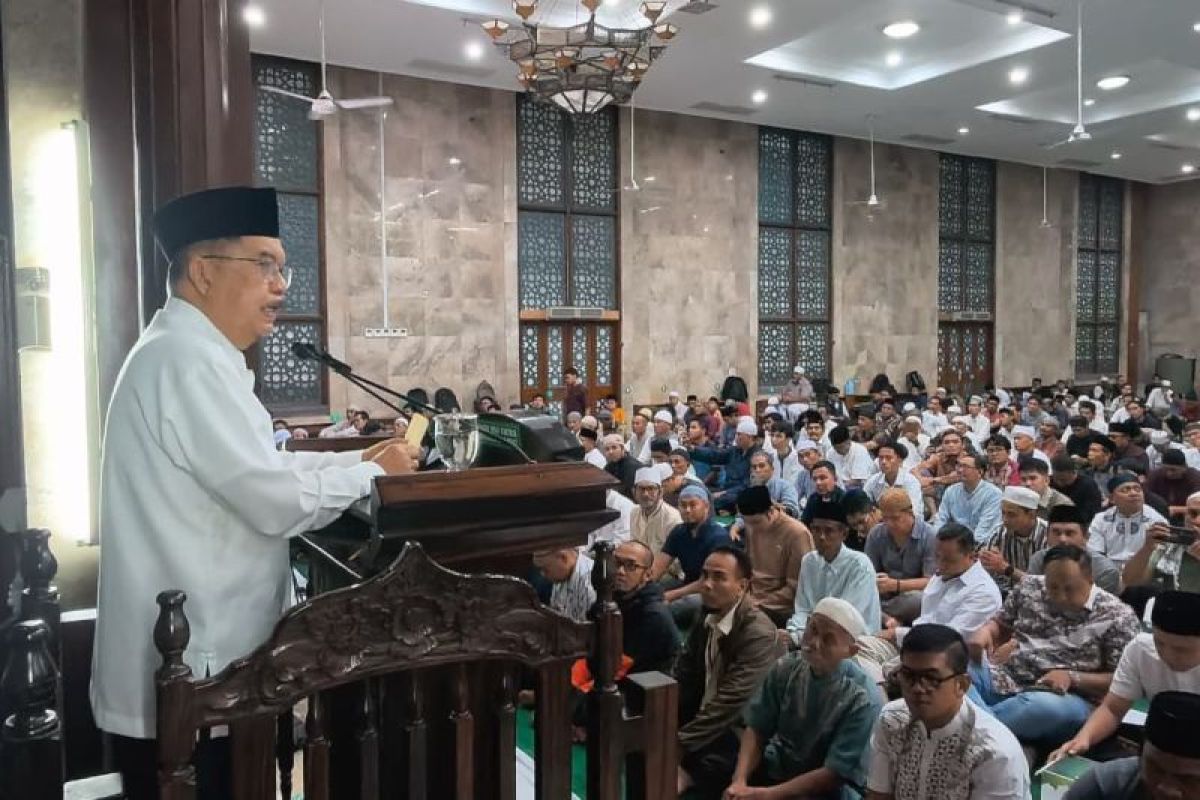
Jakarta — Jusuf Kalla, chairman of the Indonesian Mosque Council (DMI), has stated that mosques must function not only as places of worship but also as centres of Islamic civilisation.
In a statement received in Jakarta on Tuesday, Kalla noted that Indonesia is home to the world’s largest number of Muslims and mosques, with an estimated 800,000 mosques spread throughout the country.
“Mosques are, of course, first and foremost places of worship. We perform the five daily prayers, Tarawih prayers, and various other acts of worship. However, the function of a mosque extends beyond this — it is also a place of unity for the Muslim community,” said Kalla.
Speaking during a Tarawih sermon at the Sunda Kelapa Grand Mosque on Monday 9 March, Kalla highlighted the unique characteristic of mosques in bringing together Muslims from diverse organisational backgrounds and regions without division.
Beyond their role as places of worship and unity, Kalla argued that mosques must serve as centres for building civilisation. He explained that civilisation derives from the concept of “adab”, which reflects good conduct, knowledge, and faith.
“Civilisation is born from faith, knowledge, and good behaviour. Therefore, mosques must encourage the community to pursue education, develop their capabilities, and build character,” he said.
He also emphasised the importance of improving the economic capacity of the Muslim community. According to Kalla, Islam teaches believers to work hard and strive, as exemplified by the Prophet Muhammad, who spent a long period as a merchant before being appointed as a messenger.
Kalla further stressed that contemporary global progress is significantly influenced by knowledge and technology. For this reason, Muslims must strengthen their mastery of science in order not to fall behind.
He expressed hope that mosques could become places that encourage the community to unite, pursue knowledge, strengthen morality, and improve societal welfare.
“Mosques must inspire congregants towards progress, unity, knowledge, hard work, and good character. In this way, mosques will truly become centres of civilisation for the Muslim community,” said DMI Chairman Jusuf Kalla.