
Junior Secondary Academic Ability Test Participation Reaches 98%, Ministry of Basic and Secondary Education Emphasises Optional Nature
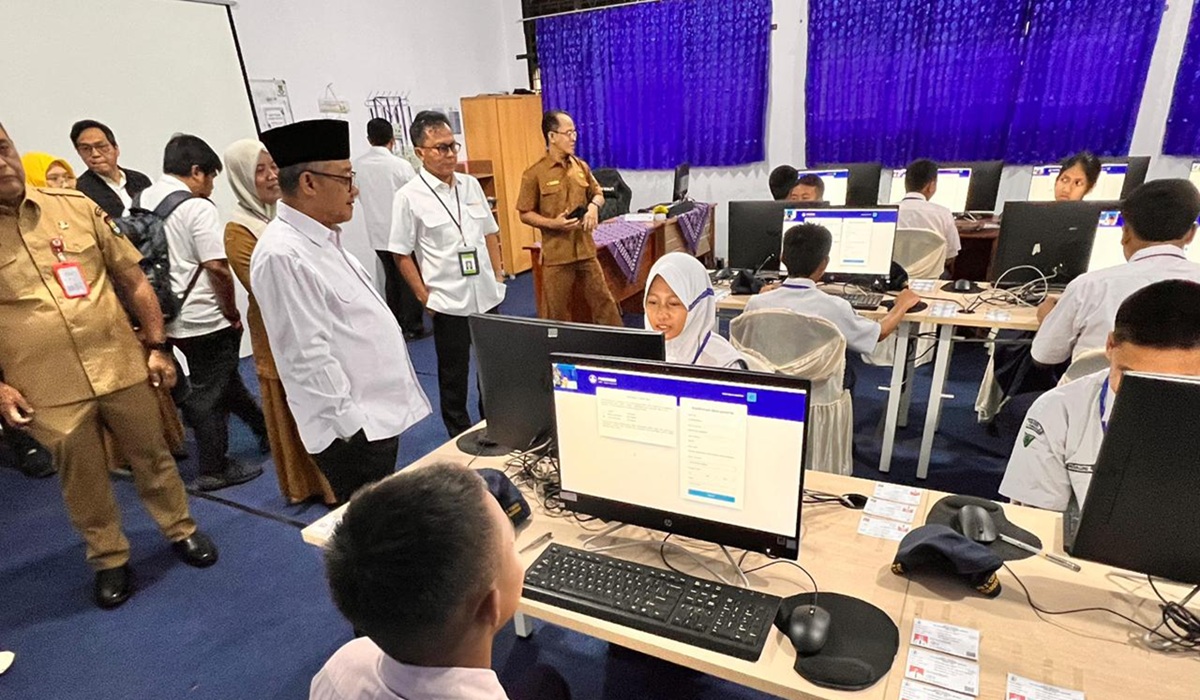
The implementation of the Academic Ability Test (TKA) for the junior secondary school (SMP) level across Indonesia has recorded a very high participation rate. The Ministry of Basic and Secondary Education (Kemendikdasmen) reported that 98% of the total junior secondary school student population participated in the exam.
The Head of the Education Standards, Curriculum, and Assessment Agency (BSKAP), Toni Toharudin, stated that this achievement has exceeded the initial target. He conveyed this during an inspection of the exam’s implementation at SMP Negeri 2 Curug, Tangerang Regency, on Monday (6/4).
“Essentially, 98% of the population. In line with the target, and I think it exceeds the target because it’s approaching the full population measure,” Toni told the media.
Regarding the remaining 2% of students who did not take the TKA, Toni explained that they have not yet identified in detail the schools or regions of those students. However, he emphasised that according to regulations, the TKA is indeed optional or not mandatory.
“We haven’t detected whether they are from public or private schools. But that 2% is in accordance with our regulations, which are optional. So it doesn’t have to be 100% because it’s not compulsory. There is also the possibility of intellectual barriers for students that prevent them from participating,” he added.
To ensure technical smoothness, Kemendikdasmen has collaborated with PLN and telecommunications providers such as Telkom and Telkomsel to anticipate disruptions in electricity or internet networks. As of the time this news was published, no significant obstacles have been reported in the field, except in cases of natural disasters (force majeure).
The Minister of Basic and Secondary Education, Abdul Mu’ti, who was also present during the visit, added that psychological factors and parental perspectives are the main reasons why some students choose not to take the TKA.
“There are findings in the field that some students feel psychologically unprepared. Additionally, there are parents who believe the TKA is not yet necessary because there are other things considered more important for their children,” Abdul Mu’ti explained.
He reaffirmed that the government remains committed to the principle of freedom of choice for students.
“Everything is a choice. We still adhere to the principle that the TKA is not mandatory. Those who participate are those who are truly ready. For example, at the school we visited today (SMPN 2 Curug), participation reached 100%,” he concluded.
The TKA is important as an instrument to more comprehensively view students’ learning achievements, especially at the junior secondary level, which is a crucial phase in the learning process.