
JSX Unexpectedly Closes Flat After Weakening Throughout the Day
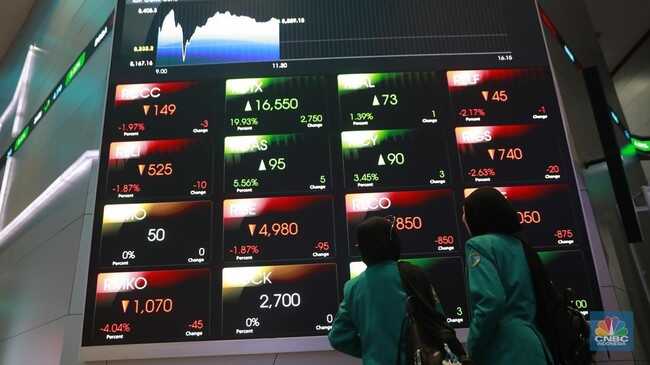
Jakarta — The Indonesian Composite Index (IHSG) unexpectedly closed flat on Friday 27 February 2026, after being under pressure throughout the trading day.
The IHSG, which had fallen 1.47% at its intraday low, managed to pare losses significantly and closed modestly higher. At the end of the second session, the IHSG closed flat or up 0.22 points at 8,235.48.
From a liquidity perspective, transaction value reached Rp38.25 trillion with a volume of 47.64 billion shares across 2.53 million transactions. A total of 315 shares declined, 341 shares advanced, whilst 163 remained flat.
According to Refinitiv data, the IHSG’s suboptimal performance today was primarily driven by corrections in large-capitalisation stocks (big caps) that carry significant weightings in the index.
The following 10 major stocks were the primary drags on the index, based on their contribution to the index point decline:
Dian Swastatika Sentosa (DSSA): -14.42 points
Bank Central Asia (BBCA): -11.84 points
Telkom Indonesia (TLKM): -11.57 points
Bank Rakyat Indonesia (BBRI): -6.26 points
United Tractors (UNTR): -4.31 points
Chandra Asri Pacific (TPIA): -5.19 points
Bank Mandiri (BMRI): -3.88 points
Indofood Sukses Makmur (INDF): -2.52 points
Bank Mega (MEGA): -2.33 points
Astra International (ASII): -2.05 points
The largest pressure came from energy and conglomerate stocks (BREN, DSSA, TPIA) and major banking stocks (BBCA and BBRI), which carry significant weightings in the index structure.
In Friday’s trading, the market is poised to move sideways with potential weakness. The correction room has opened following Thursday’s trading when market participants began profit-taking activities.
From a technical perspective, the IHSG’s weakness on Thursday has made signals of continued correction increasingly apparent. This is evident through the formation of a bearish rising wedge pattern — a price rising pattern occurring within an increasingly narrow trading range. This pattern is often interpreted as a sign that the rally is losing momentum and is vulnerable to reversal.
The pattern emerged after the IHSG plummeted in late January, then gradually climbed. However, the index failed several times to break through the psychological level of 8,400. The failure to advance in that area led to the formation of the wedge, which theoretically often culminates in a downward breakout and triggers further correction.
If this bearish rising wedge scenario is confirmed, the IHSG could potentially test support areas in the range of 7,900 to 7,800, or open room for a decline of approximately 4%.