
Journalists' Association Appreciates Constitutional Court Ruling on Anti-Corruption Law
The Journalists’ Association (Iwakum) has commended the Constitutional Court’s (MK) decision to partially grant a judicial review of Article 21 of the Anti-Corruption Law (UU Tipikor) concerning the obstruction of justice provision. In its ruling, the Constitutional Court affirmed that the dissemination of information, news reporting, journalistic investigation, public discussion, and academic opinion cannot be prosecuted as obstruction of legal process.
Iwakum Chairman Irfan Kamil stated that the ruling provides legal certainty and constitutional protection for journalistic work and freedom of expression. “This Constitutional Court decision is highly significant because it draws a clear distinction between actions that genuinely obstruct legal process and legitimate journalistic activities, public discussion, and academic opinion. Press work should not be perceived as obstruction of justice,” Kamil said in a written statement on Monday, 2 March 2026.
According to Kamil, the obstruction of justice provision has historically been interpreted too broadly, creating potential for criminalising journalists, academics, and civil society members disseminating factual information in the public interest. “The Constitutional Court sends a strong message that law enforcement cannot be conducted by silencing public discourse. Information, criticism, and investigation are in fact part of democratic control,” he added.
Iwakum Secretary-General Ponco Sulaksono emphasised that the Constitutional Court’s ruling must serve as a guideline for law enforcement officials in handling cases, particularly corruption cases that attract widespread public attention. “We hope this Constitutional Court decision is understood and applied consistently by investigators, prosecutors, and judges. There should be no further attempts to bring journalistic work or academic discourse into the criminal sphere under the guise of obstruction of legal process,” Ponco stated.
Ponco further noted that the ruling not only strengthens press freedom but also supports transparency and accountability in anti-corruption efforts. “Investigative journalism and public information disclosure actually help ensure legal processes operate objectively and with integrity,” he said.
The Constitutional Court partially granted a petition challenging Article 21 of the Anti-Corruption Law filed by advocate Hermawanto. In his petition, he questioned the phrase “directly or indirectly” in the obstruction of investigation provision, arguing it violated the right to legal certainty and the principle of the rule of law by creating space for excessive criminalisation. He contended the provision could hinder freedom of expression and deviate from the spirit of the UN Convention Against Corruption.
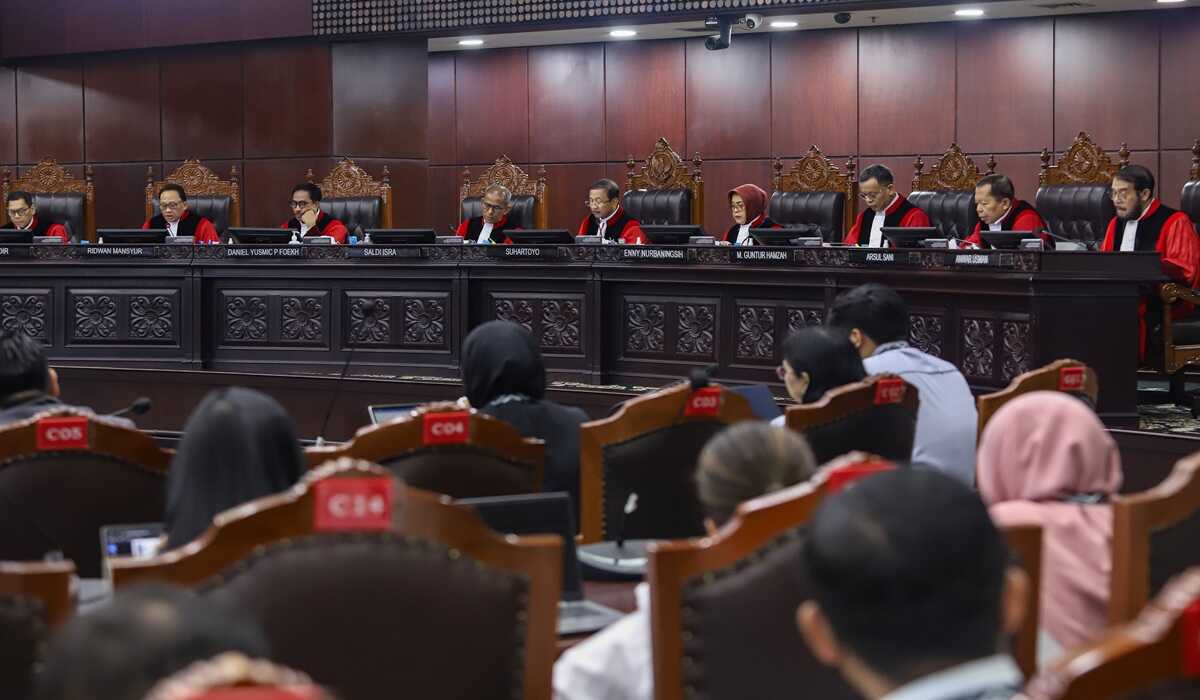
Constitutional Court Chief Suhartoyo announced the decision, declaring: “The Court grants the petitioner’s petition in part” when reading Decision No. 71/PUU-XXIII/2025 at the Constitutional Court building in Jakarta on Monday, 2 March.
In its reasoning, the Constitutional Court removed the phrase “directly or indirectly” from the Anti-Corruption Law, determining it could create legal uncertainty and excessive criminalisation. Constitutional Judge Arsul Sani explained that the phrase could lead to broad interpretation of conduct within lawful bounds.
“For instance, journalistic activity conducting investigations into an ongoing case with the purpose of providing information to the public, or the writing of academic opinion in print or electronic media carried out within lawful boundaries, could potentially fall under indirect obstruction of justice,” Arsul explained during proceedings.
According to him, the phrase had blurred the boundary between lawful conduct within the scope of freedom of expression and unlawful conduct. The Constitutional Court affirmed that journalists cannot be directly sued in civil or criminal proceedings for their journalistic work, provided it constitutes a journalistic product.