
Journalist Community Transforms Social Criticism into Theatre for Bali Language Month
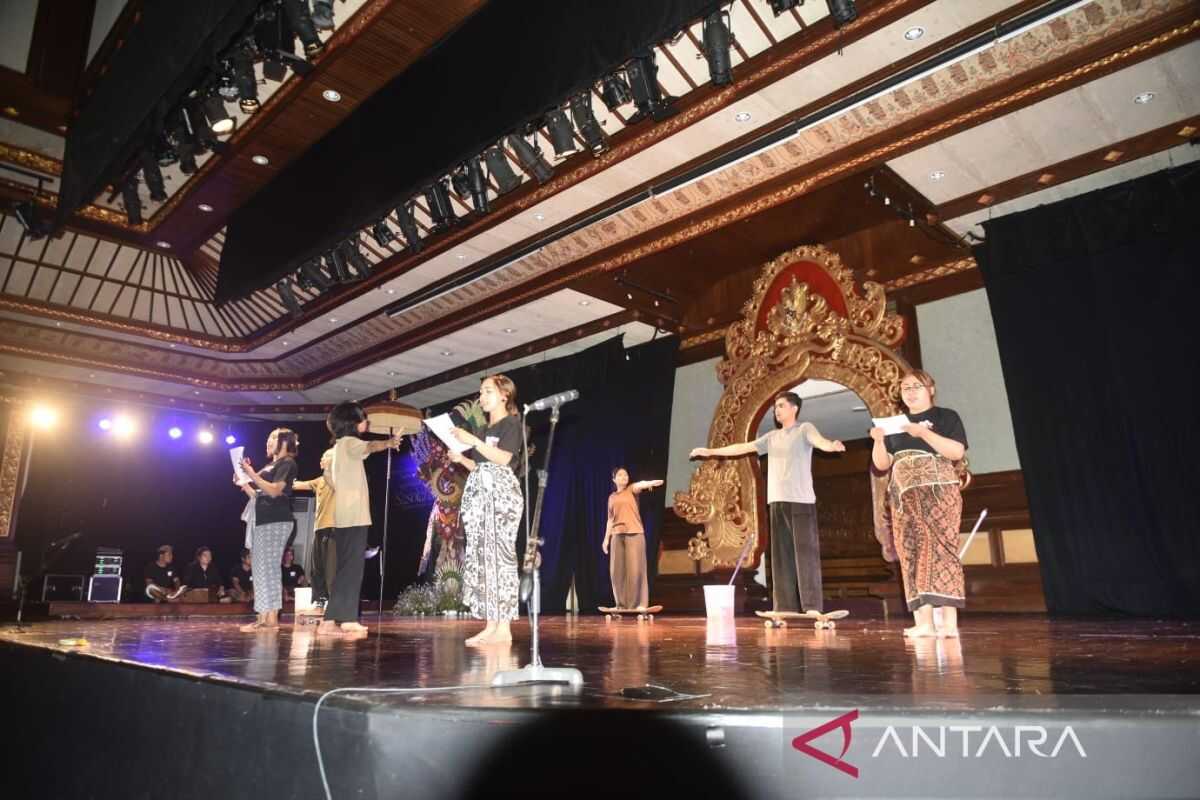
Denpasar (ANTARA) - The Bali Journalist and Cultural Writers Community (Kawiya) has transformed social criticism of current conditions in Bali into a modern theatre performance as part of the 2026 Bali Language Month celebrations.
“We linked today’s social conditions with the Bali Language Month theme of Atma Kerthi by drawing on the mythology of Jaratkaru, a legendary figure who was asked to marry in order to save his ancestors, who were left hanging because they had no descendants,” said Kawiya Bali chairman I Putu Suryadi.
Speaking in Denpasar on Monday, Suryadi explained that when applied to present-day conditions, the figure of Jaratkaru conveys a message about debts that humans must repay to save their ancestors.
These debts leave a social imprint that ultimately shapes the lives of subsequent generations today—a recurring responsibility that must be borne, compounded by the burden of survival.
Journalists and media workers who daily document phenomena in society have identified connections between Bali’s current conditions—such as economic hardship, traffic congestion, land-use conversion, waste problems, and flooding—and the debts that the younger generation inevitably inherits.
The Bali Language Month stage, which provides space for cultural and artistic activities, was thus transformed into a platform for social criticism that proved to have deep links with Balinese mythology.
Suryadi said Kawiya Bali presented four actors who danced and voiced the grievances of the younger generation navigating life today, interwoven with narrations of the Jaratkaru tale.
During the performance, over a dozen journalists appeared in succession, reading Balinese-language news reports about social realities on the Island of the Gods whilst walking around the Ksirarnawa Building at the Bali Cultural Centre.
“This was to draw the audience into the story, to make them aware that all these conditions are real and have been documented by our colleagues in the media,” Suryadi said.
Bali Governor’s companion Wayan Koster, known as Putri Koster, regarded the delivery of social criticism through an artistic performance wrapped in field-reported news as an innovative and more modern method.
“I found it extraordinary—the interplay between theory and stage ability. The concept was clear to me. This encourages us not to be afraid of voicing protest, as long as it is ethical. If it’s about traffic congestion, lay it out, make noise on stage, cut as sharp as a razor blade,” she said.
Putri Koster assessed that going forward, the younger generation would be further motivated to critique the government in a constructive manner, supported by enlightening journalistic works.