
JK: World Peace Requires Justice and Mastery of Technology
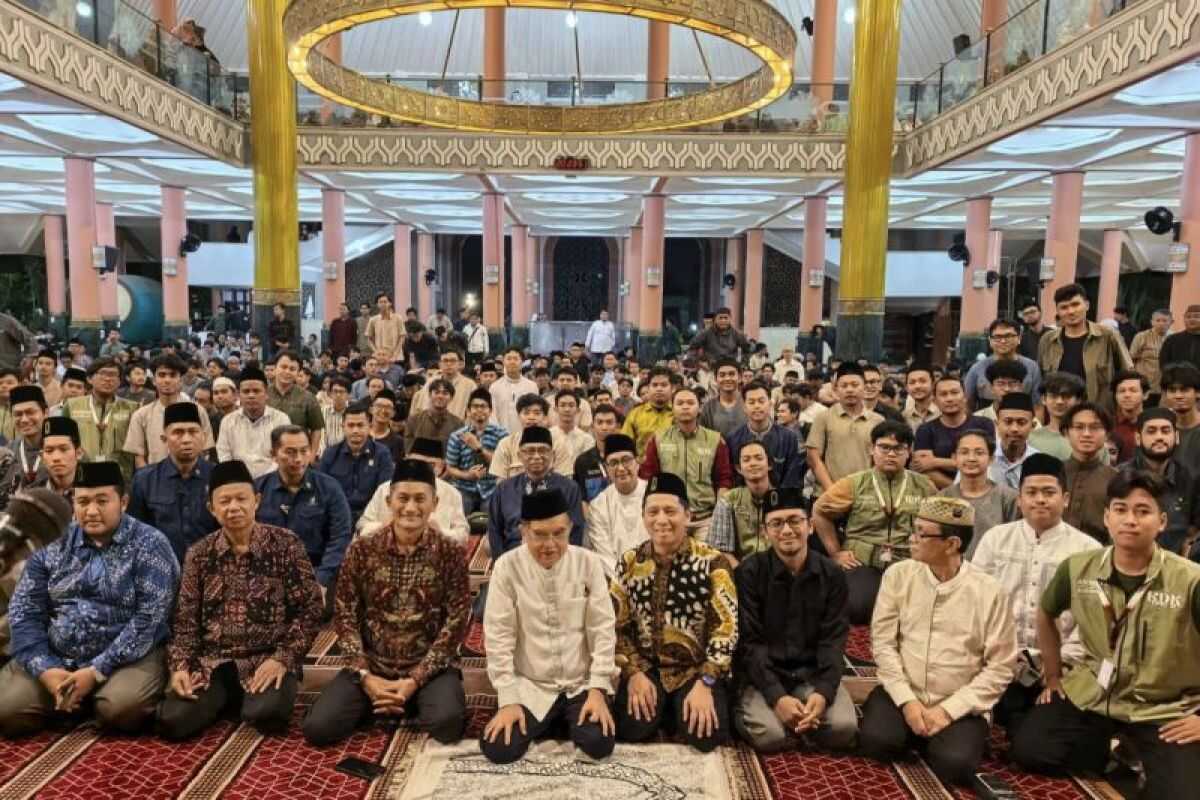
“Rasulullah mengatakan bahwa amal yang lebih tinggi daripada salat dan puasa adalah mendamaikan orang yang berselisih,”
Jakarta (ANTARA) - The 10th and 12th Vice President of Indonesia Jusuf Kalla (JK) said efforts to achieve peace, thereby creating world peace, must be based on justice and supported by mastery of science and technology.
Kalla cites the hadith of Prophet Muhammad (SAW) that reconciling parties in dispute is a greater deed than prayer and optional fasting. This underscores the importance of peace in human life.
“Prophet Muhammad said that the act higher than prayer and fasting is to reconcile those who are in dispute,” he said during Tarawih sermons at the Campus Mosque of Gadjah Mada University, Yogyakarta, Thursday night (5/3), as reported in Jakarta on Friday.
Kalla explained that conflicts generally arise from various factors, including injustice, political and social issues, territorial disputes, ideology, religion, and competition for natural resources.
He regards injustice as the biggest cause of conflicts, including in Indonesia. In Indonesian history there have been at least 15 major conflicts, most of which were sparked by injustice perceived by the public against government policies.
“From about 15 major conflicts in Indonesia, nine of them occurred because of injustice,” he said.
Kalla also highlighted global conflicts currently taking place in Muslim-majority countries. According to him, the situation is ironic because Islamic teachings emphasise the importance of peace.
Additionally, he touched on the dynamics of international conflict, including between Iran and the United States-Israel. Modern warfare is no longer determined by the number of troops, but by mastery of military technology such as rockets, drones, and advanced weapon systems.
“War today is no longer about how many soldiers there are, but who controls technology,” he said.
Therefore, Kalla stressed the importance of developing science and technology within the higher education environment. Universities have a strategic role in creating innovations that can strengthen the nation’s progress.
He also referred to Indonesia’s role in maintaining world peace, as stated in the opening of the constitution that Indonesia participates in maintaining world order based on independence, eternal peace, and social justice.
According to Kalla, Indonesia has long contributed to peace diplomacy, one example being the idea of the first Indonesian President Soekarno who proposed the 1955 Bandung Conference.
On that occasion, Kalla shared his experiences in resolving conflicts in Indonesia, including the Ambon conflict which was halted through peace negotiations later known as the Malino Agreement.
He said that dialogue, courage, and a correct understanding of religion are the keys to stopping violence between conflicting groups. “Conflicts can be stopped if we understand their root causes and are willing to sit down together to find solutions,” he said.
Through the sermon, Kalla urged society, especially academics and students, to play an active role in creating peace and in developing science for the progress of the nation.