
JCI Weakens as Investors Engage in Profit-Taking After Week of Rally
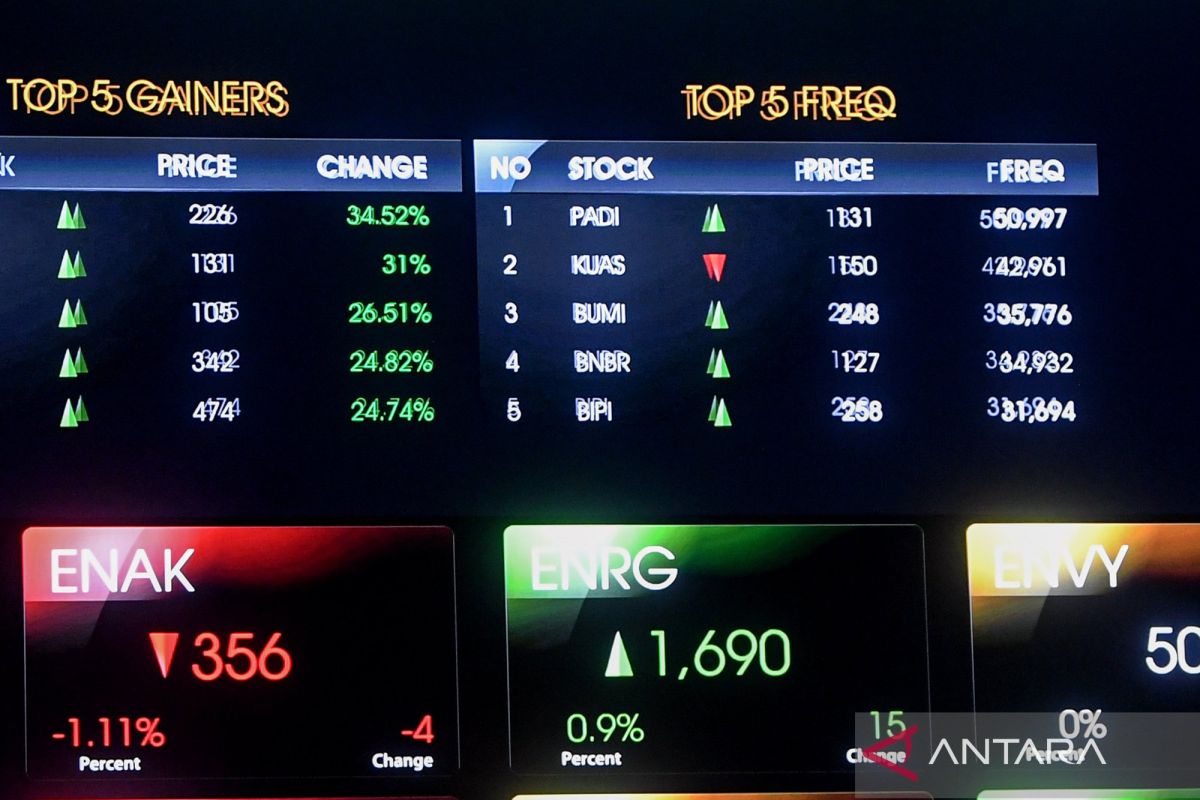
Jakarta (ANTARA) - The Jakarta Composite Index (JCI) of the Indonesia Stock Exchange (BEI) closed weaker on Wednesday afternoon, in line with profit-taking actions by market participants after the index experienced a rally (consecutive gains) over the past week or so.
The JCI closed down 52.36 points or 0.68% at 7,623.59. Meanwhile, the LQ45 index of 45 leading stocks fell 4.37 points or 0.57% to 759.95.
“The weakening of the JCI was partly due to profit-taking after experiencing a rally over the past week,” said Head of Research at Phintraco Sekuritas, Ratna Lim, in her analysis in Jakarta on Wednesday.
From abroad, Ratna said the US blockade of the Strait of Hormuz is increasing pressure on China and India.
With around 98% of Iran’s oil exports heading to China, and ahead of the meeting between US President Donald Trump and Chinese President Xi Jinping, this raises risks to the fragile peaceful relations between the US and China.
On the other hand, US-India relations are also becoming more complex, as the US policy conflicts with India’s economic interests amid its ongoing energy crisis.
Previously, Trump was scheduled to visit China in mid-May 2026, so the US wants sufficiently stable bilateral relations for the meeting to proceed as planned.
However, with the Strait of Hormuz blockade and US tariff threats, this increases the risk of the meeting’s failure.
Domestically, S&P Global Ratings stated that Indonesia’s sovereign debt rating is most vulnerable to prolonged conflicts in the Middle East region.
S&P projects that rising energy costs due to the conflict will increase Indonesia’s subsidy expenses and pressure the state budget. More expensive oil imports will widen the current account deficit.
Additionally, S&P assesses that accelerated inflation will drive interest rate hikes, which could increase the government’s borrowing costs in Indonesia.
The JCI opened higher and stayed in positive territory until the close of the first trading session. In the second session, the JCI moved into negative territory until the close of trading.
Based on the IDX-IC Sectoral Index, five sectors strengthened, led by the transportation and logistics sector which rose 3.27%, followed by the industrial sector and the technology sector, up 1.75% and 0.44% respectively.
Meanwhile, six sectors declined, with the infrastructure sector falling the most at 1.13%, followed by the non-primary consumer goods sector and the basic materials sector, down 0.95% and 0.54% respectively.
The stocks with the largest gains were SDMU, BIPP, DEFI, PSDN, and ASHA. The stocks with the largest declines were KONI, MSIN, SRAJ, BAPA, and ARKO.
Share trading frequency was recorded at 3,164,258 transactions, with 51.41 billion shares traded worth Rp22.59 trillion. 380 stocks rose, 292 fell, and 149 were unchanged.
Regional Asian stock markets on Wednesday evening included the Nikkei index up 350.61 points or 0.61% to 58,228.00, the Shanghai index up 0.58 points or 0.01% to 4,027.21, the Hang Seng up 75.00 points or 0.29% to 25,947.32, and the Straits Times up 11.08 points or 0.22% to 5,018.65.