
JCI Weakens Amid Wait-and-See Over Trump's Speech on US-Iran Conflict
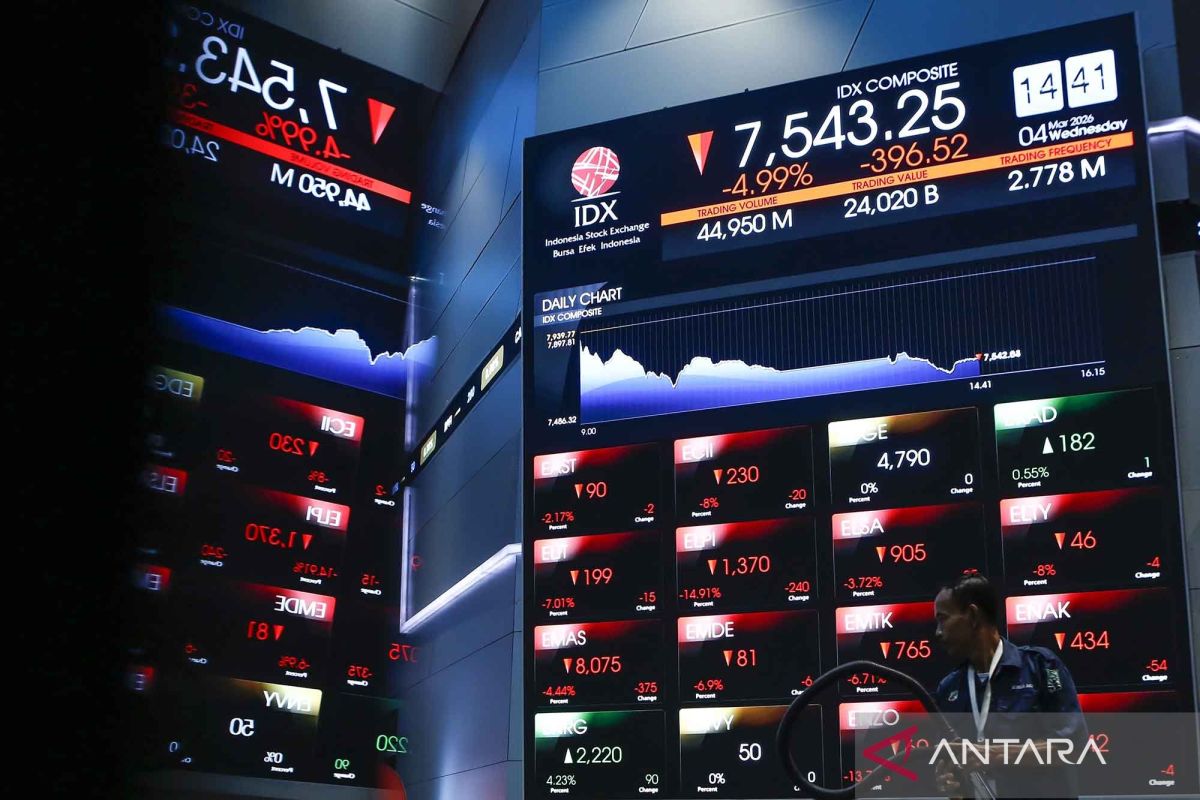
The market’s focus is now on President Trump’s official speech, which could serve as a catalyst for the next market direction.
Jakarta (ANTARA) - The Composite Stock Price Index (JCI) of the Indonesia Stock Exchange (BEI) moved lower on Thursday morning amid market participants adopting a wait-and-see approach towards US President Donald Trump’s national speech on Thursday (02/04) US time, regarding developments in the conflict between the US and Iran.
The JCI opened 31.33 points or 0.44% lower at 7,153.11. Meanwhile, the LQ45 index of 45 leading stocks fell 1.32 points or 0.18% to 725.47.
“The market’s focus is now on Trump’s official speech, which has the potential to become a catalyst for the next market direction,” said Head of Research at Kiwoom Sekuritas Indonesia, Liza Camelia Suryanata, in her analysis in Jakarta on Thursday.
From abroad, Liza said global sentiment is shifting from escalation to de-escalation, with the US stating that its main objectives against Iran have been achieved and opening the possibility of an exit in 2-3 weeks without the need for a formal agreement.
On the other hand, there are reports that Iranian President Masoud Pezeshkian is open to ending the conflict, with several conditions such as recognition of Iran’s rights, payment of compensation, and international guarantees against future aggression.
Nevertheless, uncertainty remains high due to the inconsistent direction of US policy, particularly regarding the status of the Strait of Hormuz, further military options, and the potential involvement of allies.
Meanwhile, crude oil prices are still above $100 per barrel amid optimism over de-escalation.
The Strait of Hormuz, which supplies around 20% of global oil, remains closed and tanker traffic is very limited.
From domestic economic data, Indonesia’s February 2026 trade balance recorded a surplus of $1.28 billion, with export growth slowing to 1.01% (year-on-year) and imports still growing high at 10.85% (year-on-year), reflecting solid domestic demand despite weakening external momentum.
Meanwhile, March 2026 inflation fell significantly to 3.48% (year-on-year) and 0.41% (month-to-month), both below expectations, with core inflation easing to 2.52% (year-on-year).
The decline in inflation was mainly driven by the normalisation of food prices, clothing, and base effects on housing and utilities, although there was limited growth in transportation and services sectors.
On Wednesday (01/04) trading, European stock markets broadly strengthened, including the Euro Stoxx 50 up 3.05%, the UK FTSE 100 up 1.85%, the German DAX up 2.73%, and the French CAC 40 up 2.10%.
The US Wall Street markets also broadly strengthened on Wednesday (01/04) trading, including the Dow Jones Industrial Average up 0.5% to 46,565.86, the S&P 500 up 0.7% to 6,573.89, and the Nasdaq Composite up 1.2% to 21,840.95.
Regional Asian stock markets this morning included the Nikkei down 991.68 points or 1.85% to 52,748.00, the Shanghai index down 9.61 points or 0.24% to 3,938.94, the Hang Seng down 257.53 points or 1.01% to 25,036.50, and the Straits Times down 14.32 points or 0.29% to 4,961.51.