
JCI Under Pressure from Middle East Sentiment, Investors Opt to Stay in Safe-Haven Assets
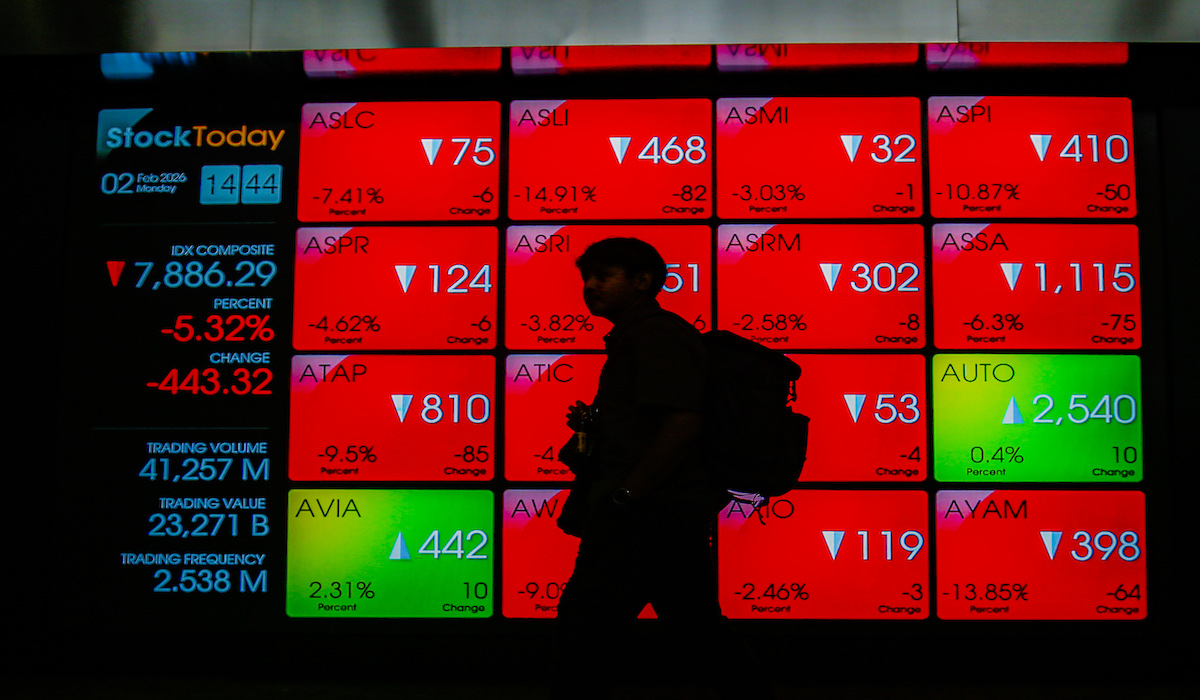
Geopolitical pressure is once again hitting global financial markets. The Composite Stock Price Index (JCI) closed sharply down in Thursday’s trading, dragged by the weakness in most Asian exchanges amid uncertainty over the direction of negotiations between the United States and Iran.
The JCI today plunged 138.03 points or 1.89% to the level of 7,164.09. In line, the LQ45 index, which contains blue-chip stocks, also corrected by 1.97% to 731.73.
This weakness did not stand alone. The surge in tensions in the Middle East, involving the US, Iran, and Israel, has driven oil prices up significantly, triggering new concerns over global inflation. This situation could delay interest rate easing by major central banks worldwide.
Capital market observer Elandry Pratama assesses that the market is now moving in a highly cautious mode.
“The rise in energy prices due to the conflict increases inflation risks, making expectations for interest rate cuts increasingly uncertain,” he said, quoted from Antara on Thursday (26/3).
Uncertainty over the conflict’s direction also amplifies risks of global energy supply disruptions. As a result, market players tend to hold positions while awaiting certainty, either from diplomatic channels or potential further escalation.
At the same time, investor attention remains focused on Federal Reserve policies, particularly regarding inflation trends and the timing of rate cuts. This combination of geopolitical and monetary factors has led global investors to adopt a defensive stance.
Foreign investor selling actions continue. There is also a shift in fund allocation from growth stocks to sectors more resilient to pressure, such as commodities and defensive sectors.
“Global fund flows are starting to move to safe-haven assets like the US dollar and energy. This adds further pressure on emerging markets, including Indonesia,” said Elandry.
From the domestic side, the pressure is exacerbated by the weakening rupiah and concerns over increasing fiscal burdens due to high energy prices.
Throughout the day, the JCI failed to exit the red zone. It opened stronger but quickly reversed direction and continued to weaken until the close of the second session.
In sectoral terms, only the transportation and logistics sector managed to stay in the green with a 2.68% gain. Meanwhile, the energy sector recorded the deepest decline of 2.67%, followed by the industrial and basic materials sectors.
At the stock level, the biggest gains were posted by AYLS, KUAS, TALF, SSTM, and SOTS. Conversely, DEFI, ROCK, INDS, ICON, and ARTA became the main market drags.
Trading activity was quite busy, with frequency reaching 1.72 million transactions. A total of 31.14 billion shares changed hands with a transaction value of Rp32.34 trillion. Of all stocks traded, 292 strengthened, 380 weakened, and 148 were stagnant.
Negative sentiment also enveloped the Asian region. The Nikkei, Shanghai, Hang Seng, and Straits Times indices closed in the red, reflecting widening global concerns.
With the current conditions, the market appears likely to remain volatile, awaiting clarity on the direction of geopolitical conflicts and global monetary policies.