
JCI Today Falls 0.94%, Leaving the 7,100 Level
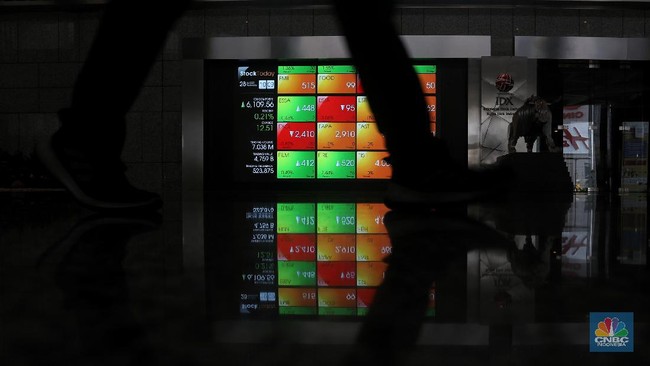
Jakarta, CNBC Indonesia — The Composite Stock Price Index (JCI) lacked momentum in today’s trading session on Friday (27/3/2027). The JCI even slipped by more than 1% during the morning session.
At the close of trading, the JCI ended down 67.03 points or -0.94% at the level of 7,097.06. A total of 396 stocks declined, 292 rose, and 270 remained unchanged.
Today’s stock trading was notably sluggish, with a total transaction value of only Rp 11.64 trillion. A total of 18.83 billion shares changed hands in 1.38 million transactions. Market capitalisation fell to Rp 12,516 trillion.
In today’s trading, investors focused heavily on selling shares of Bank Central Asia (BBCA). Shares of the Djarum Group issuer recorded the largest total buy and sell transactions, amounting to Rp 4.14 trillion or nearly 36% of the total trading volume.
Along with this selling activity, BBCA shares fell 2.55% to the level of 6,700. This was accompanied by foreign investor selling, which booked a net sell of Rp 609 billion in BBCA shares. Citing Refinitiv, BBCA became the main drag on the JCI with a weight of -16.58 index points.
In addition to BBCA, several other large-cap stocks also served as the primary burdens on the JCI. Telkom (TLKM) and Bank Rakyat Indonesia (BBRI) pulled the JCI down by -12.62 index points and -11 index points, respectively.
The JCI’s morning movement aligned with some regional markets. However, after an initial slump, several Asian bourses reduced their corrections and even managed to enter positive territory.
Japan’s Nikkei index fell 0.43%, and Taiwan’s bourse declined 0.68% after earlier dropping more than 1%. South Korea’s Kospi fell 0.4%, following a morning plunge of 3.25%. However, Hong Kong’s Hang Seng rose 0.38%, Singapore’s STI gained 0.24%, and China’s Shenzhen index rose 1.13%.
Today’s market turbulence is overshadowed by the unclear discourse on a ceasefire between the US-Israel and Iran. The optimism that emerged on Wednesday has begun to fade.
Market participants are now more focused on observing the real impacts spreading to policies of stakeholders, industries, and the real economy in various countries, especially following the blockade of the Strait of Hormuz.
Citing CNBC.com, Trump decided to extend the deadline for the attack by 10 days until 6 April to allow room for negotiations. This decision was reportedly taken at the request of the Islamic Republic of Iran’s government as part of efforts to ease tensions.
Trump stated that the extension was granted in exchange for 10 oil tankers crossing the Strait of Hormuz as a “gift” from Tehran. He also emphasised via a post on Truth Social that the delay aims to open opportunities for a diplomatic resolution.
In his statement, Trump said discussions are ongoing and proceeding very well, despite differing reports from the media. Nevertheless, Washington has stated its desire to end the conflict through negotiations, while Tehran denies any direct talks with the United States.
Along with this, oil prices strengthened again. The West Texas Intermediate contract rose to US$96.41, while Brent crude oil stood at US$110.21 per barrel this afternoon.