
JCI Surges 2.14% to 7,660, Supported by Blue-Chip Stocks and Conglomerates
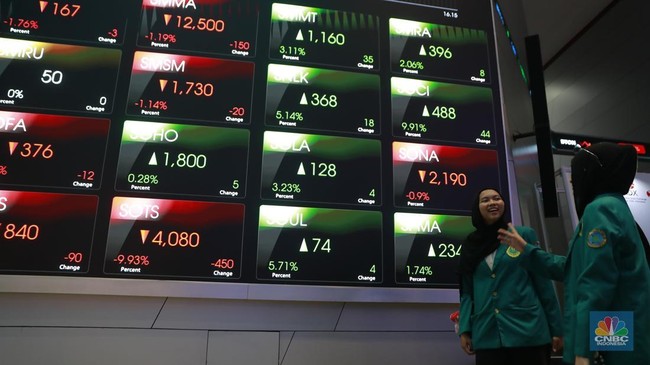
Jakarta, CNBC Indonesia - The Composite Stock Price Index (JCI) surged 2.14% or 160.57 points to 7,660.75 at the close of the morning trading session today, Tuesday (14/4/2026).
513 stocks rose, 131 fell, and 173 remained unchanged. The morning trading value reached Rp 13.60 trillion, involving 28.67 billion shares in 1.85 million transactions. Market capitalisation also rose to Rp 13,670 trillion.
Nearly all trading sectors strengthened, with the largest gains recorded in the infrastructure and basic materials sectors, while only non-primary consumer goods weakened today.
Conglomerate issuers and fundamentally strong blue-chip stocks collectively posted significant gains today. The main drivers of the JCI’s performance today were DSSA, MORA, BBRI, BRPT, BBCA, BREN, AMMN, and BMRI.
Meanwhile, today’s global financial and commodity market movements were coloured by various major macroeconomic data releases from the Asian region, such as China’s trade balance and US PPI, as well as escalating geopolitical dynamics due to the failure to find a middle ground in Iran-US war negotiations.
The United States military began imposing a blockade on ships leaving Iranian ports on Monday, while Tehran threatened retaliation against the ports of its neighbouring countries in the Gulf region after weekend talks in Islamabad to end the war failed.
A US official said communication with Iran is still ongoing, and there is progress in efforts to reach an agreement. Pakistani Prime Minister Shehbaz Sharif also stated that efforts to resolve the conflict are still underway.
However, oil prices rose again, breaking through US$100 per barrel, with no signs of a quick reopening of the Strait of Hormuz to ease the largest-ever supply disruption, as well as growing concerns over the resilience of the two-week ceasefire achieved last week.
Trump said Iran contacted the US on Monday and wants to reach an agreement, but he will not approve any deal that allows Tehran to possess nuclear weapons.
“Iran will not have nuclear weapons. We cannot allow a country to blackmail or threaten the world,” Trump said, quoted from Reuters.
Since the United States and Israel started the war on 28 February, Iran has effectively closed the Strait of Hormuz to all ships except its own, stating that shipping is only permitted under Iranian control and with the payment of certain fees.
Trump said Washington will block Iranian ships and any ships paying those fees, and Iranian “fast attack” boats approaching the blockade will be destroyed.
Brigadier General Reza Talaei-Nik, spokesman for Iran’s Ministry of Defence, warned that foreign military efforts to monitor the strait would exacerbate the crisis and instability in global energy security.
NATO allies including the UK and France said they would not be drawn into the conflict by participating in the blockade. Instead, they emphasised the importance of reopening the sea route, which normally carries about one-fifth of the world’s oil supply.
The escalation of the conflict between the United States, Israel, and Iran is putting pressure on the global economy, spilling over to Indonesia through three main channels.
First is the financial channel, where uncertainty triggers risk-off sentiment. Foreign capital moves out of emerging markets towards safe-haven assets in the US, which automatically strengthens the US dollar index (DXY) and pressures the rupiah exchange rate.
Second is the commodity channel; potential shipping disruptions in the Strait of Hormuz raise global crude oil prices. However, this provides indirect compensation for Indonesia through rises in prices of key export commodities such as coal, CPO, nickel, and gold.
Third is the trade channel; disruptions to supply chains and maritime logistics could trigger global stagflation, a condition of slowing economic growth accompanied by surging inflation.
Amid these pressures, domestic economic fundamentals are deemed to remain solid. Inflation, which spiked at the start of the year due to the low base effect from the removal of electricity subsidies, is now easing and within Bank Indonesia’s target of 2.5% ± 1%.
The government’s decision not to raise subsidised fuel prices is also seen as crucial to maintaining purchasing power while stabilising the rupiah. With still expansive production indicators, Q1 2026 economic growth is expected to reach 5.2%.
As a mitigation response, Bank Indonesia is preparing 24-hour market monitoring by optimising representative offices in London and New York, as well as conducting measured liquidity interventions in the spot market, global Non-Deliverable Forward (NDF), and Domestic NDF (DNDF).