
JCI Suffers Blows from All Sides, Closes Down 3.38%!
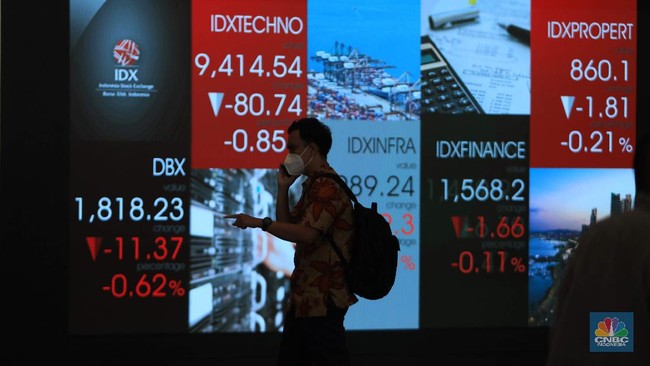
Jakarta, CNBC Indonesia — The Composite Stock Price Index (JCI) collapsed today, Friday (24/4/2026). The index closed down 3.38% or -249.49 points at the level of 7,129.49.
Throughout the day, the JCI moved in the red zone and briefly touched the green zone with a range of 7,115.97–7,383.4.
The majority or 701 stocks declined. Only 92 rose and the remaining 166 were unchanged. Today’s trading value was quite brisk, reaching Rp 24.3 trillion, involving 44.8 billion shares in 2.66 million transactions. Market capitalisation also plunged to Rp 12,736 trillion.
The JCI’s thick correction today was accompanied by foreign selling action. Total foreign buying reached Rp 3 trillion and sales reached Rp 5 trillion, resulting in net foreign sales of Rp 2 trillion.
The very strong selling pressure from foreign investors mainly occurred on big cap stocks. The biggest selling pressure was on PT Bank Central Asia Tbk (BBCA), which recorded a net sell of Rp 1.3 trillion. In addition, foreigners also offloaded PT Bank Rakyat Indonesia (Persero) Tbk (BBRI) by Rp 287.5 billion and PT Bank Mandiri (Persero) Tbk (BMRI) by Rp 192.4 billion.
Besides the banking sector, foreigners also sold PT Telkom Indonesia (Persero) Tbk (TLKM), PT Medco Energi Internasional Tbk (MEDC), PT Energi Mega Persada Tbk (ENRG), as well as energy stocks like PT Petrosea Tbk (PTRO) and PT Adaro Energy Indonesia Tbk (ADRO).
The sharp decline today is not a momentary anomaly, but the peak of various negative sentiments that have accumulated over the past few weeks and could still experience further declines due to several domestic and international factors.
Market participants are currently faced with a combination of macroeconomic challenges, dynamics of foreign capital flows, and unfavourable technical indicators. There are six crucial interconnected factors that are the main drivers of the current market weakness.
Institutions such as Fitch Ratings and Moody’s, along with several other financial institutions like major US banks (JP Morgan, Goldman Sachs), have rated Indonesia as in an “underweight” position.
This outlook downgrade has triggered caution among institutional investors, thus becoming an initial burden on market fundamentals before accumulating with other external sentiments.
From a technical analysis perspective, the JCI’s current posture shows a continuing weakening trend after breaking through the psychological support level of 7,500 and the historical support level of 7,300.
This pressure indication has actually been confirmed since the monthly chart close in March, which ended in a bearish zone.
Although on the daily chart, signs of an attempt to form a pivot reversal point are starting to appear, this movement is not supported by adequate trading volume at all.
The large liquidity withdrawn by foreigners makes the buying power of domestic retail investors not strong enough to stem the decline.
The rupiah’s weakening against the US dollar exacerbates the equity market situation. Currently, the rupiah exchange rate has depreciated and once reached Rp 17,300 per US dollar.
Compared to the position at the beginning of 2026, which was still around Rp 16,670/US$, the rupiah has weakened by 3.66% year-to-date.
For foreign investors, this domestic currency depreciation creates double loss risk. They not only face potential asset value declines from falling share prices, but also exchange rate losses when the portfolio is converted back to the home currency, thus triggering escalated selling action.
The external sentiment currently dominating market fears is the continuation of geopolitical tensions in the Middle East, which has also impacted index performance to date.
The military escalation that began with attacks on key Iranian figures since 28 February 2026 has now developed into a capital war change for markets worldwide due to rising risk premiums for daily business operations.
Although there is pressure to extend the peace period, the current ceasefire status is considered very fragile and one-sided, especially amid the struggle for control over the Strait of Hormuz. Based on the latest data, the US has stated it controls the Strait of Hormuz amid the ongoing ceasefire.
This maritime route, which normally carries about 20% of the world’s oil supply, continues to face de facto pressure. The uncertainty of this military resolution drives global investors to continue accumulating safe haven assets and liquidating high-risk instruments (de-risking), which ultimately exacerbates the capital outflow pressure on the JCI.