
JCI Strengthens on Thursday Driven by Optimism that US-Iran Conflict is Nearing an End
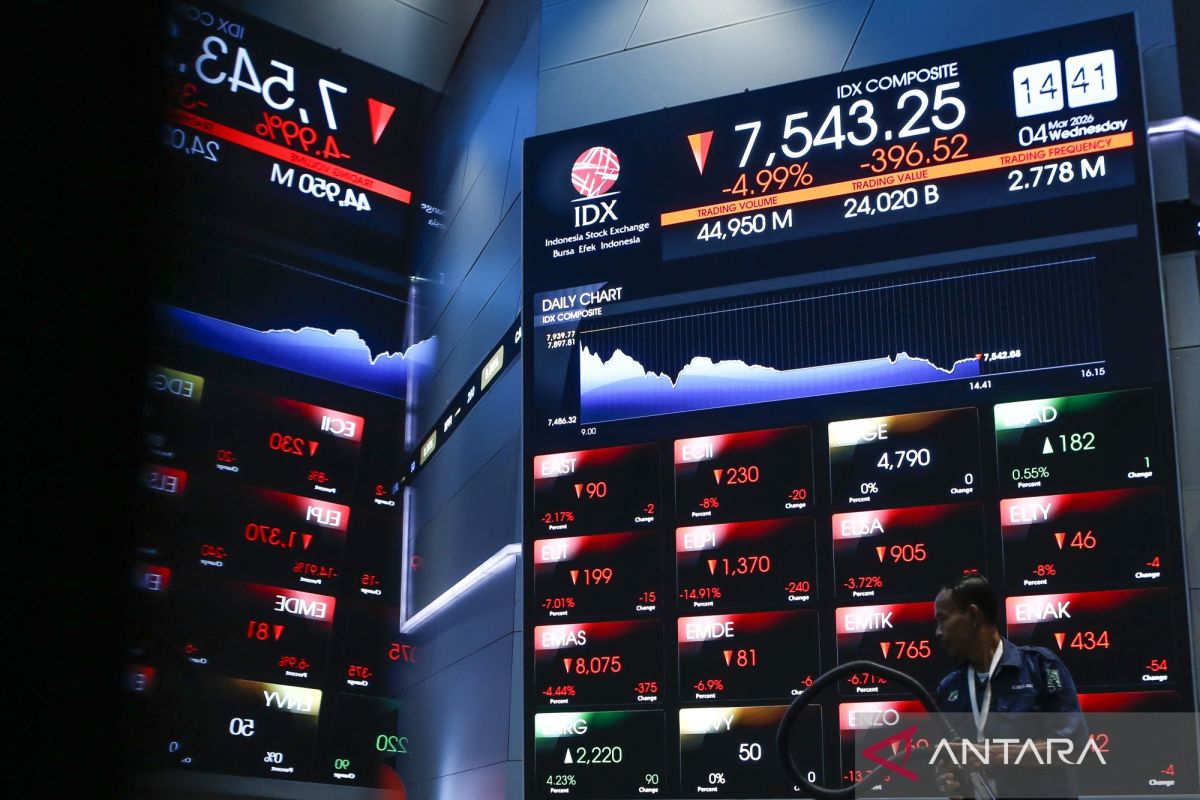
Jakarta (ANTARA) - The Composite Stock Price Index (JCI) of the Indonesia Stock Exchange (BEI) moved higher on Thursday morning, in line with investors adopting a risk-on stance (shifting to risky assets) driven by optimism that the conflict between the United States (US) and Iran is nearing an end.
The JCI opened up 39.75 points or 0.52% at 7,663.34. Meanwhile, the LQ45 index of 45 leading stocks rose 2.74 points or 0.36% to 762.69.
“The market is beginning to price in a de-escalation scenario, as seen in the rotation back to risky assets and the weakening of the US dollar, but analysts assess that risks remain high because negotiations are not yet final and the potential for escalation remains open,” said Head of Research at Kiwoom Sekuritas Indonesia, Liza Camelia Suryanata, in her analysis in Jakarta on Thursday.
From abroad, Liza noted that global sentiment is driven by expectations that the US-Iran conflict is nearing an end, with US President Donald Trump stating that the war is “very close to over”, and the chances of achieving a permanent ceasefire before the end of the month being quite high.
Further talks are expected to resume soon, after initial negotiations in Islamabad, Pakistan, did not yield an agreement, with the US affirming that the negotiation process is still ongoing, active, and productive.
However, Liza reminded that the situation on the ground remains complex, with the US instead increasing pressure on Iran through a full blockade of ports and halting maritime trade, as well as stopping waivers for purchasing Iranian and Russian oil, while Iran threatens retaliation and continues to maintain pressure in the Strait of Hormuz.
Such policies also impact China, which is expected to halt imports of Iranian oil. To date, traffic volume in the Hormuz route is still far from normal, although more than 20 ships have begun to pass through again.
Liza continued that market mechanisms remain consistent, namely that an oil shock drives up inflation, keeps interest rates high, strengthens the US dollar and yields, and pressures non-yield assets like gold.
Domestically, Indonesia’s External Debt (ED) reached $437.9 billion as of February 2026, or grew 2.5% (year-on-year) driven by the public sector.
Government ED at $215.9 billion remains the main pillar, though slightly slowing, influenced by a decline in debt securities positions. Conversely, private ED fell 0.7% (year-on-year) to $193.7 billion.
In trading on Wednesday (15/04), European stock markets moved variably, including the Euro Stoxx 50 weakening 0.73%, the UK FTSE 100 weakening 0.47%, the German DAX strengthening 0.09%, and the CAC weakening 0.64%.
US stock markets on Wall Street were also variable on Wednesday (15/04), including the Nasdaq Composite strengthening 1.59% to 24,016.02, the S&P 500 strengthening 0.80% to 7,022.95, and the Dow Jones weakening 0.15% to 48,463.72.
Regional Asian stock markets this morning included the Nikkei strengthening 1,394.76 points or 2.40% to 59,529.00, the Hang Seng strengthening 276.68 points or 1.07% to 26,224.00, the Shanghai strengthening 19.01 points or 0.47% to 4,046.21, and the Strait Times weakening 12.47 points or 0.25% to 5,008.73.