
JCI Strengthens Amid Market Monitoring US-Iran Developments
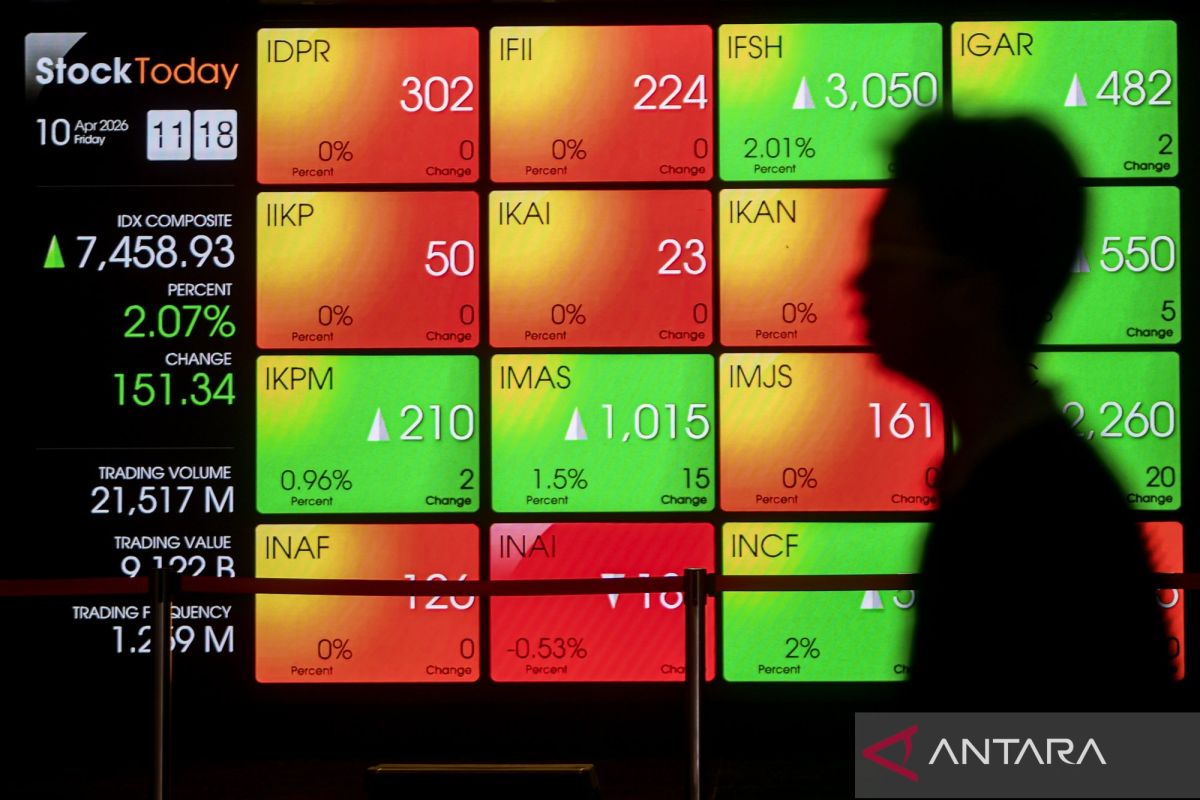
Jakarta (ANTARA) - The Composite Stock Price Index (JCI) on the Indonesia Stock Exchange (BEI) moved higher on Friday morning amid market participants still monitoring developments in the ongoing negotiations between the United States (US) and Iran.
The JCI opened up 24.43 points or 0.32% to 7,645.81. Meanwhile, the LQ45 index of 45 leading stocks rose 1.16 points or 0.15% to 758.48.
“Based on technical analysis, we see the JCI potentially weakening in a limited manner with support and resistance at 7,500-7,850. There is potential for strengthening but it is limited,” said Associate Director of Research and Investment at Pilarmas Investindo Sekuritas, Maximilianus Nico Demus alias Nico, in his analysis in Jakarta on Friday.
From abroad, US President Donald Trump stated that America has reached an agreement with Iran, and talks will continue over the weekend.
However, Trump claimed without evidence that Iran has agreed to nuclear terms and to hand over nuclear material, including not possessing nuclear weapons, and will open the Strait of Hormuz.
In addition, Trump approved a 10-day ceasefire between Israel and Lebanon to ease broader tensions in the region. Trump will invite Lebanese President Joseph Aoun and Israeli Prime Minister Benjamin Netanyahu for discussions within the next week.
From Europe, inflationary pressures are starting to rise due to the conflict in the Middle East, which has driven up global energy prices.
As a result, projections for interest rate cuts by the European Central Bank (ECB) have changed, from previously two cuts in 2026 to now potentially facing increases if inflation does not stabilise.
Domestically, Finance Minister Purbaya Yudhi Sadewa stated that S&P Global has maintained Indonesia’s credit rating at BBB (investment grade) with a stable outlook, reflecting relatively low default risk.
In macroeconomic terms, Nico assessed that S&P’s decision is a positive sentiment for Indonesia’s financial markets as it maintains global investor confidence, particularly institutional investors who require an investment grade rating.
“The stability of the rating also has the potential to hold back increases in government bond (SBN) yields, thus keeping the country’s funding costs stable amid global pressures,” said Nico.
From the capital market perspective, Nico stated that this will support capital inflows into stocks and bonds, especially if combined with disciplined fiscal trends and improving economic growth.
“Sectors sensitive to interest rates such as banking and property could receive positive sentiment due to expectations of funding cost stability,” said Nico.
Nevertheless, Nico noted S&P’s comments regarding the debt interest coverage ratio still above 15% as a medium-term risk.
“If not balanced with sustainable increases in state revenues, it could limit the government’s fiscal space going forward,” said Nico.
On Thursday (16/4) trading, European stock markets moved variably, including the Euro Stoxx 50 down 0.04%, the UK FTSE 100 up 0.29%, the German DAX up 0.36%, and the French CAC 40 down 0.14%.
Meanwhile, the US Wall Street markets collectively strengthened on Thursday (16/4), including the Dow Jones Industrial Average up 0.24% to 48,578.72, the S&P 500 up 0.26% to 7,041.28, and the Nasdaq Composite up 0.36% to 24,102.70.
Regional Asian stock markets this morning included the Nikkei down 576.34 points or 0.97% to 58,942.00, the Shanghai index down 15.04 points or 0.37% to 4,040.50, the Hang Seng down 254.76 points or 0.97% to 26,139.50, the Kuala Lumpur index down 1.26 points or 0.07% to 1,688.45, and the Straits Times down 12.75 points or 0.25% to