
JCI Slumps in Morning Session, Closes Down 0.36%
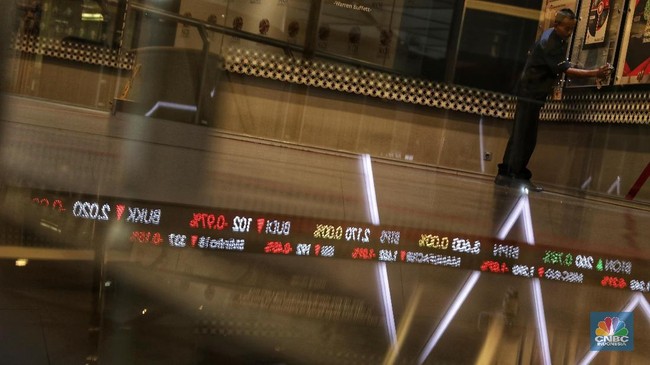
Jakarta, CNBC Indonesia — The Jakarta Composite Index (JCI) closed the morning session with a decline of 27.49 points or -0.36% to the level of 7,596.10 on Thursday (16/4/2026).
A total of 344 stocks rose, 340 fell, and 275 remained unchanged. The transaction value reached Rp 10.74 trillion, involving 24.18 billion shares in 1.65 million transactions. Market capitalisation also dropped to Rp 13,523 trillion.
Based on market data, Bank Mandiri (BMRI) was the stock with the largest transaction value, at Rp 1.33 trillion. This was followed by Barito Renewables Energy (BREN) at Rp 1.17 trillion, Bakrie & Brother (BNBR) at Rp 1.17 trillion, and Astrindo Nusantara Infrastruktur (BIPI) at Rp 1.06 trillion.
This morning, the JCI had risen by more than 1%. Citing Refinitiv, the JCI was supported by the healthcare sector, which rose 5.52%. This was in line with shares of hospital issuer Dato Sri Tahir, Sejahteraraya Anugrahjaya (SRAJ), which soared 14.5% in the morning session to 15,000. SRAJ contributed 8.76 points to the JCI.
However, about an hour into trading, shares of Dian Swastatika Sentosa (DSSA) and Barito Renewables Energy (BREN) experienced significant corrections. DSSA fell 3.28% and BREN -3.88%, dragging the JCI by -9.7 points and -9.22 points respectively.
Meanwhile, the geopolitical situation received a positive breeze. The Trump administration expressed optimism on Wednesday regarding the chances of reaching an agreement to end the war with Iran, while warning of increasing economic pressure on Tehran if it remains stubborn.
Trump stated that the war he launched with Israel since late February is nearly over, although the shipping blockade he announced has begun to take effect and traffic through the Strait of Hormuz remains far below normal levels.
The United States warned that it could add secondary sanctions against Iranian oil buyers as an effort to strengthen its bargaining position ahead of further negotiations, just weeks after Washington relaxed enforcement of some energy sanctions against Iran.
US and Iranian officials are considering returning to Pakistan for further talks as soon as this weekend, after negotiations on Sunday ended without a breakthrough. Pakistan’s military chief arrived in Tehran on Wednesday to try to prevent the conflict from reigniting.
Pakistan’s military confirmed that Field Marshal Asim Munir has arrived in Tehran. A senior Iranian source told Reuters that Munir, who mediated the last round of talks, will seek to “narrow the differences” between the two sides. Foreign Minister Abbas Araqchi wrote on X welcoming Munir and stating that Iran is committed to “promoting peace and stability in the region.”
Last weekend’s talks ended without an agreement to end the war, which Trump initiated with Israel on 28 February, triggering Iranian attacks on Gulf countries and reigniting the conflict between Israel and Iran-backed Hezbollah in Lebanon.
In other developments, in the April 2026 World Economic Outlook, the IMF revised down its global economic growth projection to 3.1% for 2026 and 3.2% for 2027. This figure represents the weakest growth rate in the last two decades. The IMF also outlined a worst-case scenario if the Middle East conflict escalates and damages energy infrastructure.
In that heavy scenario, global growth is projected to plummet to 2%, with global inflation surging above 6% in 2027.
Amid the shadow of global pessimism, Indonesia’s economy is assessed to have solid resilience. The IMF projects Indonesia to record economic growth of 5% in 2026, higher than the projection for China at 4.4% and the Philippines at 4.1%, though still below India, which is projected to grow 6.5%. Domestic inflation is also expected to be controlled around 3% for this year.
The IMF cut its economic growth projection for Indonesia to 5.0% in 2026, from 5.1% in the previous projection.
International confidence in Indonesia is growing stronger. In a meeting on the sidelines of the IMF Spring Meetings, IMF Managing Director Kristalina Georgieva described Indonesia as a “bright spot” amid the world economy.
This predicate is based on the government’s consistency in keeping the fiscal deficit below 3% of GDP, as well as Bank Indonesia’s adaptive policy mix in maintaining exchange rate stability and macroeconomic liquidity.