
JCI Potentially Volatile Amid Market Focus on US-Iran Developments
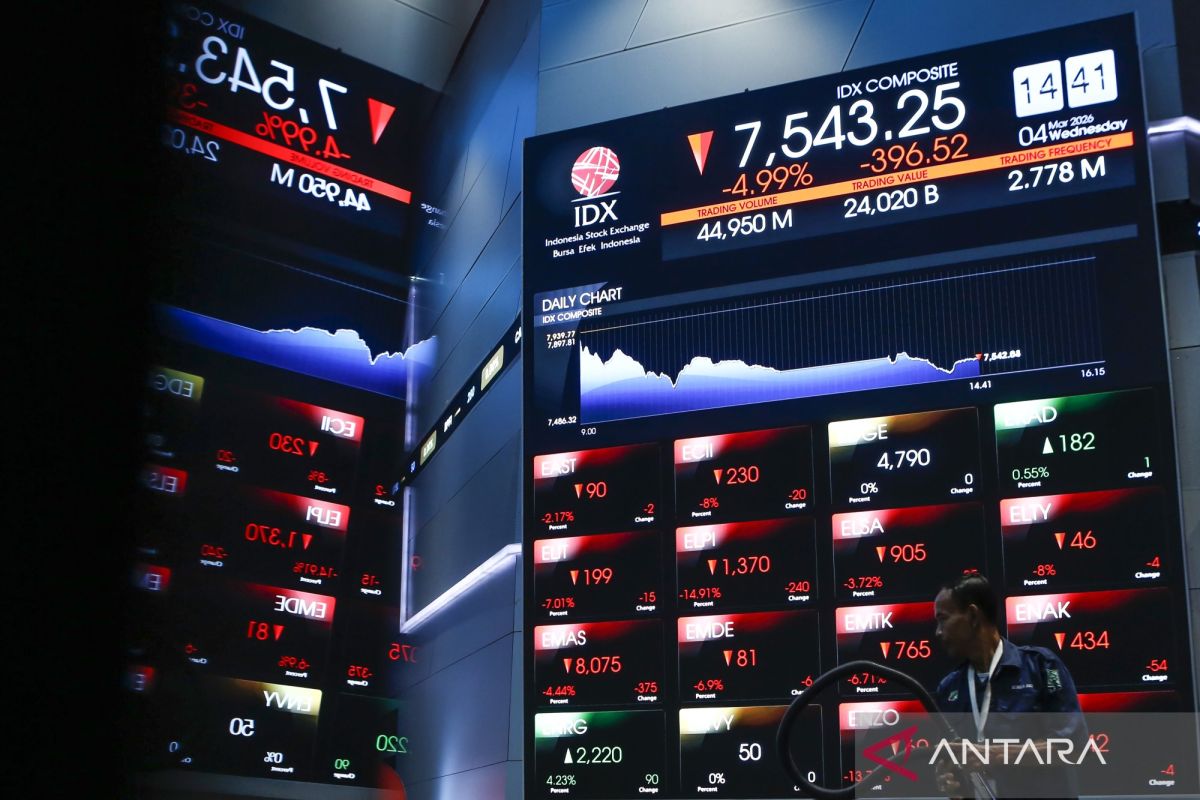
The Jakarta Composite Index (JCI) on the Indonesia Stock Exchange is expected to move variably on Wednesday, as market participants continue to monitor developments in the conflict between the United States (US) and Israel with Iran.
The JCI opened lower by 22.22 points or 0.31 percent to 7,084.62. Meanwhile, the LQ45 index of 45 leading stocks rose 1.20 points or 0.17 percent to 723.60.
“The JCI is expected to potentially weaken and test support levels at 6,800-7,000,” said Head of Research at Phintraco Sekuritas, Ratna Lim, in her analysis in Jakarta on Wednesday.
From abroad, US President Donald Trump stated he would temporarily halt the war with Iran following negotiations and delay military strikes on Iran’s power plants unless Iran promptly opens the Strait of Hormuz.
However, Iran denied that negotiations had taken place, although it acknowledged receiving messages from other countries regarding the US request for dialogue.
Previously, Iran threatened to attack US and Israeli energy infrastructure, information technology, and desalination facilities if the US targeted Iran’s energy infrastructure.
Meanwhile, volatility in crude oil and gas prices has put central banks worldwide on high alert for potential resurgent inflation.
Last week, the Federal Reserve (The Fed), European Central Bank (ECB), Bank of England (BoE), Bank of Japan (BoJ), and Bank of Canada maintained their respective interest rates unchanged.
The Fed still projects one 25 basis point rate cut this year, but investors are no longer factoring this in due to inflation concerns.
Domestically, Bank Indonesia (BI) has lowered the threshold for mandatory supporting documentation on US dollar purchases to $50,000 from the previous $100,000, aimed at curbing speculative actions that could worsen rupiah volatility.
This regulation takes effect from 1 April 2026, with a transition period until 30 April 2026. However, BI has increased the hedging transaction limit to $10 million per transaction from $5 million per transaction to allow corporations to better manage exchange rate risks.
Additionally, the government is reviewing several budget efficiency measures, particularly in expenditure posts of ministries and agencies (K/L) deemed compressible, to maintain fiscal discipline and ensure priority programmes continue amid rising global crude oil prices.
The government is also examining a one-day-per-week work-from-home policy or a four-day work option for civil servants (ASN) and private sector employees to save on fuel consumption.
“Investors are eagerly awaiting what policies the government will pursue,” said Ratna.
On Tuesday (24/03), European stock markets moved variably, including the Euro Stoxx 50 down 0.08 percent, the UK’s FTSE 100 up 0.72 percent, Germany’s DAX down 0.07 percent, and France’s CAC up 0.23 percent.
Meanwhile, Wall Street indices in the US uniformly weakened on Tuesday (24/03), with the S&P 500 down 0.37 percent to 6,556.37, the Nasdaq down 0.77 percent to 22,002.45, and the Dow Jones down 0.18 percent to 46,124.06.
This morning’s regional Asian stock markets included the Nikkei up 1,515.60 points or 2.90 percent to 53,767.90, the Shanghai index up 41.52 points or 1.07 percent to 3,922.80, the Hang Seng up 318.00 points or 1.27 percent to 25,381.72, and the Straits Times up 35.06 points or 0.72 percent to 4,897.49.