
JCI Opens Weaker by 0.39% at 7,136 Level
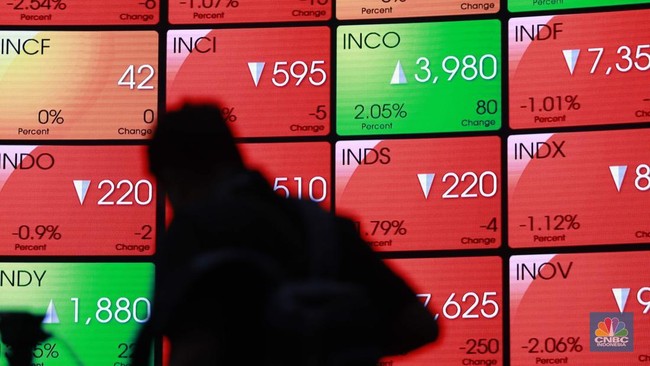
The Jakarta Composite Index (JCI) began the morning in the red on Friday (27/3/2026). The index opened down 0.39% or 27.72 points at the level of 7,136.37.
A total of 127 stocks rose, 139 fell, and 313 remained unchanged. Trading value reached Rp 214 billion, involving 183 million shares in 27,266 transactions. Market capitalisation also declined to Rp 12,584 trillion.
Shortly after the market opened, the JCI corrected more sharply to 0.66% before gradually trimming the weakness.
The movement of Indonesia’s financial markets appears likely to remain volatile at the end of this week on Friday (27/3/2026).
The discourse on a ceasefire between the US-Israel and Iran remains murky; the optimism that emerged last Wednesday seems to be fading.
Market participants are now more focused on the real impacts spreading to the policies of stakeholders, industries, and the real economy in various countries, especially after the blockade of the Strait of Hormuz.
Meanwhile, the majority of Asia-Pacific stock markets weakened in Friday’s trading (27/3/2026), following the volatile movement in Wall Street overnight, amid uncertainty over messages related to the Middle East conflict between Donald Trump and Iran.
Citing CNBC.com, Trump decided to extend the deadline for the attack by 10 days until 6 April to allow room for negotiations. This decision was reportedly taken at the request of the Islamic Republic of Iran’s government as part of efforts to ease tensions.
Trump stated that the extension was given in exchange for 10 oil tankers crossing the Strait of Hormuz as a “gift” from Tehran. He also emphasised via a post on Truth Social that the delay aims to open opportunities for a diplomatic resolution.
In his statement, Trump said talks are still ongoing and going very well despite differing reports from the media. Nevertheless, Washington stated it wants to end the conflict through negotiation channels, while Tehran denies any direct talks with the United States.
Oil prices had strengthened on Thursday before showing weakness as indications of progress towards a US-Iran peace agreement emerged. The West Texas Intermediate contract for May delivery fell 1.3% to US$93.29 per barrel, while Brent crude oil closed at US$108.01 per barrel.
From the Asian region, Australia’s S&P/ASX 200 index fell 0.42% at the start of trading. In Japan, the Nikkei 225 weakened 0.9% and the Topix corrected 0.4%.
In South Korea, the Kospi index plunged 3% and the Kosdaq fell 1.5%. Meanwhile, Hang Seng Index futures were at 24,782, lower than the previous close at 24,856.43.
From China, market participants are awaiting the release of industrial profit data for the first two months of 2026, which could provide an early picture of the manufacturing sector’s condition. This data is considered important amid tight competition and weak demand.
Meanwhile, US futures markets strengthened as concerns over an oil price surge eased. Dow Jones Industrial Average futures rose 175 points or 0.4%, while the S&P 500 and Nasdaq 100 each strengthened by nearly 0.4%.
However, Wall Street’s major indices closed weaker in the previous trading session. The S&P 500 fell 1.7%, marking the largest daily decline since early 2026; the Nasdaq Composite dropped 2.4% and entered correction territory; and the Dow Jones fell 1.01%.