
JCI Opens Up 0.39% to 7,663 Level
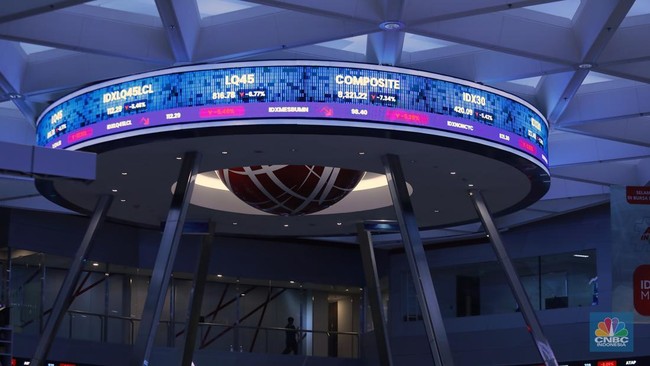
The Jakarta Composite Index (JCI) strengthened modestly this morning, on Monday (20/4/2026). The index opened up 29.39 points or 0.39% to the level of 7,663.39.
A total of 281 stocks rose, 89 fell, and 319 remained unchanged. The morning trading value reached Rp189.84 billion, involving 330.24 million shares in 50,434 transactions. Market capitalisation also rose to Rp13,703 trillion.
Indonesia’s financial markets are expected to remain volatile throughout this week after Iran reimposed a blockade on the Strait of Hormuz following a brief ceasefire announcement.
Beyond the war dynamics, market participants will focus on Bank Indonesia’s interest rate decision to be announced on Wednesday this week.
Shipments through the Strait of Hormuz came to a complete halt on Sunday after Iran reasserted control over the strategic waterway, which is key to global energy supplies, just days before a fragile ceasefire with the United States was scheduled to end.
Iran’s chief negotiator stated that the latest talks with the US showed progress, while President Donald Trump described “very good conversations” with Tehran.
However, neither side provided specific details. Iran’s lead negotiator, Mohammad Baqer Qalibaf, said the two countries still have major differences on nuclear issues and the Strait of Hormuz, the two main stumbling blocks in negotiations.
The United States stated it had seized an Iranian cargo ship attempting to breach the blockade, while Iran threatened retaliation. This situation has raised concerns that the ceasefire between the two countries could collapse before the end of this week.
Iran also rejected a new round of peace talks planned by the US in Islamabad, making the prospects for peace even more uncertain.
This tension has caused oil prices to surge. Brent crude rose about 7% to US$96.85 per barrel, while S&P 500 futures fell 0.9% at the start of Asian trading.
The war, now entering its eighth week, is said to have triggered the most severe global energy supply shock in history, particularly due to disruptions in the Strait of Hormuz, a vital route for around 20% of the world’s oil supply.
On Saturday, Iran, which had previously announced it would allow ships to pass through Hormuz, reversed course by accusing Washington of violating the ceasefire agreement by maintaining a blockade on Iranian ports.
Domestically, the most anticipated agenda for market participants is the announcement of the results of Bank Indonesia’s Board of Governors Meeting (RDG BI) on Tuesday and Wednesday this week (21-22/4/2026). In the previous month’s meeting, BI decided to keep the benchmark interest rate or BI Rate at 4.75%.
This move aligns with the central bank’s main focus on mitigating global spillover effects and maintaining rupiah exchange rate stability. The rupiah previously faced pressure, reaching Rp16,985 per US dollar in mid-March, triggered by global risk aversion sentiment.
BI will also consider the dynamics of domestic inflation rate, which rose to 4.76% year-on-year in February. Given the solid realisation of fourth-quarter 2025 economic growth at 5.39%, Bank Indonesia is assessed to still have adequate policy space to manage monetary stability.
Meanwhile, Asia-Pacific stock markets moved variably on Monday trading (20/4/2026) amid investor caution reflecting developments in the Middle East conflict. Tensions have escalated again between Iran and the United States following the latest military incident in the region.
South Korea’s Kospi index rose 0.27% while Kosdaq fell 0.52%. In Japan, the Nikkei 225 strengthened 0.62% and Topix rose 0.68%, while Australia’s S&P/ASX 200 weakened 0.39%.
Hong Kong’s Hang Seng index futures were at 26,502, higher than the last close at 26,160.33. This movement reflects limited optimism amid global uncertainty.
On Wall Street, Dow Jones Industrial Average futures fell 425 points or 0.9%. Meanwhile, S&P 500 futures weakened 0.8% and Nasdaq-100 fell 0.65%.
In Friday’s regular trading, the S&P 500 surged 1.2% to 7,126.06 and broke through the 7,100 level for the first time. The Nasdaq Composite rose 1.52% to 24,468.48, marking an increase for 13 consecutive days and becoming the longest rally since 1992.