
JCI Opens Lower as Iran–US Conflict Triggers Uncertainty Over the Fed's Rate Path
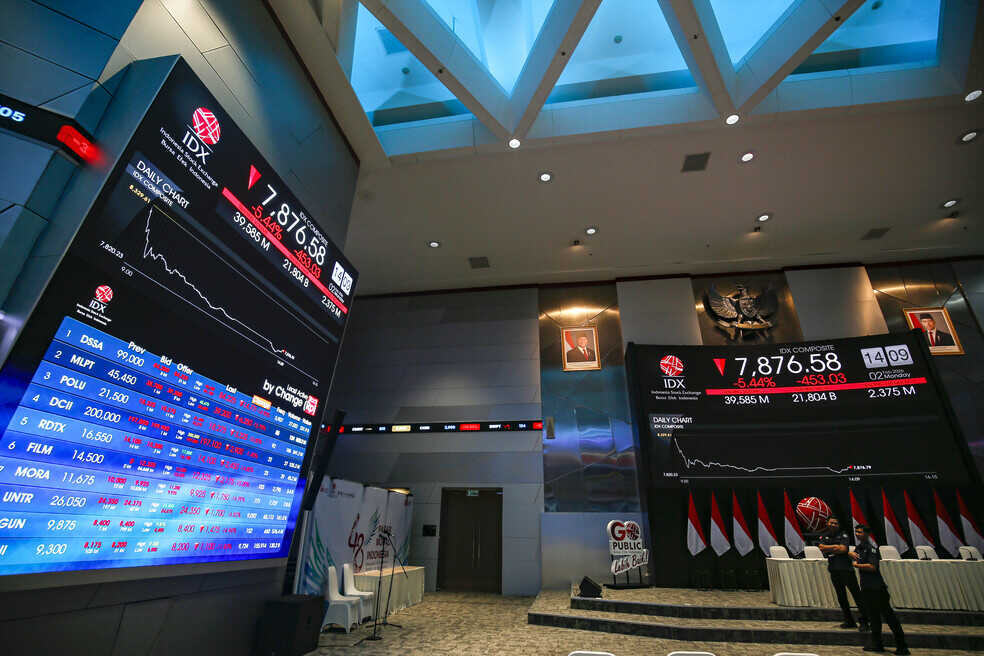
The Jakarta Composite Index (IHSG) on the Indonesia Stock Exchange (BEI) began trading on Friday (6 March) weaker, as geopolitical tensions between Iran and the United States stoked uncertainty about the Federal Reserve’s policy on interest rates. At the start of the session, the IHSG fell 11.07 points or around 0.14% to 7,699.47. The benchmark LQ45 index declined by 1.61 points or 0.20% to 786.21. Kiwoom Sekuritas Indonesia Head of Research Liza Camelia Suryanata assessed that short‑term upside for the market remains limited. “Kiwoom Research estimates that the technical rebound yesterday will not be long‑lived, with resistance at the critical gate of 7,712–7,720. Investors are advised to increase cash holdings towards the end of the week to anticipate high volatility over the weekend,” she said in Jakarta on Friday. Globally, the conflict involving Iran, the United States, and Israel has persisted for six days, fuelling concerns about energy‑related inflation and the Fed’s monetary policy path. The Fed’s Federal Open Market Committee (FOMC) is scheduled to meet on 17–18 March 2026 to determine the next policy rate. “The market now prices in around 40 basis points of rate cuts through 2026, down from about 50 basis points before the conflict began,” Suryanata said. Tensions in the Middle East intensified after Iran launched missiles at targets in Israel, while US and Israeli aircraft conducted strikes on various Iranian targets. In addition, attacks on tankers in the Gulf and Iranian drones entering Azerbaijan raised the risk of broader conflict involving energy‑producing nations. Former President Donald Trump even stated that the United States wished to play a role in determining Iran’s next leadership. The International Monetary Fund (IMF) warned that the geopolitical conflict could test global economic resilience; prolonged tensions could raise inflation pressures and slow global growth. Fears of disruption to Middle East energy supply also supported higher global oil prices. Brent crude rose 4.93% to US$85.41 per barrel, while West Texas Intermediate (WTI) jumped 8.51% to US$81.01 per barrel. Domestically, external risk also stems from a slowing Chinese economy. In the Two Sessions forum, officials warned that China’s slowdown could affect Indonesia’s economy. China remains Indonesia’s largest trading partner, contributing around 24% of total non‑oil and gas exports in 2025, worth about US$64.82 billion. If Chinese industrial activity weakens, demand for Indonesian commodities and inputs could also weaken. The impact would extend beyond trade to investment, with China listed as one of Indonesia’s major investors, realising about US$7.5 billion in 2025. Historically, a 1% slowdown in China can shave roughly 0.3 percentage points off Indonesia’s growth. On Thursday (5 March), most European stock markets fell. The Euro Stoxx 50 dropped 1.46%, the UK’s FTSE 100 fell 1.45%, Germany’s DAX declined 1.61%, and France’s CAC 40 slid 1.49%. Wall Street ended in the red, with the Dow Jones Industrial Average down 1.61% to 47,954.74, the S&P 500 down 0.56% to 6,830.71, and the Nasdaq Composite down 0.26% to 22,748.99. In Asia, early trade showed mixed movements. The Nikkei rose 80.59 points (0.15%) to 55,358.69, the Hang Seng gained 263.59 points (1.04%) to 25,584.93, the Shanghai Composite edged higher by 0.33 points (0.01%) to 4,108.90, while the Straits Times fell 17.90 points (0.37%) to 4,828.66. (Ant/E-4) The IHSG closed up 1.76% at 7,710.54 on Thursday (5 March 2026). Look out for analysis of bargain-hunting activity and today’s top gainers. The IHSG opened Thursday morning up 118.29 points to 7,695.35. Readers can check technical analyses, the latest Rupiah rate, and recommended stocks here. The IHSG had closed sharply lower by 4.57% at 7,577 on Wednesday (4 March 2026) after Fitch Ratings revised its outlook to negative and the Middle East conflict spurred a mass capital outflow. The IHSG slid to the 7,500s as a consequence of ongoing global pressure. The IHSG is forecast to move erratically through the week. Previously, MSCI flagged concerns about the structural quality of Indonesia’s market. © 2026 Media Group - mediaindonesia. All rights reserved.