
JCI Opens Lower Amid MSCI Rebalancing
JCI Opens Lower Amid MSCI Rebalancing
Oleh - Naura Sofia Rahmanita
Editor - Lasti Martina
27 Feb 2026
Voice of Indonesia
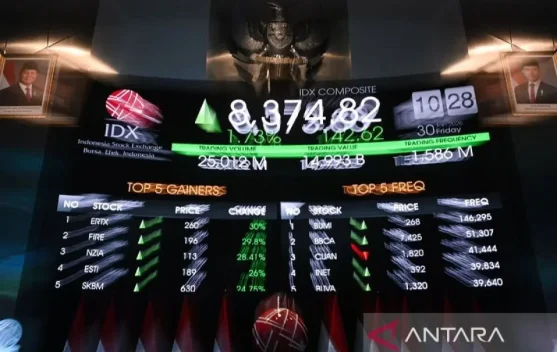
RRI.CO.ID, Jakarta - The Jakarta Composite Index (JCI) of the Indonesia Stock Exchange (IDX) opened lower on Friday, February 27, 2026, as investors engaged in profit-taking ahead of the weekend.
The JCI fell 23.95 points, or 0.29 percent, to 8,211.31 at the opening, while the LQ45 index, which tracks 45 leading stocks, dropped 2.99 points, or 0.36 percent, to 834.90.
Head of Research at Kiwoom Sekuritas Indonesia, Liza Camelia Suryanata, said a combination of fiscal risks, sensitivity to rating headlines, and fund flows related to index rebalancing has made the domestic market more vulnerable to profit-taking than regional peers.
“A combination of fiscal risk, sensitivity to headline rating, and fund flows related to rebalancing makes the domestic market more susceptible to profit-taking compared to the region,” Liza said in Jakarta on Friday.
She said the domestic market remains pressured by a warning from S&P Global Ratings, which highlighted that the government’s debt interest burden has very likely exceeded the 15 percent threshold of state revenue, raising the risk of a negative rating action.
Market concerns also followed the January 2026 state budget deficit of IDR 54.6 trillion. However, the government raised IDR 50.8 trillion through global bond issuances denominated in euros and offshore yuan, with a bid-to-cover ratio of 3.4 times and yields ranging from 4 to 5 percent, reflecting solid demand.
Technical pressure also stemmed from the MSCI rebalancing, which takes effect after the market closes on February 27, 2026. Shares of Indofood (INDF) will move from the MSCI Global Standard Index to the MSCI Small Cap Index, while ACES and CLEO will be removed from the Small Cap Index. The next MSCI review is scheduled to be announced on May 12, 2026, and will take effect on June 1, 2026.
Globally, markets are influenced by uncertainty surrounding artificial intelligence investment, shifting interest rate expectations, and geopolitical and trade risks.
Investors are reassessing whether large capital expenditures in the AI sector can generate expected returns, while positive surprise expectations for Nvidia remain high after the stock’s sharp rally since October 2022.
On monetary policy, futures markets have fully priced in a 25-basis-point rate cut by the US Federal Reserve in September 2026. With US core PCE inflation at 3 percent, a policy pause is considered reasonable, while Fed chair candidate Kevin Warsh is not necessarily expected to adopt a dovish stance.
Trade policy uncertainty also lingers after the US Supreme Court altered the legal framework for tariffs. The US government is pursuing the possibility of new tariffs of up to 15 percent through alternative legal channels.
Meanwhile, follow-up technical talks between the United States and Iran are scheduled to take place in Vienna next week, with US President Donald Trump warning of consequences if no meaningful progress is achieved.
On Wall Street on Thursday, the S&P 500 fell 0.54 percent to 6,908.86, the Nasdaq declined 1.16 percent to 25,034.37, and the Dow Jones Industrial Average edged up 0.03 percent to 49,499.20.
In Asia on Friday morning, Japan’s Nikkei dropped 0.39 percent to 58,527.00, Shanghai slipped 0.02 percent to 4,145.81, Hong Kong’s Hang Seng gained 0.27 percent to 26,451.00, and Singapore’s Straits Times Index fell 0.04 percent to 4,962.34. ***