
JCI Opens in Sharp Decline, Rupiah Exchange Rate Poised to Breach 17,000 Level Today
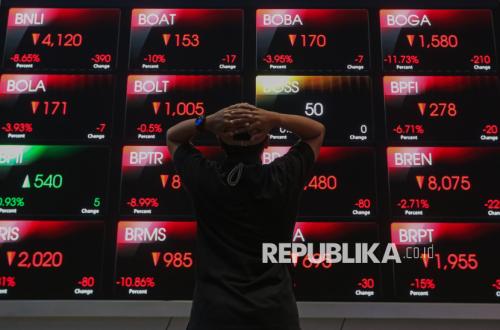
The Composite Stock Price Index (JCI) on the Indonesia Stock Exchange (BEI) moved lower on Monday morning (30/3/2026), following the weakness in Asian stock markets as investors avoided risky assets due to uncertainty over the direction of the conflict between the United States (US) and Iran. The JCI opened weaker by 76.53 points or 1.08 percent to 7,020.53. Meanwhile, the LQ45 index of 45 leading stocks fell 11.00 points or 1.53 percent to 707.96.
“Kiwoom Research reminds investors to exercise more restraint, adopting a wait-and-see approach pending developments in the US-Iran war, US payroll data, Indonesian inflation data, and the government’s planned risk mitigation measures for the fuel crisis this week,” said Head of Research at Kiwoom Sekuritas Indonesia, Liza Camelia Suryanata, in her analysis in Jakarta on Monday (30/3/2026).
From abroad, Liza said sentiment remains dominated by high uncertainty, with market movements highly headline-driven. The delay in attacks by US President Donald Trump failed to provide relief as escalation risks remain high, including the potential addition of 10,000 US troops.
Pakistan has emerged as a mediator with a 15-point peace proposal, while Iran has given limited signals, such as permitting 20 ships to pass through Hormuz, but still rejects the US proposal.
The current conflict is entering its fifth week. The Strait of Hormuz remains closed to most tankers, and attacks on energy infrastructure continue.
The United Arab Emirates (UAE) is pushing for the formation of a Hormuz Security Force but faces resistance from US allies and potential vetoes from Russia and China. Meanwhile, Saudi Arabia is diverting exports through the Red Sea but has not yet been able to replace the global supply disruptions.
From the US, political pressure is mounting with over 3,000 “No Kings” demonstration points involving 9 million people protesting Trump’s policies, including the Iran war and mass deportations, adding layers of risk to future policy stability.
“In this situation, the market faces the reality that almost no asset class is truly safe. Even safe havens like US Treasuries, the Japanese yen, and gold have failed to provide protection, driving investors to aggressively reduce risk exposure,” said Liza.
Oil prices remain high amid global supply disruptions, with Brent and WTI holding above $100 per barrel. The effective closure of the Strait of Hormuz, which previously carried around 15–20 million barrels per day, is the main factor behind the price surge.
Mitigation efforts such as optimising Saudi Arabia’s East-West pipeline at 7 million barrels per day and increasing exports through Yanbu only cover a small portion of the disruptions.
According to UBS, in an extreme scenario, oil prices could rise to $150 per barrel, potentially triggering global inflation above 4 percent and even pushing the US and Europe into recession.
Domestically, Iran has finally granted permission for two Pertamina tankers (Pertamina Pride and Gamsunoro) to exit the Strait of Hormuz following intensive communication with the Indonesian government, though they are still awaiting technical readiness such as insurance and crew before sailing.
With a capacity of around 2–2.5 million barrels, this amount is equivalent to only about 1–1.5 days of national fuel needs. However, this incident underscores the fragility of Indonesia’s energy resilience. A single tanker shipment plays only a small role in the daily supply chain, so prolonged disruptions in the Strait of Hormuz remain a direct risk to domestic supply stability.
On Friday’s trading (27/3) last week, European stock markets closed uniformly weaker. Among them, the Euro Stoxx 50 fell 1.56 percent, the UK’s FTSE 100 index weakened 0.05 percent, Germany’s DAX index fell 1.38 percent, and France’s CAC 40 index weakened 0.87 percent.
The US Wall Street markets also closed uniformly weaker on Friday (27/3). Among them, the Dow Jones Industrial Average fell 1.73 percent to 45,166.64, the S&P 500 weakened 1.67 percent to 6,368.85, and the Nasdaq Composite corrected 1.93 percent to 23,132.77.
This morning’s regional Asian stock markets include the Nikkei index weakening by 2,417.07 points or 4.53 percent to 50,956.00, the Shanghai index falling 31.33 points or 0.80 percent to 3,882.40, the Hang Seng index declining 427.38 points or 1.71 percent to 24,524.50, and the Straits Times index weakening 13.96 points or 0.29 percent to 4,884.22.