
JCI Opens in Red Following Dow’s 1,000-Point Drop and Rising Oil Prices - Jakarta Globe
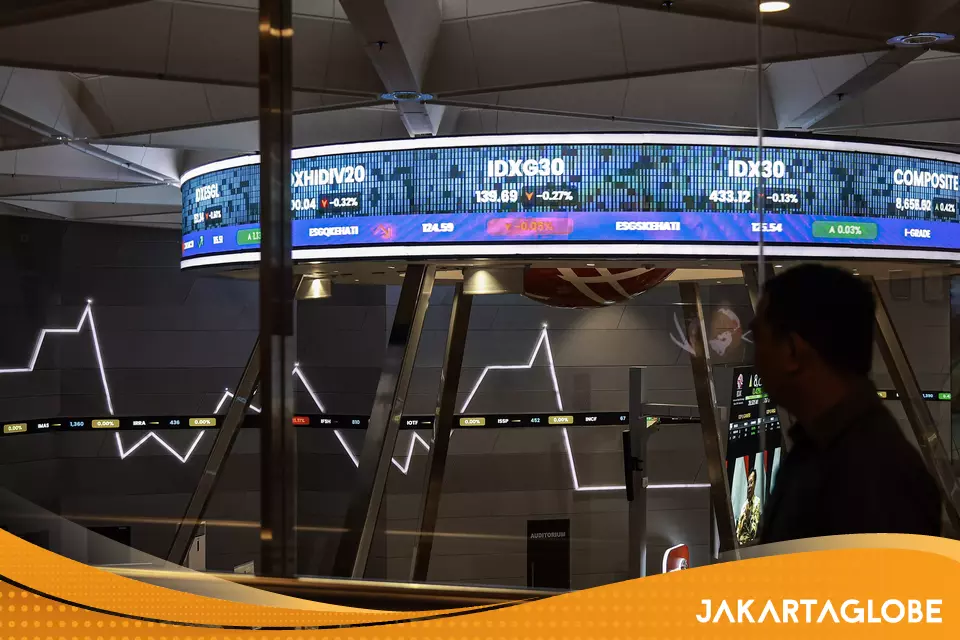
JCI Opens in Red Following Dow’s 1,000-Point Drop and Rising Oil Prices
Jakarta. Indonesian stocks opened slightly lower on Friday, tracking sharp losses on Wall Street after escalating tensions in the Middle East pushed oil prices higher and rattled global markets.
The Jakarta Composite Index (JCI) slipped 11 points, or 0.14%, to 7,699 at the Friday opening bell, moving within a range of 7,634 to 7,700.
Within the first five minutes of trading, volume reached 2.82 billion shares with turnover totaling Rp 1.28 trillion ($75.65 million) across more than 172,000 transactions. Decliners outnumbered gainers, with 325 stocks falling, 171 rising and 178 unchanged.
Kiwoom Sekuritas Indonesia warned that Indonesia could face economic headwinds from slowing activity in China, highlighted during Beijing’s annual “Two Sessions” policy meetings. China remains Indonesia’s largest trading partner, accounting for roughly 24% of the country’s total non-oil and gas exports in 2025, valued at about $64.82 billion.
The brokerage noted that weaker Chinese industrial activity could dampen demand for Indonesian commodities and raw materials. It also highlighted risks to investment flows, as China was among Indonesia’s biggest investors last year with realized investment of around $7.5 billion. Historically, Kiwoom estimates that every 1% slowdown in China’s economy could trim Indonesia’s economic growth by roughly 0.3%.
Despite Thursday’s rebound in Indonesian stocks, Kiwoom expects the rally to be short-lived as the JCI approaches a key resistance level between 7,712 and 7,720. The firm suggested investors may want to increase cash positions toward the end of the week to brace for potential volatility over the weekend.
Global markets turned cautious after a sharp sell-off in the United States. The Dow Jones Industrial Average plunged 1,066 points, or 2.2%, while the S&P 500 fell 1.2% and the Nasdaq Composite dropped 1.1%.
The losses followed a surge in oil prices to their highest level since mid-2024 after Iran launched a new wave of attacks targeting Israel, U.S. bases and other locations across the region, raising concerns over disruptions to energy production and transport.
Market strategists noted that while geopolitical conflicts often trigger short-term volatility, equities historically tend to recover once tensions begin to ease. However, a prolonged spike in oil prices, particularly if crude reaches $100 per barrel and stays elevated, could weigh heavily on the global economy.
Investors are also closely watching developments around the Strait of Hormuz, a crucial shipping route off Iran’s coast through which roughly one-fifth of the world’s oil supply typically passes.
Across Asia on Friday morning, most markets also opened lower. Japan’s Nikkei fell 1.1% to 54,674, while South Korea’s Kospi dropped 1.6%. China’s Shanghai Composite declined 0.56%. Hong Kong’s Hang Seng, however, edged up 0.14% to 25,358.
Tags: Keywords: