
JCI in Critical Condition: Which Conglomerate Stocks Are Most Battered?
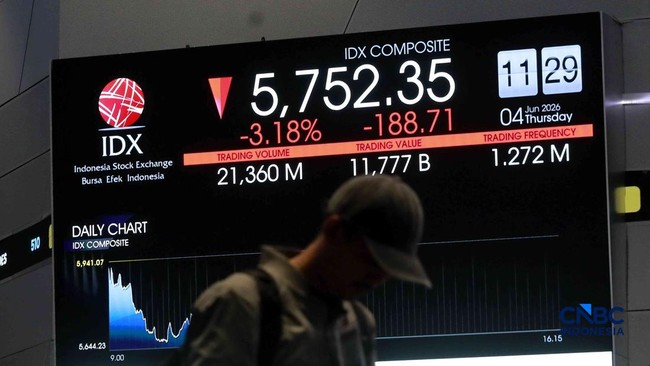
The Jakarta Composite Index (JCI) has recorded massive selling pressure since the close of trading on 29 May 2026. The benchmark index for the Indonesian capital market, which previously stood at 6,127.38, has now plunged sharply to 5,681.54 today, weakening by 2.71% as of 10:27 WIB. This significant decline is directly influenced by the index rebalancing effect, which triggered large-scale portfolio reallocation, prompting sell-offs by various foreign and domestic institutional investors. Furthermore, the relentless weakening of the Rupiah has placed psychological pressure on both domestic and foreign investors, as the Rupiah against the US dollar had just reached Rp17,000/US$ on 1 April 2026 but has now depreciated further to Rp18,000/US$ as of 4 June 2026. Ultimately, this sentiment has heavily burdened the overall index movement amid the currently high macroeconomic uncertainty.
Amid this aggressive market correction phase, shares affiliated with large conglomerate groups are among those recording the deepest declines. Based on cumulative price movement data since the rebalancing up to 5 June 2026, a number of listed companies have experienced a very significant shrinkage in market capitalisation. PT Bakrie & Brothers Tbk (BNBR) leads the list of declines with a price correction reaching -27.91%. This position is closely followed by PT Raharja Energi Cepu Tbk (RATU), which plummeted by -21.89%, and PT Bakrieland Development Tbk (ELTY), with a weakening level of -21.88%. Selling pressure also hit other giant-scale issuers. PT Pantai Indah Kapuk Dua Tbk (PANI) and PT Barito Pacific Tbk (BRPT) experienced value depreciation of -21.02% and -17.53%, respectively. This simultaneous decline reflects market participants’ tendency to avoid high-volatility assets.
Although the data shows a sharp correction in the ranks of these conglomerate-backed listed companies, this condition is not absolute for all business entities affiliated with large groups. There are exceptions where several other conglomerate issuers managed to book positive performance or at least hold on in the green zone. This is generally supported by solid corporate fundamental resilience, strategic corporate actions, or specific sectoral catalysts for each respective issuer. This fact confirms that the rebalancing does not always have a wholly destructive impact, but rather creates a sectoral rotation. This rotation requires market participants to readjust their risk profiles amid the ever-changing market dynamics.