
JCI First Session Declines 0.29% to 6,969
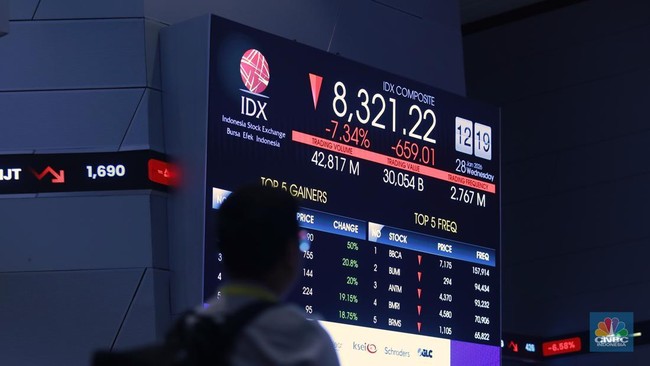
The Jakarta Composite Index (JCI) opened weaker by 0.29% at the end of the first session today, Tuesday (7 April 2026). The index fell to 6,969.16, or a cut of 20.27 points.
A total of 371 stocks declined, 261 rose, and 174 remained unchanged. Transaction value reached Rp 7.23 trillion, involving 17.42 billion shares in 1.12 million transactions.
Market capitalisation also decreased to Rp 12,232 trillion.
Most trading sectors weakened, with only energy and infrastructure strengthening, while the non-primary consumer and industrial sectors recorded the deepest corrections.
Blue-chip issuers were the main drag on JCI performance, with the largest contributions to the decline coming from BBRI, TLKM, ASII, BMRI, and AMMN.
Indonesia’s financial markets are expected to face continued pressure today. Uncertain war developments and domestic economic concerns could weigh on the JCI and the rupiah.
Statements from stock exchange officials regarding Indonesia’s weight in the MSCI index could become a burden today. However, the greening of Wall Street could provide positive sentiment.
The Indonesia Stock Exchange (BEI) does not deny the potential for a reduction in Indonesia’s index weight by Morgan Stanley Capital International (MSCI) from Emerging Market to Frontier Market.
Acting President Director of BEI Jeffrey Hendrik said realistically, this potential does exist in the short term. According to him, several factors could prompt the global index provider to lower Indonesia’s weight despite ongoing improvements in transparency and governance.
“For example, one or two things that make the global index provider, for this short term, lower the weight. Yes, the potential is there. But we also realise that what we have been doing to address concerns from global index providers is for the long-term good of our capital market industry,” Jeffrey explained to reporters at the BEI Building on Monday (6 April 2026).
With improvements in transparency, market depth, and better governance, BEI believes Indonesia’s weight will increase in the future. Jeffrey also acknowledged that this transition phase could cause short-term market pressure.
Previously, the Chief Executive of the Capital Market, Financial Derivatives, and Carbon Exchange Supervisory Authority (OJK) Hasan Fawzi said OJK and BEI are preparing risk mitigation if the JCI is downgraded by MSCI.
Hasan asked investors not to respond reactively if a weight reduction occurs. He admitted that the ongoing capital market reforms will have short-term impacts.
“This may involve portfolio adjustments by domestic or global investors, which could trigger temporary selling pressure, as well as potential outflows during rebalancing, then volatility and widening bid-ask spreads on certain stocks,” Hasan said in a virtual press conference on Monday (6 April 2026).
However, Hasan said such dynamics are transitional and temporary responses. They are part of unavoidable progress. The main focus of capital market regulators is to build a foundation of market integrity that is transparent, credible, and consistently growing.
Meanwhile, Asia-Pacific stock markets strengthened in Tuesday’s trading (7 April 2026), following gains on Wall Street amid market participants’ attention to developments in the Iran conflict. Investors also noted statements from US President Donald Trump regarding potential conflict escalation.
Citing CNBC.com, Trump threatened to target Iran’s civilian infrastructure if a peace agreement is not reached in less than 24 hours. Nevertheless, he also signalled that Iran’s leadership is engaging in serious negotiations.
Trump reiterated his demand for Iran to open the Strait of Hormuz by 8:00 p.m. local time on Tuesday. He warned that the United States would destroy Iran’s bridges and power plants within four hours if the deadline is not met.
On the other hand, the United States and Iran are considering a framework agreement to end the five-week conflict. However, Tehran rejects Washington’s pressure to immediately open the Strait of Hormuz in a temporary ceasefire scheme and still demands a permanent end to the war.
Iran also rejected the US ceasefire proposal and submitted a counter-proposal of 10 points, including cessation of hostilities in the region, guarantees of safe passage in the Strait of Hormuz, lifting of sanctions, and reconstruction. In response, Trump called Iran’s proposal a significant step but not sufficient to reach an agreement.
In the commodities market, crude oil prices strengthened amid high geopolitical tensions. West Texas Intermediate futures rose 0.7% to US$113.25 per barrel, while Brent strengthened 0.68% to US$109.77 per barrel.
From the stock markets, Australia’s S&P/ASX 200 surged 2.3%, leading gains in the region. Japan’s Nikkei 225 rose 0.26% and Topix added 0.23%, while South Korea’s Kospi strengthened 1.5% and Kosdaq rose 0.85%.
Hong Kong markets remained closed on Tuesday due to Easter holidays. Meanwhile, Wall Street futures showed mixed movements ahead of the trading open.
S&P 500 futures were relatively unchanged, and Nasdaq 100 fell around 0.2%. Dow Jones Industrial Average futures rose 48 points or 0.1%, after the previous regular session where the S&P 500 rose 0.44%, Nasdaq Composite strengthened 0.54%, and Dow Jones added 165.21 points or 0.36%.