
JCI Closes Weaker, Burdened by Global Energy Supply Concerns
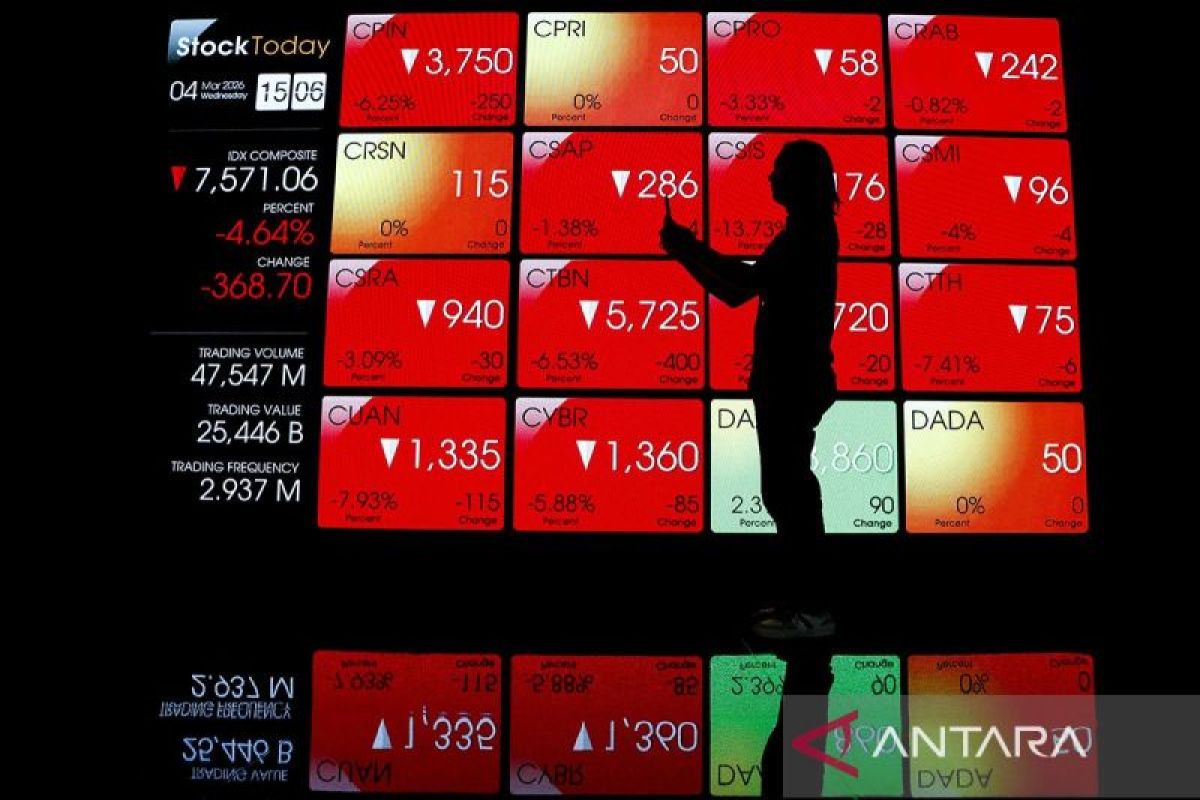
Regional Asian stock markets largely weakened on Friday as rising oil prices pressured sentiment, amid stalled peace negotiations between the United States and Iran. Jakarta (ANTARA) - The Composite Stock Price Index (JCI) of the Indonesia Stock Exchange (BEI) closed weaker on Friday afternoon, burdened by concerns over global energy supplies. The JCI closed down 249.12 points or 3.38% at 7,129.49. Meanwhile, the LQ45 index of 45 leading stocks fell 25.12 points or 3.51% to 690.76. “Regional Asian markets largely weakened on Friday as rising oil prices pressured sentiment, amid stalled peace negotiations between the United States (US) and Iran, as well as ongoing disruptions in the Strait of Hormuz,” said Associate Director of Research and Investment at Pilarmas Investindo Sekuritas, Maximilianus Nico Demus, alias Nico, in his analysis in Jakarta on Friday. From abroad, ongoing supply uncertainties are keeping energy prices high, thereby strengthening concerns over global inflation and growth. Meanwhile, next week, market participants will await the FOMC Meeting by the Fed, which is expected to maintain the benchmark interest rate at 3.53-3.75%. In addition, from the US, scheduled releases include consumer confidence data, housing data, Q1-2026 GDP, personal income, personal spending, PCE price index, and ISM manufacturing index. Market participants will also monitor the Bank of Japan (BoJ) meeting next week, which is expected to keep the benchmark interest rate steady at 0.75%, despite rising inflation data in Japan. From the Asian region, Q1-2026 GDP, inflation, and unemployment data will be released. The European Central Bank (ECB) and Bank of England (BoE) are also expected to maintain their respective benchmark rates at 2.15% and 3.75%. Domestically, the JCI weakened after Fitch Ratings downgraded the credit outlook for four major banks in Indonesia—Bank Mandiri (BMRI), Bank Rakyat Indonesia (BBRI), Bank Central Asia (BBCA), and Bank Negara Indonesia (BBNI)—from stable to negative. On the other hand, to protect crude oil stocks amid conflicts in the Middle East region, the government is securing 150 million barrels of Russian oil as part of the national energy strategy. Opening weaker, the JCI remained in negative territory until the close of the first trading session. In the second session, the JCI stayed in the red zone heading into the close of trading. Based on the IDX-IC Sectoral Index, all eleven sectors weakened, with the non-primary consumer goods sector declining the most at 4.14%, followed by the infrastructure sector and the energy goods sector, which fell 4.03% and 3.82% respectively. The stocks with the largest gains were PSDN, BNBA, BRNA, CTTH, and SMMT. Meanwhile, the stocks with the largest price declines were AMIN, SKBM, LPPF, KRYA, and HOPE. Share trading frequency was recorded at 2,685,048 transactions, with 47.12 billion shares traded worth Rp24.34 trillion. 83 stocks rose, 670 fell, and 62 were unchanged. Regional Asian stock markets this afternoon included the Nikkei index, which rose 539.77 points or 0.91% to 59,680.00, the Hang Seng index up 62.87 points or 0.24% to 25,978.07, the Shanghai index down 13.35 points or 0.33% to 4,079.90, while the Straits Times index fell 21.25 points or 0.43% to 4,922.86.