
JCI Closes Lower Amid Uncertainty Over US-Iran Ceasefire
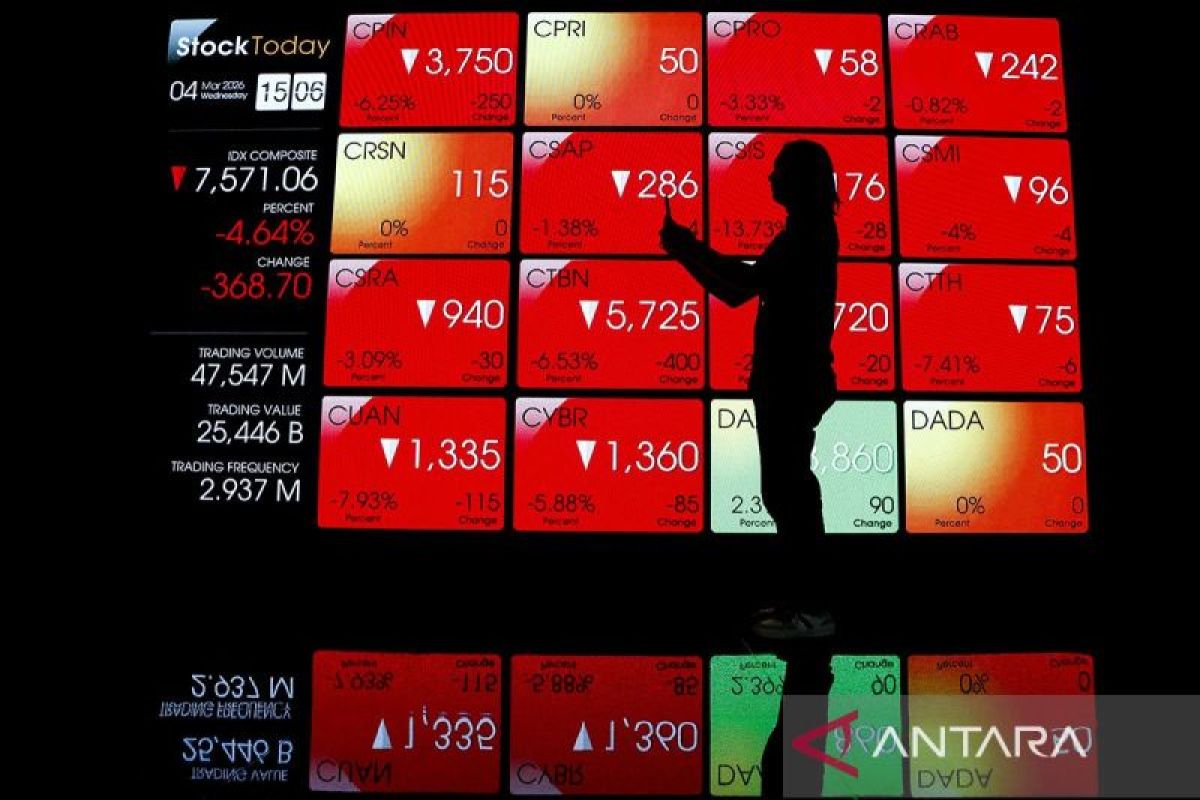
Regional Asian stock markets came under pressure influenced by the Middle East conflict, contrary to expectations of emerging peace, despite the extension of the ceasefire.
Jakarta (ANTARA) - The Composite Stock Price Index (JCI) of the Indonesia Stock Exchange (BEI) closed lower on Wednesday afternoon, weighed down by uncertainty over the direction of the ceasefire between the United States (US) and Iran.
The JCI closed down 17.77 points or 0.24 percent at 7,541.61. Meanwhile, the LQ45 index of 45 leading stocks fell 7.70 points or 1.04 percent to 735.97.
“Regional Asian markets are under pressure influenced by the Middle East conflict, contrary to expectations of emerging peace, despite the ceasefire extension,” said Associate Director of Research and Investment at Pilarmas Investindo Sekuritas, Maximilianus Nico Demus, in his analysis in Jakarta on Wednesday.
From overseas, market participants’ concerns stem from the failure of the second round of peace talks between the US and Iran. US President Donald Trump extended the ceasefire with Iran, which eased worries about further escalation in the Middle East.
However, the US blockade on Iranian ships remains in place, as plans for a second round of US-Iran peace talks failed.
Reports indicate that US Vice President JD Vance cancelled a planned trip to Islamabad, Pakistan, for negotiations after Tehran informed the US through Pakistan that they would not participate in the meeting.
Meanwhile, Iran has also indicated it will keep the Strait of Hormuz closed as long as US naval interceptions continue, and signalled that it may not honour the ceasefire.
Domestically, the JCI moved variably amid global pressures, compounded by the suspension of Indonesia’s stock valuation by MSCI, which remains a negative sentiment.
Meanwhile, as expected, the Bank Indonesia (BI) Board of Governors Meeting decided to maintain the BI-Rate at 4.75 percent as an effort to maintain and strengthen rupiah stability from the worsening impact of the global economic situation due to the war in the Middle East.
“This decision is still consistent with efforts to enhance the effectiveness of the interest rate structure adjustment strategy for monetary operation instruments in strengthening exchange rate stabilisation from the worsening impact of the global economic situation due to the war in the Middle East,” said BI Governor Perry Warjiyo.
Opening lower, the JCI remained in negative territory until the close of the first trading session. In the second session, the JCI stayed in the red zone until the close of trading.
Based on the IDX-IC Sectoral Index, eight sectors strengthened, led by the transportation and logistics sector which rose 4.30 percent, followed by the non-primary consumer goods sector and the infrastructure sector, each up 1.22 percent and 1.11 percent.
Meanwhile, two sectors corrected, with the basic materials sector falling the most at 0.45 percent, followed by the energy sector down 0.01 percent.
The stocks with the largest gains were COAL, KOTA, BDMN, HOPE, and TALF. The stocks with the largest price declines were KICI, DEFI, LCKM, DSSA, and BREN.
Share trading frequency was recorded at 2,948,972 transactions with 49.44 billion shares traded worth Rp18.14 trillion. A total of 440 stocks rose, 240 fell, and 141 remained unchanged.
Regional Asian stock markets this morning included the Nikkei index strengthening 313.83 points or 0.53 percent to 59,663.00, the Shanghai index up 21.18 or 0.52 percent to 4,106.26, the Hang Seng weakening 324.24 points or 1.22 percent to 26,163.24, and the Straits Times falling 12.24 points or 0.24 percent to 5,002.72.