
Japanese PM pushes for swift constitutional amendment
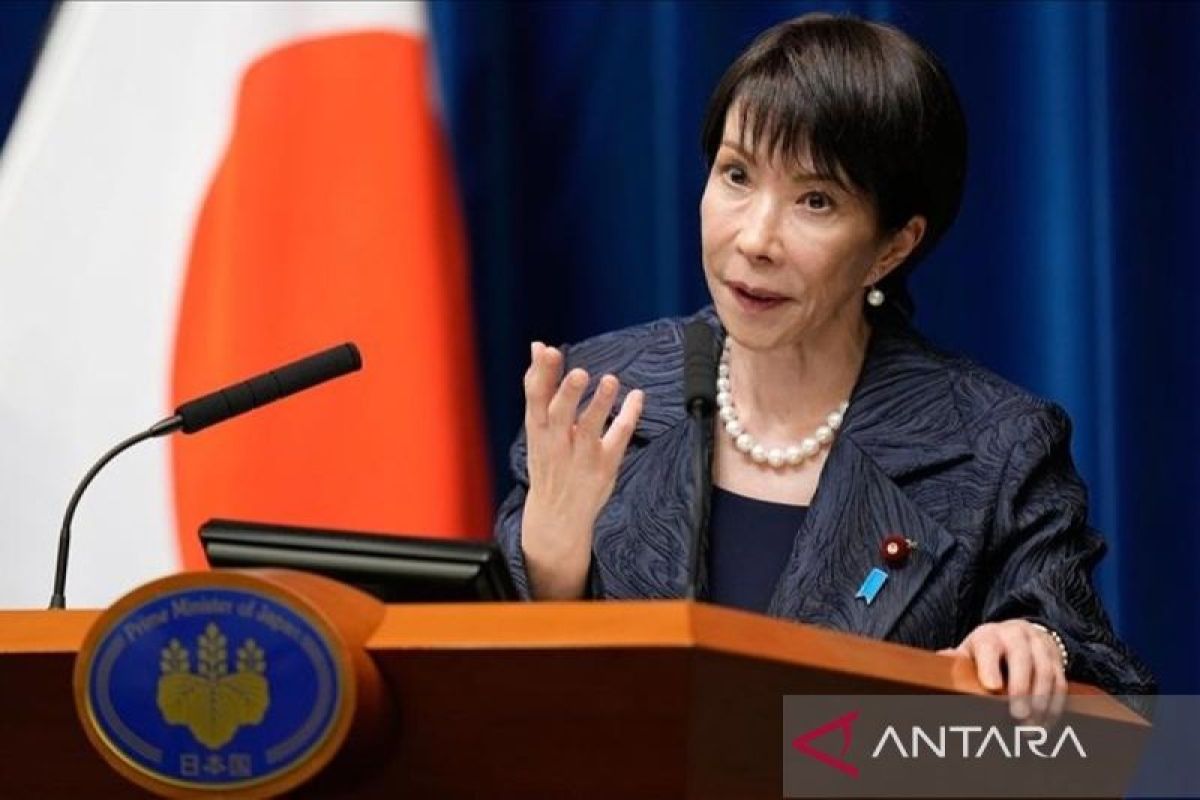
Tokyo (ANTARA) - Japanese Prime Minister Sanae Takaichi stated on Sunday (12/4) that she wants to promptly amend Japan’s pacifist constitution.
The pacifist constitution, adopted after the Second World War in 1947, essentially means that Japan legally rejects war as a sovereign right and prohibits the use of military force to settle international disputes.
The conservative leader, known for her firm security views, is seeking to enshrine the existence of the Self-Defence Forces in the constitution, which would be the first revision to the nation’s basic law.
“The time has come” to reform the constitution, Takaichi said in her speech at the annual convention of the Liberal Democratic Party (LDP) in Tokyo. “We want to hold next year’s conference with a constitutional amendment proposal,” she added.
However, Takaichi did not detail the constitutional change proposals, particularly regarding Article 9, which rejects war and prohibits Japan from having military forces or other war potential. The statement was delivered at the party’s first annual event since she became LDP leader and prime minister in October.
The LDP also approved its 2026 campaign policy targeting the submission of a revised constitutional draft to parliament, by forming a drafting committee in the relevant commissions in both houses of parliament.
The meeting took place amid efforts by the LDP and Japan Innovation Party coalition to capitalise on their landslide victory in the House of Representatives election on 8 February to push for constitutional amendment.
The ruling coalition secured more than three-quarters of the total 465 seats in the lower house, surpassing the two-thirds threshold required to bring a constitutional revision to a national referendum, in line with Takaichi’s high popularity.
However, in the upper house or House of Councillors, which also requires two-thirds support, the government bloc remains in the minority, although some opposition parties support constitutional reform.
The high procedural threshold for revising the constitution, combined with differing public views, has meant that the basic law drafted by US-led occupation forces after the Second World War has not been amended since 1947.
The Japan Innovation Party, known as Nippon Ishin, is pushing for more radical steps by allowing the full exercise of collective self-defence rights, which could provoke rejection from neighbouring countries in Asia.
Adding an emergency clause to grant greater powers to the government in facing major disasters or armed attacks is also one of the focuses of constitutional reform.
Imperial Household Law Revision
In her speech, Takaichi also emphasised the need to revise the 1947 Imperial Household Law to ensure a sufficient number of imperial family members to guarantee stable succession to the Chrysanthemum Throne, while maintaining the male line of descent, which she considers the basis of the emperor’s legitimacy.
Amid concerns over the decreasing number of imperial family members, several plans under discussion include the possibility of current imperial family members adopting male descendants from former imperial branches to restore their imperial status.
The current law limits succession only to males in the male line of descent from the emperor and requires female members to leave the imperial family after marrying commoners.
Several figures attended the convention, including Japan Innovation Party leader Hirofumi Yoshimura and Chairman of the Japan Business Federation Yoshinobu Tsutsui, known as Keidanren, Japan’s largest business lobby.
Yoshimura expressed his commitment to realising the joint policy goals of the LDP based on the coalition agreement reached in October, including suspending the consumption tax by eight percent on food products for two years, reducing the number of lower house seats by 10 percent, and constitutional amendment.
“Voters will watch whether the coalition agreement is truly implemented,” said Yoshimura.